
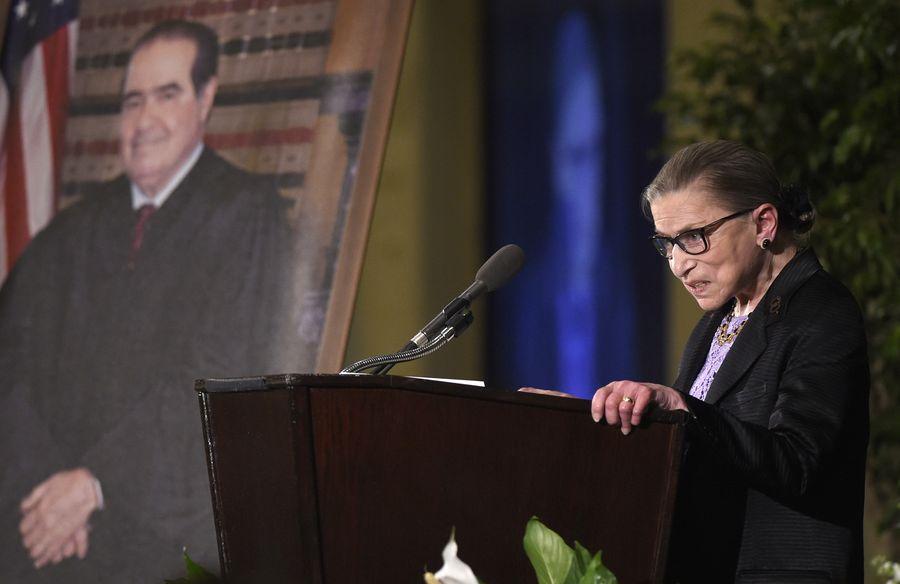
Supreme Court Justice Ruth Bader Ginsburg speaks at the memorial service for Supreme Court Justice Antonin Scalia, Tuesday, March 1, 2016, at the Mayflower Hotel in Washington. (AP Photo/Susan Walsh, Pool)
Democrats and Republicans Aren't So Different, After All
COMMENTARY
Published June 26, 2019 • Read time: 4m
America is on the brink of a civil war. We’re living in an outrage culture. Friendships are ending over what political pundits are saying. Republicans and Democrats can’t even use the same dating apps.
We’re inundated with assertions like those. (Yes, even that last one.) Given the many tough problems our country is facing, the pervasiveness of such pessimism is cause for concern. But brand-new research from an international initiative dubbed “More in Common” suggests our deepening division may not stem from fundamental differences in values and opinions. Instead, we simply don’t know each other well enough.
The “perception gap”
More in Common’s research took a close look at what it terms the “perception gap.” The gap was found by asking Republicans and Democrats what percentage of the other side held extreme positions — and then compared these perceptions with polling on what both groups actually think.
According to the report, Democrats and Republicans overestimate this percentage by nearly twice the actual number. While only 34% of Republicans hold extreme views, Democrats believe that number to be 53%. While only 29% of Democrats hold extreme views, Republicans believe that number to be 56%.
If you think your opponents are more extreme than they truly are, you’re also more likely to see them as hateful or brainwashed — and more likely to lose respect for their opinions and ideas. Some 88% of Republicans thought Democrats were brainwashed. At the same time, 86% of Democrats thought the same about Republicans.
Sanders Seeks Caucus Trifecta Win to Close Delegate Gap
Sanders Fighting Perception He Can't Overcome Clinton Edge
Clinton Targets Trump as Sanders Circles
Sanders, Clinton Differ Sharply at Flint Debate
When confronted by alarming headlines heralding the degradation of our social fabric, it’s easy to point a finger at our ideological opposites or at institutions such as the media or “big tech.” But what’s driving the problem is complex. To really get at the root causes, we must take a holistic view.
Unlikely allies collaborating to heal the deepest divisions
At what point a belief becomes too radical may be in the eye of the beholder. But we should all agree that violence in the face of disagreement is an unacceptable extreme.
Consider the tragic death of a peaceful counter-protester at the rallies in Charlottesville, Va., nearly two years ago. It ignited a national conversation about intolerance and political violence, issues so urgent that a diverse group united to examine where such truly extreme behavior comes from, aiming to prevent future instances and to heal communities impacted by extremism’s devastating consequences.
The Anti-Defamation League, the Charles Koch Institute, Ford Foundation, Soros Fund Charitable Foundation, Fetzer Institute and others came together to start the Communities Overcoming Extremism: The After Charlottesville Project — a national initiative that brings together public- and private-sector leaders to combat extremism and empower communities with tools for healing.
The diversity of the groups is more than a characteristic. It’s a critical part of the model.
To address such a pressing problem, we can’t afford to devolve into political debates or respond reactively with censorship — that will only breed more extremists and hasten the escalation of intolerance. Collaborating to understand the root causes of division allows us to protect both civil liberties and public safety, and to lay the groundwork for addressing intolerance long-term.
For hundreds of years, we have seen the benefits of differing perspectives coming together. During World War II, British intelligence relied on a diverse group of mathematicians, computer scientists, linguists and crossword puzzle masters to break the code of the Enigma machine. The close friendship of the deeply ideologically different Supreme Court Justices Ruth Bader Ginsburg and Antonin Scalia improved the quality of their legal reasoning and writing. And it was a conversation between a guided-missile designer and a gastroenterologist that led to the diagnostic camera pill.
It will take a diversity of fields and perspectives — individuals with big ideas who are willing to challenge both one another and their own assumptions — to find innovative solutions to such complex problems. Those solutions will require the courage to come together and the humility to search for the answers we don’t have.
That’s not easy. But the good news from this research is that there’s more of a potential arena for engagement than our perceptions would have us believe.

Congress Doesn’t Need Another Blame Game. It Needs To Find What’s Broken
Jarrod Bernstein • RealClearPolitics
Democrats Won the Midterms. Common Sense Won, Too
Jordanne Kemper • RealClearPolitics
The 120th Congress Shapes Up
Carolina Lumetta • RealClearPolitics
Flooding GOP Primaries With Democrats
Robert Natelson • RealClearPolitics
Washington Keeps Rewarding Oracle—Veterans Keep Paying the Price
Darin Gaub • RealClearPolitics
The Seeds of Unrestricted Warfare
John Teichert • RealClearPolitics
RCP Today
Top stories on RealClearPolitics
The Takeaway
Polling intelligence and analysis delivered to your inbox
World News
Featuring the latest world news
Policy
Featuring the latest policy news
Support Our Mission
As part of RealClearPolitics, authors aim to provide balanced, non-partisan analysis by presenting top reporting and commentary from all sides of the political spectrum.
Trusted by policymakers and citizens alike since 2000