
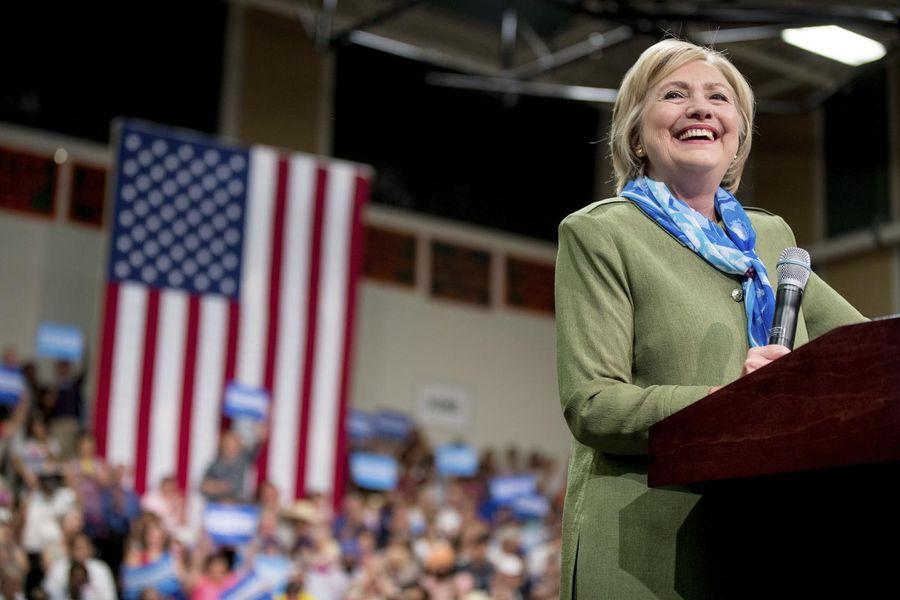
Democratic presidential candidate Hillary Clinton pauses while speaking at a rally at Adams City High School in Commerce City, Colo., Wednesday, Aug. 3, 2016. (AP Photo/Andrew Harnik)
Change-Makers
Published Aug. 5, 2016 • Read time: 4m
Now that the Democratic national convention is over, we can look forward, not necessarily in every sense of that term, to the campaign. The major Democrats have previewed their arguments for the fall, and we can at least steel ourselves for the upcoming exchanges.
For President Obama, the stakes are clear. As he told Politico recently, he wants his legacy to include “a 16-year era of progressive rule” that would upend the Reagan Revolution and fulfill his promise in 2008 to transform the country “fundamentally.” Obama’s own achievement, in other words, depends on eight years of a Hillary Clinton Administration, its agenda shoved further left by Bernie Sanders’s “political revolution.” Whether Obama likes it or not, if Change doesn’t continue, Hope will die, above all his hope of being the progressive Reagan.
In Philadelphia, therefore, he did his best to transfer his mandate to Hillary, always understanding that a charisma transfer was impossible. He hugged her long enough that images of Al Gore and Tipper in 2000 came to mind, or was that Michael hugging Fredo in The Godfather? Though Michelle and Barack were on their best behavior, the rivalry between the Obama and Clinton families is not so easily buried, as his icy praise of Hillary showed. “She’s been there for us [Americans],” he explained, “even if we haven’t always noticed.”
At his warmest, Obama still held something back. He declared, “there has never been a man or a woman more qualified than Hillary Clinton to serve as President of the United States….” The statement’s over-the-top absurdity (James Madison, phone home) left one waiting for the other shoe to drop, waiting to hear “and yet qualifications are no guarantee….”
Sanders Seeks Caucus Trifecta Win to Close Delegate Gap
Sanders Fighting Perception He Can't Overcome Clinton Edge
Clinton Targets Trump as Sanders Circles
Sanders, Clinton Differ Sharply at Flint Debate
Bill Clinton was nicer, but his rambling story of Life with Hill paid tribute both to her and to the minefields in their long marriage. Take his charming first sentence, “In the spring of 1971, I met a girl.” A girl?! One thing Hillary in full Seventies feminist, Yale Law School mode would never have allowed herself to be called was a girl. She was a woman, if not Woman, and boy could she roar. But Bill couldn’t say he met a woman, because that was not unusual for him, and it might recall “that woman” with whom he did not have sexual relations.
So he settled for telling us about 45 years with “the best darn change-maker I have ever met in my entire life,” “the best mother in the whole world,” the woman “who has never been satisfied with the status quo in anything.” Despite constantly studying the issues, filing government reports, “always making things better,” Hillary, he admitted, can come off as earnest, “boring,” and, worse, an agent of the status quo. Bill took pains to deny the last point, at least. The Democrats face a tough question: if he can’t sell her, who can?
Hillary tried, but one thing this change-maker can’t change is herself. She brought up It Takes a Village, her 20-year-old book, and tried to explain it again in her acceptance speech. Her stumbling block remains the same:
Americans don’t live in villages. She has friends in Greenwich Village, no doubt, but Americans live in small towns, suburbs, cities, but everywhere, until recently at least, in families. Her book confuses government with civil society in ways that invite the expansion of government into civil society—administering the affairs of families, churches, schools, and every other civil association.
Hillary’s latest formulation of this bad idea is “Stronger Together,” the theme of her speech and her campaign. Beyond its obvious value as a truism, her slogan raises the question why, for what purposes, do we want to be stronger together? So that we don’t have to “fear the future and fear each other,” she answered, which makes the Trumpian alternative sound like a return to the dystopia that Thomas Hobbes called the state of nature. But she was only getting started. Americans need to unify, she went on, so that we can achieve the full benefits of modern liberalism, from expanded welfare (including federally funded abortions) to new restrictions on “mean and divisive” political and private speech.
Yet “my fellow villagers” remains a hard sell. Mrs. Clinton’s best moments mocked Donald Trump, which is fine so long as he remains his own worst enemy. In the long, uncertain campaign ahead of us, however, the world may grow more dangerous, and he more formidable. Hobbes, who lived in a very dangerous world and loved to play cards, noted wryly that in the state of nature clubs are always trump.
This essay will appear in the forthcoming Summer 2016 Claremont Review of Books.

Congress Doesn’t Need Another Blame Game. It Needs To Find What’s Broken
Jarrod Bernstein • RealClearPolitics
Democrats Won the Midterms. Common Sense Won, Too
Jordanne Kemper • RealClearPolitics
The 120th Congress Shapes Up
Carolina Lumetta • RealClearPolitics
Flooding GOP Primaries With Democrats
Robert Natelson • RealClearPolitics
Washington Keeps Rewarding Oracle—Veterans Keep Paying the Price
Darin Gaub • RealClearPolitics
The Seeds of Unrestricted Warfare
John Teichert • RealClearPolitics
RCP Today
Top stories on RealClearPolitics
The Takeaway
Polling intelligence and analysis delivered to your inbox
World News
Featuring the latest world news
Policy
Featuring the latest policy news
Support Our Mission
As part of RealClearPolitics, authors aim to provide balanced, non-partisan analysis by presenting top reporting and commentary from all sides of the political spectrum.
Trusted by policymakers and citizens alike since 2000