
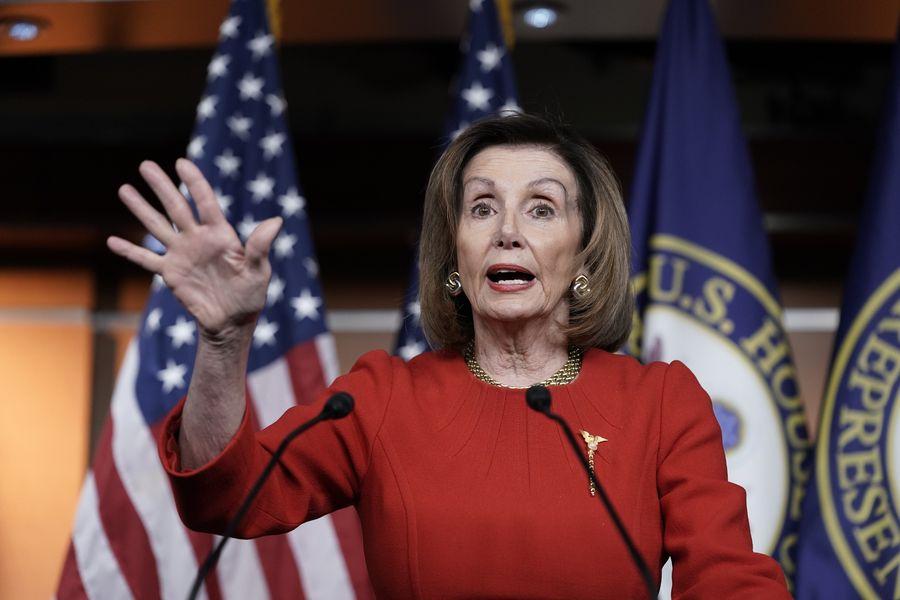
House Speaker Nancy Pelosi, D-Calif., meets with reporters at the Capitol in Washington, Thursday, Dec. 19, 2019, on the day after the House of Representatives voted to impeach President Donald Trump on two charges, abuse of power and obstruction of Congress. (AP Photo/J. Scott Applewhite)
Is the American Experiment in Need of Renewal?
Published Dec. 19, 2019 • Read time: 5m
For the second time in 21 years a U.S. president has been impeached on a virtual straight party-line vote. House Democrats this time, like House Republicans last time, insisted they were only following the dictates laid out by the Constitution. The Framers of that venerable document, in their considerable -- but not infinite -- wisdom bequeathed us malleable language in hopes that future generations would use it sagaciously. The relevant portion consists of eight fateful words. A president, it says, shall be removed from office “for and Conviction of, Treason, Bribery, or other high Crimes and Misdemeanors.”
Deciding what that means in practice is not political science. If you witnessed this week’s impeachment of Donald J. Trump -- or the House vote on this date in 1998 impeaching William Jefferson Clinton -- “performance art” seems a more apt description. Each member of Congress speaking as though the very future of the Republic depends on this vote, and then aligning themselves not with any particular principles of governance, but instead in near-perfect harmony with their party’s leadership. Every member of the House who was here during Clinton’s presidency voted the exact opposite way they did two decades ago. If not for one factor, this would be a coincidence of mathematically improbable dimensions. But, of course, it’s not anything of the kind. The one factor that explains it is partisanship. Bill Clinton is a Democrat; Donald Trump a Republican.
“An impeachable offense,” prominent GOP House leader (and future president) Gerald Ford explained in 1970, “is whatever a majority of the House of Representatives considers it to be at a given moment in history.”
McCain to Code Pink Protestors: Get Out of Here You Low Life Scum
AG Nominee Lynch Deflects Cruz Missile
Senate to Begin Hearings on Obama Attorney General Nominee
Democrats, Republicans Spar Over Benghazi Investigation
That description may be literally correct, but it hardly squares with the high-minded sentiments present at the Philadelphia founding of this country. For guidance on how we got from there to here, we can turn to the nation’s first president. George Washington mistrusted the political parties that were already forming in his time and in his farewell address he warned how they would stoke the kind of partisanship that could erode the very foundations of self-government:
“However [political parties] may now and then answer popular ends,” Washington wrote, “they are likely in the course of time and things, to become potent engines, by which cunning, ambitious, and unprincipled men will be enabled to subvert the power of the people and to usurp for themselves the reins of government, destroying afterwards the very engines which have lifted them to unjust dominion.”
I strive to be even-handed, so after re-reading George Washington’s 1796 farewell address I feel impelled to reprise another warning he made that is also applicable today. In President Washington’s mind the greatest danger posed by “factions” -- his word for political parties -- was how susceptible they were to manipulation by foreign powers. This was the 18th century, so he had Great Britain, France, and Spain in mind, not China, Russia, and Ukraine, but you get the point. Here’s how Shira Lurie, a scholar of early American history, explains Washington's worries:
“The greatest danger to the Union, though, stemmed from the combination of factionalism and external invasion. Washington explained that partisanship ‘opens the door to foreign influence and corruption’ because it weakened voters’ abilities to make reasoned and disinterested choices.”
Instead of picking the best candidates for office, the people would base decisions on “ill-founded jealousies and false alarms,” and in the process would elect party politicians aligned with foreign conspirators.
By the time Washington imparted his well-considered words to his countrymen, much had happened on these shores in a brief period of time -- an even shorter span than between the impeachments of Bill Clinton and Donald Trump.
On Dec. 19, 1776, the Continental Army commanded by George Washington was bogged down in a winter camp near Trenton, N.J. As Washington made a strategic retreat across the Delaware River, the Philadelphia Journal published an essay by fiery patriot Thomas Paine called “The American Crisis.”
“These are the times that try men's souls,” it began. “The summer soldier and the sunshine patriot will, in this crisis, shrink from the service of his country; but he that stands it now, deserves the love and thanks of man and woman.
“Tyranny, like hell, is not easily conquered,” Paine continued. “Yet we have this consolation with us, that the harder the conflict, the more glorious the triumph.”
Gen. Washington was so taken with Paine’s prose that he had it read to his men. His army had been beset by desertions, and many of the contracts the men had signed were set to expire on Dec. 31. Inspired by Paine’s stirring words and their commander’s confidence, however, the re-energized Continental Army crossed the Delaware on Christmas night, surprising the Hessians at Trenton. On Jan. 2, they bested Lord Cornwallis at Princeton. The American Revolution continued, and would prevail. But occasionally this great experiment finds itself in need of renewal. This may be one of those times.

Congress Doesn’t Need Another Blame Game. It Needs To Find What’s Broken
Jarrod Bernstein • RealClearPolitics
Democrats Won the Midterms. Common Sense Won, Too
Jordanne Kemper • RealClearPolitics
The 120th Congress Shapes Up
Carolina Lumetta • RealClearPolitics
Flooding GOP Primaries With Democrats
Robert Natelson • RealClearPolitics
Washington Keeps Rewarding Oracle—Veterans Keep Paying the Price
Darin Gaub • RealClearPolitics
The Seeds of Unrestricted Warfare
John Teichert • RealClearPolitics
RCP Today
Top stories on RealClearPolitics
The Takeaway
Polling intelligence and analysis delivered to your inbox
World News
Featuring the latest world news
Policy
Featuring the latest policy news
Support Our Mission
As part of RealClearPolitics, authors aim to provide balanced, non-partisan analysis by presenting top reporting and commentary from all sides of the political spectrum.
Trusted by policymakers and citizens alike since 2000