
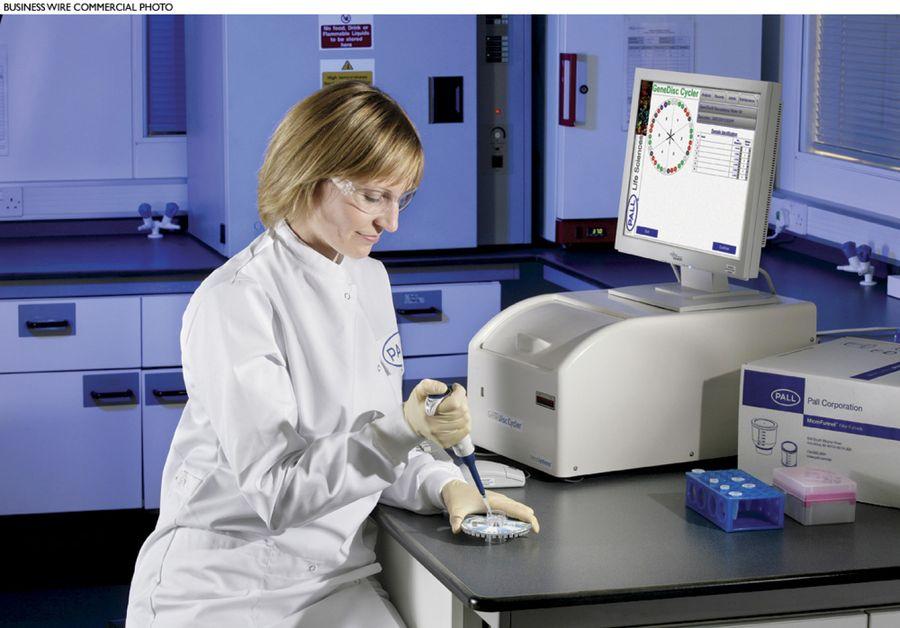
Pall Corporation's New GeneDisc® Rapid Microbiology System Advances Quality Assurance Analysis
America's 250-Year Foundation for Biopharmaceutical Leadership
Published July 2, 2026 • Read time: 4m
As America celebrates its 250th birthday, it’s worth pausing to recognize one of our nation’s greatest achievements: a legacy of scientific discovery that has transformed and saved millions of lives. We are living in the golden age of medical innovation.
Every day, scientists, physicians, and researchers are doing something that would have seemed impossible just a generation ago, turning once-fatal diseases into manageable conditions, transforming deadly diagnoses into survivable ones and unlocking entirely new ways to prevent illness before it starts.
None of this happened by accident.
America’s biopharmaceutical leadership is the result of 250 years of ingenuity paired with deliberate policy choices that rewarded discovery. From the outset, our founders understood that promoting the progress of science was essential to the nation’s future, going so far as to enshrine the protection of innovation directly in the Constitution.
We built on that with policies that prioritize strong IP protections, a transparent and efficient regulator, market-based incentives, and collaboration across academia and government. Actions like the first federal biologics law in 1813 ensuring a reliable smallpox vaccine, or building the modern drug safety system in the mid-20th century, to the landmark bipartisan legislation of the 1980s and ’90s, including the Bayh-Dole Act, Hatch-Waxman, and the Prescription Drug User Fee Act. This is why America leads today.
President Calls Drug Addiction a Health Problem
Lawmakers Hail New Opioid Rules -- But Call for More
No Opiates for the Masses?
Obamacare's Tax-Time Torment
American science created vaccines that ended polio, antibiotics and antivirals that turned deadly infections into treatable conditions, HIV antiretrovirals and cancer therapies that transformed once-fatal diagnoses, and cell and gene therapies, including CAR-T and breakthrough treatments for sickle cell disease, that are rewriting the future of medicine entirely.
Today, that progress is accelerating.
- Researchers are on the 10-yard line of novel treatments for pancreatic cancer, a disease that offers patients few options and little hope.
- PCSK9 inhibitors already lower LDL cholesterol by roughly 55% and reduce major cardiovascular events by 25%. Now, researchers are developing one-time gene-editing treatments that could achieve the same result for life with a single dose – a game changer against the number-one killer in the U.S.
- And GLP-1 medicines, widely known for treating obesity and diabetes, are showing promise across an even wider range of conditions, from heart failure and kidney disease to sleep apnea and certain cancers.
This progress is only possible because the United States has built the world’s most productive biomedical innovation ecosystem. It is why patients here often gain access to new medicines first and have access to nearly 90% of innovative new cancer therapies, compared to just 41% in other high-income countries. It is why so many of the most important medical breakthroughs of the last half century have emerged here from American laboratories. And the implications extend far beyond treatments for individual patients. The U.S. biopharmaceutical industry supports the economic health of our country, providing 5 million high-skilled jobs nationwide, fueling economic growth in communities in every state. When medicine works, America works.
Medicine is also changing in a more fundamental way. For most of human history, treatment meant responding to disease after it appeared. Today, advances in genetics, molecular biology, artificial intelligence, and precision medicine are enabling researchers to identify disease earlier, understand its root causes, and develop therapies targeted to individual patients. We are moving from reaction to prediction, and the potential of that shift is enormous.
America’s story has always been one of solving problems once thought unsolvable. We landed on the moon. We connected the world through the Internet. We decoded the human genome. The next great chapter is already being written – in laboratories, clinical trials, and the medicines reaching patients today. As we celebrate 250 years of American ingenuity, let’s continue to embrace innovation and discovery for a healthier and more prosperous future.
Support Our Mission
The Internet provides an endless stream of content. Not all of it is worth your time. That's why, every day, RealClearPolitics curates the most essential news and information—from all sides and across mediums. The links, videos, and podcasts curated here are the product of human judgment, not algorithms or AI. Please help power our mission of presenting a thoughtful, balanced public discourse through a tax-deductible donation.
Would you consider supporting us today?

The Danger Before the Attack
Leslie J. Sullivan • RealClearPolitics
Jon Finer’s Old and Dangerous ‘New Approach’ to Israel
Peter Berkowitz • RealClearPolitics
The President Deserves Better
John Ullyot • RealClearPolitics
Congress Doesn’t Need Another Blame Game. It Needs To Find What’s Broken
Jarrod Bernstein • RealClearPolitics
Democrats Won the Midterms. Common Sense Won, Too
Jordanne Kemper • RealClearPolitics
The 120th Congress Shapes Up
Carolina Lumetta • RealClearPolitics
RCP Today
Top stories on RealClearPolitics
The Takeaway
Polling intelligence and analysis delivered to your inbox
World News
Featuring the latest world news
Policy
Featuring the latest policy news
Support Our Mission
As part of RealClearPolitics, authors aim to provide balanced, non-partisan analysis by presenting top reporting and commentary from all sides of the political spectrum.
Trusted by policymakers and citizens alike since 2000