
Supreme Court Voting Rights Act
Voting Rights Act Never Mandated Racial Districts
COMMENTARY
Published May 18, 2026 • Read time: 6m
Ever since the recent decision of the Supreme Court limiting the use of race in drawing congressional districts, there has been a steady drumbeat of criticism claiming that the ruling somehow took away the rights of blacks and other minorities.
But nothing could be further from the truth.
As Justice Samuel Alito explained in his majority opinion, the prevailing interpretation of the Voting Rights Act of 1965 as requiring states to create congressional districts along racial lines actually undermined the constitutional rights of other citizens by colliding with the Equal Protection Clause of the 14th Amendment.
Unfortunately, the legal language of Alito’s opinion is difficult for the average reader to penetrate, so it is worth stepping back and looking at the actual language of the Voting Rights Act itself. The part of the law at issue is Section 2.
As originally passed in 1965, Section 2 simply said:
No voting qualification or prerequisite to voting, or standard, practice, or procedure shall be imposed or applied by any State or political subdivision to deny or abridge the right of any citizen of the United States to vote on account of race or color.
This was a just and appropriate guarantee that no state could use devices such as literacy tests or other discriminatory practices to prevent citizens of a particular race from voting.
And in 1965, those concerns were tragically real.
On March 7 of that year, the infamous Bloody Sunday attack occurred on the Edmund Pettus Bridge in Selma, Alabama, where state troopers and local police attacked civil rights demonstrators with billy clubs, tear gas, mounted horse charges, and whips. Similar efforts to intimidate black voters existed throughout much of the South.
Gavin Newsom's Misguided Redistricting Initiative
A Warning Against the Overuse of Sanctions
Open The Books on the California State Checkbook
Senate Passes Bill Addressing Heroin, Opioid Crisis
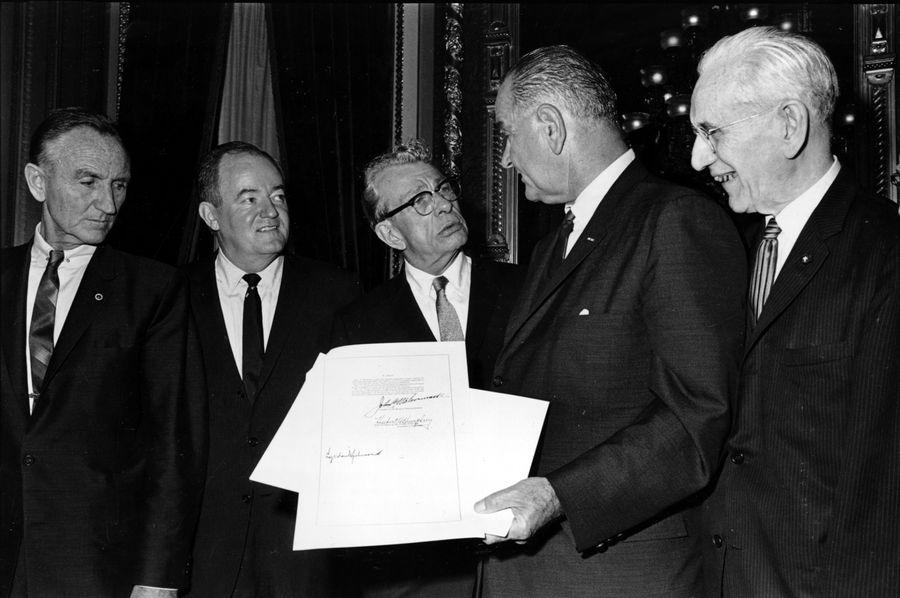
Thus when President Lyndon B. Johnson signed the Voting Rights Act into law later that year, it was widely understood as a landmark effort to guarantee minorities access to the ballot box as equal participants in the democratic process.
What it was not understood to require was racial engineering of congressional districts.
There was no suggestion in the original text that states would someday be expected to create congressional districts designed primarily around race in order to increase minority representation in Congress.
That interpretation arose largely after Congress amended Section 2 in 1982 under President Ronald Reagan. Although subsection (a) continued the language of the original 1965 act, subsection (b) added new language that stated that minority voters must have equal opportunity “to participate in the political process and to elect representatives of their choice.”
For more than 40 years, courts interpreted that language in ways that encouraged or required states to create majority-minority districts.
But let us look carefully at the actual text of the revised Section 2 to see whether the law itself truly mandates racial districting.
Subsection (b) states:
A violation of subsection (a) is established if, based on the totality of circumstances, it is shown that the political processes leading to nomination or election in the State or political subdivision are not equally open to participation by members of a class of citizens protected by subsection (a) in that its members have less opportunity than other members of the electorate to participate in the political process and to elect representatives of their choice.
The statute then adds an important limitation:
Nothing in this section establishes a right to have members of a protected class elected in numbers equal to their proportion in the population.
That limitation matters enormously.
The plain language of the section is not itself racist, but the interpretation of the courts gradually became race-centered. Whereas every voter has a chance to elect representatives of their choice from among the candidates on the ballot, courts increasingly interpreted minority voters’ ability to “elect representatives of their choice” to require districts in which minority-supported candidates had a realistic opportunity to win.
The distinction is crucial.
The revised Voting Rights Act never explicitly required states to create majority-minority congressional districts. Nor did it establish a right to proportional representation. Yet over time, courts developed a doctrine that pushed states toward drawing districts heavily influenced by race.
The theory was that if minority voters consistently supported certain candidates, and majority voters consistently defeated those candidates through bloc voting, then the political process was not “equally open” to minority participation.
But that interpretation transformed a law intended to guarantee equal access to voting into a system increasingly focused on electoral outcomes.
To be fair, courts did not openly declare that minority voters are entitled to representatives of the same race. The legal test instead focused on “minority-preferred candidates.” But in practice, race became central to the analysis because courts relied heavily on evidence of racially polarized voting patterns.
And that is precisely the constitutional problem Justice Alito addressed.
The Equal Protection Clause does not permit states to sort citizens primarily by race absent an extraordinarily compelling justification. However well-intentioned the goals of the Voting Rights Act may have been, courts gradually interpreted the law in ways that encouraged states to divide voters into racial categories and design congressional maps accordingly.
The absurdity of the doctrine becomes especially obvious when compared to Senate elections.
Every state elects its senators statewide. In almost every state, minority voters routinely vote in elections where most candidates are white. Yet courts have never suggested that Senate elections violate the Voting Rights Act simply because minority voters do not always elect their preferred candidates.
Defenders of the current doctrine argue that House districts can be manipulated in ways statewide Senate elections cannot. That is true. But it still does not explain why equal participation in the political process should require government officials to sort citizens by race when drawing congressional boundaries.
At some point, a law intended to eliminate racial discrimination became a justification for government-mandated racial line-drawing.
That is why the Supreme Court’s recent ruling matters.
Contrary to the claims of critics, the court did not take away anyone’s right to vote. Nor did it repeal the Voting Rights Act. What it did was recognize that the Constitution places limits on how far government may go in using race as a political tool – even for ostensibly benevolent purposes.
For decades, courts attempted to reconcile two competing principles: the Voting Rights Act’s guarantee of equal political opportunity and the Constitution’s guarantee of equal treatment under the law. Increasingly, those principles came into conflict.
Justice Alito’s opinion did not erase that conflict. But it did move the law back toward a simpler and more constitutionally sound principle: Citizens should be treated as individuals, not sorted into political categories based primarily on race.
Support Our Mission
The Internet provides an endless stream of content. Not all of it is worth your time. That's why, every day, RealClearPolitics curates the most essential news and information—from all sides and across mediums. The links, videos, and podcasts curated here are the product of human judgment, not algorithms or AI. Please help power our mission of presenting a thoughtful, balanced public discourse through a tax-deductible donation.
Would you consider supporting us today?

Congress Doesn’t Need Another Blame Game. It Needs To Find What’s Broken
Jarrod Bernstein • RealClearPolitics
Democrats Won the Midterms. Common Sense Won, Too
Jordanne Kemper • RealClearPolitics
The 120th Congress Shapes Up
Carolina Lumetta • RealClearPolitics
Flooding GOP Primaries With Democrats
Robert Natelson • RealClearPolitics
Washington Keeps Rewarding Oracle—Veterans Keep Paying the Price
Darin Gaub • RealClearPolitics
The Seeds of Unrestricted Warfare
John Teichert • RealClearPolitics
RCP Today
Top stories on RealClearPolitics
The Takeaway
Polling intelligence and analysis delivered to your inbox
World News
Featuring the latest world news
Policy
Featuring the latest policy news
Support Our Mission
As part of RealClearPolitics, authors aim to provide balanced, non-partisan analysis by presenting top reporting and commentary from all sides of the political spectrum.
Trusted by policymakers and citizens alike since 2000