
Starbucks Strike
The Rise of City Leftists: Mamdani, Wilson and the Democrats
COMMENTARY
Published Nov. 17, 2025 • Read time: 4m
Even before the swearing in, Seattle has given Zohran Mamdani his own “Mini-Me”; expect many more. New York City and Seattle now have democratic socialist mayors-elect. Democrats’ overwhelming support from cities and these supporters’ increasing embrace of far-left positions promise to elevate more democratic socialists in the party.
Zohran Mamdani understandably monopolized national media attention. He was a political neophyte and self-declared democratic socialist running for mayor of America’s largest city. His policies were radical: free buses, government-built housing, government-run grocery stores, government-provided daycare – all paid for by higher corporate and wealth taxes. En route to victory, he knocked off the incumbent Democratic mayor in the primary and a former Democratic governor in the general election.
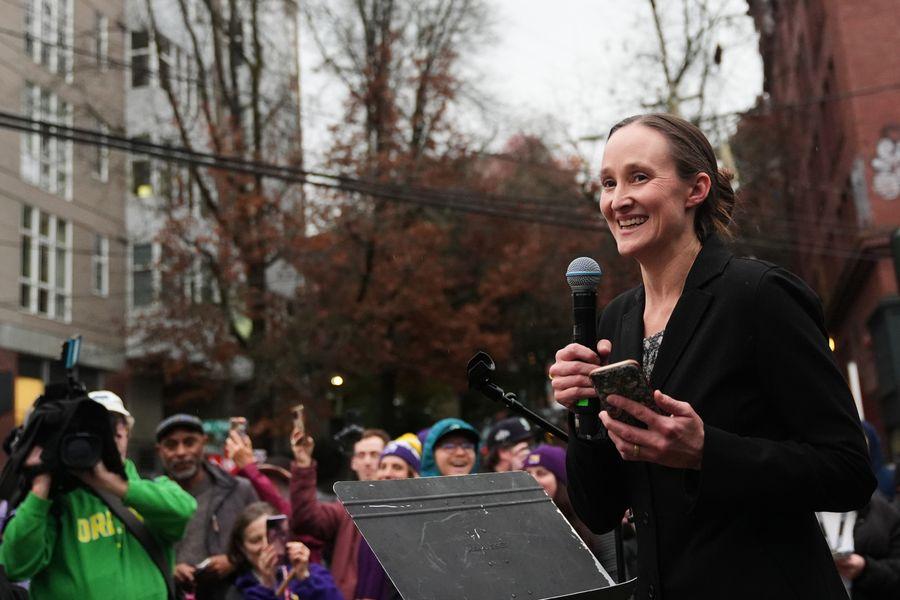
However, beneath Mamdani’s umbrella coverage, a similar neophyte and self-declared democratic socialist was running for mayor in another deep blue city a continent away. Katie Wilson’s resume is perhaps even thinner than Mamdani’s, and her proposed policies (including one to “Trump-Proof Seattle”) and tax hikes (“progressive revenue”) are no less radical – despite being less covered and fleshed out. Wilson, too, beat the incumbent Democratic mayor Bruce Harrell, not once but twice – first in Seattle’s open nonpartisan August primary and now again in the November general election.
The phenomena of democratic socialists winning Democrat nominations and general elections are new, but they will not be short-lived. The reason is because they represent the intersection of trends within the Democratic Party.
Sanders Seeks Caucus Trifecta Win to Close Delegate Gap
Sanders Fighting Perception He Can't Overcome Clinton Edge
Clinton Targets Trump as Sanders Circles
Sanders, Clinton Differ Sharply at Flint Debate
First, the Democratic Party is dominated by its city votes. Look at blue states and you will see that they are dominated by even deeper blue cities. New York City’s 8 million voters make up 44% of New York state’s voters. As goes New York City, so goes the state: Kamala Harris won New York City by almost 1 million votes, equaling roughly her entire margin in the state as well. New York City’s 1 million votes served to leverage New York state’s 28 electoral votes – well over a tenth of Harris’ 2024 total.
The same city population preponderance applies in Illinois (Chicago is 22% of Illinois’ population), Washington (Seattle and Spokane are 12% of Washington’s population), Colorado (Denver and Colorado Springs are 20% of Colorado’s population) and more. City populations not only control their states; they control the Democratic Party which depends on these populations for national political power.
In 2024, Democrats won only 18 states (CA, CO, CT, DE, HI, IL, MD. MA, MN, NH, NJ, NM, NY, OR, RI, VT, VA, and WA) to Republicans’ 32. Democrats won another six states (ME, NH, NJ, VA, MN, and NM) by less than 7 percentage points – a 3.5 percentage-point swing meaning that Democrats would have only won a dozen states. Without their city votes in these states, Democrats would have assuredly lost them all.
Second, the Democratic Party has moved rapidly to the left. Just 30 years ago, only 25% of Democrats identified as liberals. In 2023, it was 54%, the highest since Gallup had been sampling. From looking at today’s leaders – especially Mamdani and Wilson – can anyone doubt that Democrats as a whole have moved even further left in the last two years?
Within Democrats’ leftward trend runs an even further-left undercurrent. In 2016, Vermont Independent Sen. Bernie Sanders made waves by running in the Democratic presidential primaries – and not running away from the democratic socialist label. He gave Democratic establishmentarian Hillary Clinton a tough contest throughout the primaries.
Less than ten years later, Sanders’ democratic socialist comrades are continuing what he started: No longer simply contesting elections with the Democratic establishment, they are winning them. It is hardly surprising that these successes are now coming in large cities, the places where Democrats are most concentrated.
The Democratic Party is dependent on its city supporters to be politically relevant nationally. The party’s base of support is not simply growing more left (as evidenced by polling) overall, it is growing more and further left (as evidenced by its policies and its leaders) – particularly in the cities which control the party.
The Democratic Party cannot walk away from where its urban base is leading it. While Mamdani and Wilson may be upstarts within the party, they are hardly the end of a trend that is only beginning.
Support Our Mission
The Internet provides an endless stream of content. Not all of it is worth your time. That's why, every day, RealClearPolitics curates the most essential news and information—from all sides and across mediums. The links, videos, and podcasts curated here are the product of human judgment, not algorithms or AI. Please help power our mission of presenting a thoughtful, balanced public discourse through a tax-deductible donation.
Would you consider supporting us today?

Congress Doesn’t Need Another Blame Game. It Needs To Find What’s Broken
Jarrod Bernstein • RealClearPolitics
Democrats Won the Midterms. Common Sense Won, Too
Jordanne Kemper • RealClearPolitics
The 120th Congress Shapes Up
Carolina Lumetta • RealClearPolitics
Flooding GOP Primaries With Democrats
Robert Natelson • RealClearPolitics
Washington Keeps Rewarding Oracle—Veterans Keep Paying the Price
Darin Gaub • RealClearPolitics
The Seeds of Unrestricted Warfare
John Teichert • RealClearPolitics
RCP Today
Top stories on RealClearPolitics
The Takeaway
Polling intelligence and analysis delivered to your inbox
World News
Featuring the latest world news
Policy
Featuring the latest policy news
Support Our Mission
As part of RealClearPolitics, authors aim to provide balanced, non-partisan analysis by presenting top reporting and commentary from all sides of the political spectrum.
Trusted by policymakers and citizens alike since 2000