
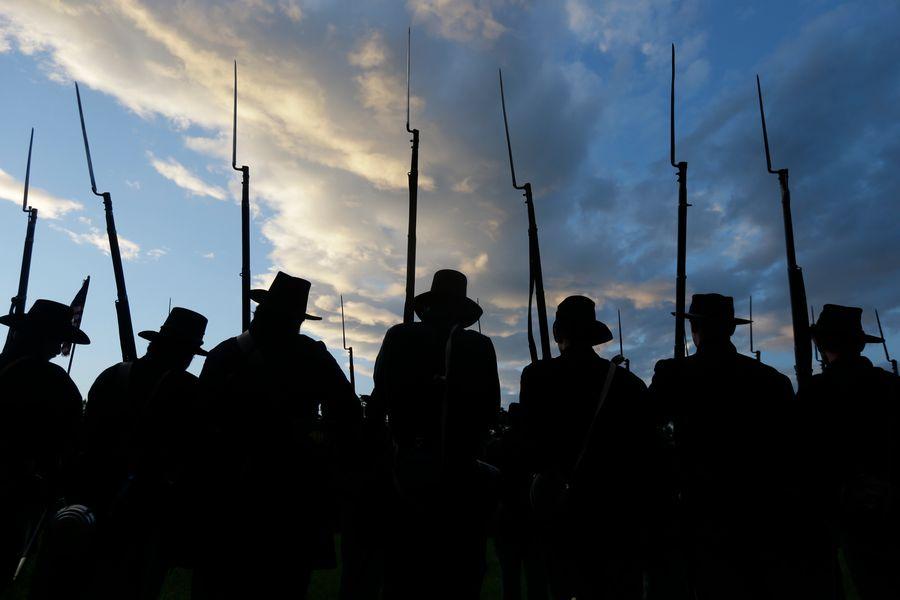
Divided America Guns
Avoiding Another Gettysburg
Published Nov. 8, 2022 • Read time: 22m
Join the Conversation
0GETTYSBURG, Pa.— On a chilly late October night, by a campfire only partially reassuring to the amphitheater audience hearing coyotes howling in the adjacent woods, a National Park Service ranger is explaining the significance of a little-remembered gathering that occurred here 50 years after the fierce battle that made this town famous.
The 1913 event, hailed by politicians and the press as the “Grand Reunion,” featured some 53,000 Civil War veterans, from the Union and Confederate armies, and was meant to signify the “unity of North and South.”
Meaningful unity wasn’t possible at that time and place, at least not as the assembly was organized. As Christopher Gwinn, the interpretive ranger giving the lecture pointed out, black soldiers – while not expressly barred – were not welcomed at the 1913 reunion. Nor was any real discussion of slavery.
An unidentified Confederate and Union soldier in a photo titled "The Blue and the Grey at Gettysburg, Assembly Tent" on the 50th anniversary reunion at Gettysburg, Pa., in 1913.
AP Photo
The absence of black veterans and an honest reckoning about the cause of the Civil War underscored a national problem, not just with the “Grand Reunion,” but with the ever-evolving American Identity in the early 20th century. As grizzled veterans of this country’s most profound crucible were passing from the scene, a new generation of Americans was in the process of deliberately forgetting why the Civil War was fought in the first place. “Unity” without true reconciliation was an illusion that couldn’t last forever.
To be sure, in 1913, this nation’s civic leaders had ample reasons to tell Americans they were all in it together. “At that very moment, U.S. ground forces were in Cuba, Mexico, Nicaragua, and the Philippines,” wrote Thomas Flagel, author of a book about the Grand Reunion.
“Trouble in the Balkans threatened to escalate into a much larger European crisis,” he added. “Not mentioned but certainly pressing were the many bitter divisions at home. Conservatives were continuously fighting progressives over Jim Crow and lynching, female suffrage, overseas expansion, immigration, and labor rights. In this time of peril, so said the organizers, only the finest of military heroes could save our great nation.”
And so President Woodrow Wilson and a tedious lineup of luminaries, few of whom had ever run toward the sound of the guns, looked nostalgically to the past. In uninspiring prose over three sweltering July days, speaker after speaker invoked the shared sacrifice and unquestioned valor exhibited by both armies in the first three days of July 1863. Although the bravery of those aged warriors was beyond question, limiting the discussion to their battlefield exploits was missing a much larger point. It was the one made by Ulysses S. Grant in his 1885 memoir when describing his emotions as Robert E. Lee surrendered his army at Appomattox.
Rethinking the Pledge; Trump and Women; One Last Egg Roll; Eulogizing Ike
2016: A Repeat of the 1960s
An Apology, Fashioned for Nancy Reagan
Nancy Reagan, Guardian of a Legacy
“I felt like anything rather than rejoicing at the downfall of a foe who had fought so long and valiantly,” Grant recalled, “and had suffered so much for a cause, though that cause was, I believe, one of the worst for which a people ever fought, and one for which there was the least excuse.”
And contrary to Abraham Lincoln’s modest disclaimer (“The world will little note, nor long remember what we say here …”), it was the Gettysburg Address, more than Pickett’s Charge, that elevated the iconic battle in the Pennsylvania countryside to its exalted position in America’s story.
And what was that story? Freedom for all, in President Lincoln’s telling. Historian Garry Wills called Lincoln’s brief, sublimely crafted, 272-word Nov. 19, 1863, oration the words “that remade America.”
“Men died that the nation might live,” Civil War scholar James McPherson said of the fighting at Gettysburg. After that battle – and after their sacrifice was consecrated by Lincoln’s eloquence – the old, slaveholding nation began to die, McPherson wrote.
That was the precise goal of Lincoln’s prose, which managed to be succinct, subtle, and soaring all at once. “Four score and seven years ago” was an archaic formulation even in 1863. But if one did the math, Lincoln had placed the nation’s founding in 1776, the year of the Declaration of Independence, not 1787, the year the Constitution was adopted.
The Constitution codified slavery. The Declaration stated flatly that “all men are created equal.” At Gettysburg, Lincoln declared by fiat, in six innocuous-sounding words, which of those two documents must henceforth encompass the national spirit. Moreover, when he asserted that the slain Union soldiers had given their “last full measure of devotion” to that ideal, Lincoln was saying that they had died to free the slaves – a claim understood by both Lincoln’s friends and foes.
An undated illustration depicts President Abraham Lincoln making his Gettysburg Address at the dedication of the Gettysburg National Cemetery on the battlefield at Gettysburg, Pa., Nov. 19, 1863. (AP Photo)
The Gettysburg speech’s “misstatement of the cause for which they died,” fumed The Chicago Times, a Democratic Party newspaper, “was a perversion of history so flagrant that the most extended charity cannot regard it as otherwise than willful.”
“The dedicatory remarks by President Lincoln,” countered the Chicago Tribune, “will live among the annals of man.” New York newspaper editor Horace Greeley, a Lincoln ally, added that it was doubtful “that our national literature contains a finer gem than that little speech at the Gettysburg celebration.”
Is it jarring to read such politically biased news coverage? It might have been in the mid-20th century. It’s not today. As Americans vote in the 2022 midterm elections, a partisan U.S. media covers politics the way it did at the time of the Civil War, lionizing those they agree with, while demonizing the other side. We live in a country that is in basic ways as polarized as in Lincoln’s time. Sometimes it seems even worse.
When a politicized Supreme Court renders a controversial decision on abortion in 2022, for instance, those who disagree with the ruling not only stalk justices in their homes, they desecrate churches. Can a president still say, as Lincoln did in his second inaugural address, that Americans on both sides of our great political divide “read the same Bible and pray to the same God”?
If not, what is to keep our politics from descending to the depths that produced 40,000 dead and maimed on the battlefield in this bucolic village? That is the ominous question hanging over the 2022 midterms, especially the fight over control of the Senate, which may well be decided by voters in the ballot box battlefields here in Pennsylvania.
Glass Houses
As summer gave way to autumn in a midterm election environment historically unfavorable to the party in power, the Democratic Party’s mantra that “abortion is on the ballot” was supplemented by a more apocalyptic slogan: “Democracy is on the ballot.”
This talking point, repeated by candidates and party leaders from President Biden on down the Democratic Party ticket, is meant to convince voters that it’s imperative not to vest authority in a Republican Party that has strayed far from its roots as the “Party of Lincoln.”
Rioters loyal to President Donald Trump rally at the U.S. Capitol in Washington on Jan. 6, 2021. (AP Photo/Jose Luis Magana, File)
The evidence Democrats cite while declaring U.S. democracy to be endangered ranges from the GOP disenfranchising voters through partisan gerrymandering, engaging in “voter suppression” in Republican-controlled states, and constitutionally dubious GOP machinations in the Supreme Court confirmation process, to the 2020 Donald Trump-led “election denial,” which led directly to the Jan. 6, 2021 “insurrection” at the U.S. Capitol, and random violence directed all over the country at liberal politicians and commentators.
The establishment media has accepted this narrative at face value and often embellished on it.
Liberals’ obsession over voter ID laws has proven overblown, as record-breaking early voting numbers in Georgia and elsewhere have shown. (The same is true regarding conservatives’ breathless and fact-free claims of widespread “voter fraud.”) But with that exception, the disturbing litany cited by Democrats and the press are not imaginary. These things have happened. They are dangerous and put a serious stress on civil society. Put simply, elective self-government cannot function properly when those seeking public office refuse to accept adverse results.
Yet, there are problems with the Democrats’ narrative – two in particular.
For starters, public opinion polling suggests that the argument that a vote for Republicans is a vote to undermine democracy has a basic flaw in logic. As American children are taught in school, the United States isn’t a pure democracy. We don’t take polls or conduct referendums on every public policy issue and – wham! pass a new law. The U.S. is a republic. We vote for officeholders from city council up to president, presumably because we share an ideology, but also because we trust their judgment to handle public policy issues that arise.
That said, we do expect elected officials to be responsive to the citizens’ priorities. Democrats have said, correctly, that public opinion polling shows broad support for their pro-choice position on abortion, albeit with some caveats. But Republicans have pointed out that pluralities or majorities of voters want the government to try to curb inflation, crack down on violent crime, secure America’s borders, and rein in the excesses of “woke” culture.
But if Democrats gaslight the majority, saying, in effect, “You’ve imagined all those problems,” which political party is really undermining elective democracy? Aren’t politicians supposed to respond to the concerns of the people? And how much hubris does it take to assert that in the name of “saving democracy,” America should become a one-party state, something it has never been?
The second flaw in their line of attack is that Democrats have engaged in the same destructive behaviors they decry as a threat to democracy when Republicans do it.
It was California Democrats in Sacramento and Washington who elevated the dark art of the political gerrymander to high science. It was Senate Democrats, including Ted Kennedy and Joe Biden, who first weaponized the Supreme Court nominating process. It was Democrats as prominent as Jimmy Carter, Hillary Clinton, and Joe Biden who led the way in election denial, not just regarding Donald Trump, but George W. Bush as well. And Georgia gubernatorial candidate Stacey Abrams is still doing it.
As for the riot at the U.S. Capitol, the Democrats’ claims are correct: The mob was directed there by Trump, it did turn violent, it was an attempt to interfere with the certification of a presidential election, and Vice President Mike Pence and many members of Congress ran to safety legitimately believing their lives were in danger. It’s inexcusable.
A high school graduate poses for a photo at the Robert E. Lee Monument, covered by protest graffiti, in Richmond, Va. (AP Photo/J. Scott Applewhite)
But excuses are exactly what Democrats made in the summer of 2020 when hundreds of businesses were burned, ransacked, or vandalized in the name of “social justice,” and when statues not just of Confederate generals, but also of Union heroes Ulysses Grant and William McKinley – not to mention Christopher Columbus and Miguel Cervantes – were defaced or destroyed. As for the riot at the U.S. Capitol, that was awful. But a decade earlier something similar took place at the Wisconsin State Capitol. Although the circumstances weren’t identical, this mob was made of pro-union progressives; it was Republican lawmakers fleeing out windows in fear. Nancy Pelosi praised that riot as “an impressive show of democracy in action.”
As for political violence, yes, Pelosi’s home was targeted – and her husband nearly killed – in a home invasion by a deranged drug addict whose precarious mental state was exacerbated by hours of watching right-wing Internet programming. Numerous other liberal officeholders, medical health professionals, and election officials have been on the receiving end of an ever-escalating number of hateful and frightening death threats.
But it was an angry progressive in Wisconsin who was convicted of warning every Republican state senator that she was going to kill them and their entire family. And it was a Bernie Sanders campaign volunteer and Rachel Maddow devotee who opened fire on a baseball field trying to assassinate as many Republican members of Congress as he could. Rep. Steve Scalise was grievously wounded that day in an attack that could have been far worse.
It’s also a fact that Republican Sen. Rand Paul was hospitalized after being physically attacked from behind in his own yard by a politically active neighbor, a Democrat, who was supposedly inflamed by yard waste. It’s also true that some progressive commentators and Democratic political candidates somehow find this funny.
After Trump administration cabinet members and White House officials were heckled out of restaurants in Washington, D.C., and Virginia, Democratic Rep. Maxine Waters told a crowd in Los Angeles, “You ain’t seen nothing yet,” and went ahead to advocate protestors going to their homes. “No peace, no sleep!” she threatened.
Rep. Maxine Waters joins abortion-rights activists outside the Supreme Court following Supreme Court's decision to overturn Roe v. Wade in Washington, June 24, 2022. (AP Photo/Jacquelyn Martin)
That mantra seems to be the animating motivation for the protestors who routinely gather outside the homes of conservative Supreme Court justices. By the way, such demonstrations are a clear violation of federal law, a law the Biden administration Justice Department has not enforced, and which the president and his press secretary seemed to dismiss. Predictably, in June of this year, a 26-year-old California college student showed up outside the home of Justice Brett Kavanaugh dressed in black and carrying a hammer and crowbar, duct tape, zip ties, a tactical police vest, a combat knife, pepper spray, and a Glock 17 pistol with ammunition. The man told an arresting officer that he planned to kill Kavanaugh to “give his life meaning.” At his arraignment, the defendant was asked by a federal magistrate if he understood the charges against him and whether he was thinking clearly.
“I think I have a reasonable understanding,” the young man replied, “but I wouldn’t say I’m thinking clearly.”
It was an unwittingly concise summary of the current state of U.S. politics.
Race to the Bottom
As the soothing voice of National Park service ranger Chris Gwinn filled the night air near Seminary Ridge, the airwaves over Pennsylvania were filled with nasty television ads smearing Republican Mehmet Oz and Democrat John Fetterman.
Pennsylvania Lt. Gov. John Fetterman, the Democratic Senate candidate in Pennsylvania, speaks to a crowd gathered at a United Steel Workers of America Labor Day event outside Pittsburgh, Sept. 5, 2022. (AP Photo/Rebecca Droke, File)
Although the winner may determine control of the U.S. Senate for the next two years, and along with it President Biden’s ability to fill vacancies in the federal judiciary, Oz and Fetterman hardly fit the ideal of wise and seasoned statesmen.
Born to affluent parents, both of whom were Republicans, Fetterman dabbled in the insurance business, served as mayor of a small Pennsylvania town, and won the Democratic primary for lieutenant governor in a fluky 2018 race with 38% of the vote and an endorsement from Bernie Sanders. In statewide office, he’s attracted attention mainly for wearing gym clothes in public, trolling Trump on Twitter, and staking out policy positions far to the left of the average Pennsylvanian. Fetterman suffered a serious stroke in May and had publicly campaigned infrequently until a late October debate, where he exhibited cognitive impairment.
His opponent is a television personality, “Dr. Oz,” with zero political experience, a troubling track record of pushing quack medical theories on his show – and who isn’t even a Pennsylvanian. (He lived in New Jersey.)
As if those resumes weren’t thin enough, the two candidates have conspired to run a campaign so hideous that independent news outlets as different in outlook as The Intercept and Reason magazine have come to the same conclusion. Akela Lacy of The Intercept called it “the dumbest” Senate race of the season. Reason magazine described it as “the stupidest.” And in 2022, that is saying something.
“That a race which politicians and strategists have anticipated for years has become so vapid tells us more about modern American electoral politics than any of the nonstop horserace polling could,” Lacy wrote. “Substance is a liability, and the base is everything. Social media is an attractive battleground. The soundbite has been replaced by the meme war.”
Republican candidate for U.S. Senate Dr. Mehmet Oz addresses an election rally in Latrobe, Pa., Nov. 5, 2022. (AP Photo/Jacqueline Larma)
It’s also, as are all modern campaigns, an air war. Poor Pennsylvanians merely trying to watch the Steelers-Eagles game last week – or Philly’s beloved over-achieving baseball team in the World Series – couldn’t escape the nonstop attacks.
Dr. Oz tortured dogs to death in lab experiments. He profiteered from the opioid crisis while people suffered and died. So say the pro-Fetterman ads. The scariest anti-Oz spot features a young woman’s face with a moderator saying that if she were raped, Oz would force her to have the baby. “Oz is so extreme, he’d ban abortion,” a narrator says.
This is not, incidentally, the candidate’s position on abortion, but no matter. In cookie-cutter attacks used across the country, Oz stands accused of wanting to let “politicians” decide this poor woman’s fate. It's an odd line of attack in a year in which the Supreme Court has thrown the issue back to state legislatures, but it must test well in focus groups.
Oz’s own ads are equally dispiriting.
In one of them, two black voters are portrayed as discussing a weird 2013 incident in which Fetterman pulled a shotgun on a black jogger. “He didn't even apologize and now he wants our vote?” one woman says. And so it goes.
Lest one wants to blame the political consultants, when the candidates did finally face off in an Oct. 25 debate, the rhetoric was just as low. (It started at the opening bell, despite a softball from the moderator: “What qualifies you to be a U.S. senator?”) This is hardly a trick question, but it stumped these guys. As Reason’s Eric Boehm noted, “Fetterman did not offer a single complete sentence to justify his place on the ballot before attacking Oz. ‘I'm running to serve Pennsylvania; he's running to use Pennsylvania,’ Fetterman said before accusing Oz of lying in television ads and during the debate (a debate that had literally just started).”
Oz took the same tack: “I’m running for the U.S. Senate because Washington keeps getting it wrong with extreme positions,” he said. “John Fetterman takes everything to an extreme, and those extreme positions hurt us all.”
These two cats are particularly awful, but similar tactics are being used in all the states with competitive Senate races: Washington, Nevada, Arizona, Colorado, Ohio, New Hampshire, Georgia. In Ohio, for instance, the race between Ivy League-educated best-selling Republican author J.D. Vance and accomplished Democratic congressman Tim Ryan should be about the issues. It isn’t. Vance has run ads and issued press releases claiming that Ryan voted with Biden and Pelosi 100% of the time.
It’s a goofy assertion; Rep. Ryan ran against Pelosi for speaker in 2016, and has risked his standing among the party hierarchy for criticizing her publicly and voting against leadership.
Saving the Nation
The elections are forgotten now, even in the states which held them, but in 1862 and 1863, midterms were held in which Abraham Lincoln was in Joe Biden’s position. The Republican Party lost some 21 seats, but retained control in the House of Representatives by virtue of an alliance with the Unionists – pro-union Democrats.
In 1863, pivotal gubernatorial elections were held in Pennsylvania and Ohio in mid-October between the Battle of Gettysburg and Lincoln’s Gettysburg Address. In Ohio, pro-war Democrat John Brough, running as an anti-slavery Unionist loyal to Lincoln, won in a landslide. “Glory to God in the Highest,” Lincoln said in a telegram to the winner. “Ohio has saved the Nation.”
It was close in Pennsylvania, but another Lincoln loyalist, Republican Andrew Curtin, won the governorship, a position he would use to set aside much of the Gettysburg battlefield as a national monument. Those political victories in Ohio and Pennsylvania foreshadowed Lincoln’s own successful reelection the following year – a victory assured when William Tecumseh Sherman occupied Atlanta on his famous “March to the Sea.”
Sen. Raphael Warnock, D-Ga.; Republican Senate candidate Herschel Walker. (AP Photo)
In 2022, the Georgia Senate race between Republican challenger Herschel Walker and Democratic incumbent Raphael Warnock is a historical first. It should be celebrated, and probably would be if the campaign were being conducted on a higher plane. It’s an American success story. Both candidates are African Americans of considerable accomplishment, Walker on the football field and Warnock in the pulpit.
Gen. Sherman would be pleasantly surprised. Maybe even amazed. But today’s political activists in this country don’t look at things that way. Lacking sufficient historical memory, we are becoming a glass-half-empty people. Or maybe just a society in which hyper-partisans hog the microphone.
The Past and Present Meet the Future
If the 1913 “Grand Reunion” accomplished no larger purpose than allowing combat veterans to mingle with their old comrades-in-arms – a noble endeavor – the organizers of the 75th reunion rose to a greater occasion. At the time, some 8,000 Civil War veterans were still living, almost all of them in their 90s, and some 1,800 showed up, 25 of whom fought at Gettysburg. This time, black soldiers were invited, and feted, a milestone celebrated in the African American press.
It's unfair to compare any orator to Abe Lincoln. But Woodrow Wilson’s wooden rhetorical performance in 1913 contrasted conspicuously poorly with Abraham Lincoln’s eloquence in 1863. But in 1938, the Oval Office was occupied by a gifted communicator and superb future wartime president. Franklin D. Roosevelt got good marks at the time for his speech at the 75th Gettysburg anniversary, as did the event organizers. With some 200,000 people overwhelming the town, an “Eternal Peace Light Memorial” was dedicated, and a photo-op – featuring an elderly Confederate and Union veteran shaking hands across the stone wall where Picket’s division of Virginians met their fate – went around the world. Like Wilson, however, FDR had a country to run—and pressing troubles abroad. The 75th reunion occurred at the height of the Great Depression, and while war clouds gathered in Europe. In other words, Roosevelt had good reasons to embrace the unity theme again preferred by the organizers. Roosevelt embraced the notion of reconciliation, noted Chris Gwinn, because it was in the national interest for him to remind his countrymen “what a unified American nation could do.”
“All of them we honor,” FDR said that day, “not asking under which flag they fought then – thankful that they stand together under one flag now.”
President Franklin D. Roosevelt faces a huge crowd that gathered at the National Cemetery at Gettysburg, Pa., May 30, 1934, Memorial Day, to honor the nation's dead. (AP Photo)
It was just as well for the old soldiers – average age 94 – all of whom knew at the time why they had fought. But was an opportunity lost that day? Modern historians think so. “The veterans themselves recognized that the Civil War was passing into history,” Gwinn said. “It was going from a lived event to a remembered event.”
And so it was left to future generations to look out on that killing field and give it contemporary meaning, which is exactly what happened at the centennial observations in 1963.
President John F. Kennedy, a hero of the Second World War, didn’t make the trip. He was on his way to Dallas. By then, however, it was well-understood in the White House that merely paying homage to the bravery on both sides in the Civil War was no longer enough. Then, as now, America was undergoing a convulsive period of reckoning over the issue of racial justice. And a month before the 100th anniversary of Gettysburg, Kennedy, who had toured the battlefield in March, dispatched his vice president to speak there.
Lyndon Johnson's remarks were pointedly different in tone than Wilson's or Roosevelt’s. “One hundred years ago, the slave was freed,” Johnson said. “One hundred years later, the Negro remains in bondage to the color of his skin.” This was a signal that the civil rights movement was now being pursued all the way at the top.
Yet today, we are now engaged in another form of civil war, one that so far has entailed only sporadic acts of violence. Can we reconcile in time to avoid secession or massive social unrest or, God forbid, outright war? If so, perhaps America’s youngest generation of voters, Gen-Z, will lead the way. They are more progressive than their forebears, and vote that way, but they also seem committed to the idea of discourse over demonization.
The question is put to Tracie Potts, a former television newswoman hired last year as executive director of Gettysburg College’s Eisenhower Institute.
“I’m an optimist by nature (not yet jaded by 30 years covering news!),” she replies. “I have so much hope in Gen-Z. They’re repulsed by polarized politics, eager to lead and motivated to work through differences.”
Potts herself moderated a recent student-organized debate at the school among the college’s Democrats, Republicans, Socialists, Libertarians, and the ultra-conservative Young Americans for Freedom.
A Confederate artillery piece sits atop a ridge above the field of Pickett's Charge, Gettysburg, Pa. (AP Photo/Matt Rourke)
“They spent 90 minutes providing fact-based arguments on immigration, the economy and foreign policy largely without snapping at each other,” Potts reported. “At the end, nearly half the audience said they heard something that made them rethink their positions. Imagine if these kids were in Congress!”
They may be, as a wise man once said, the last best hope of Earth.

Congress Doesn’t Need Another Blame Game. It Needs To Find What’s Broken
Jarrod Bernstein • RealClearPolitics
Democrats Won the Midterms. Common Sense Won, Too
Jordanne Kemper • RealClearPolitics
The 120th Congress Shapes Up
Carolina Lumetta • RealClearPolitics
Flooding GOP Primaries With Democrats
Robert Natelson • RealClearPolitics
Washington Keeps Rewarding Oracle—Veterans Keep Paying the Price
Darin Gaub • RealClearPolitics
The Seeds of Unrestricted Warfare
John Teichert • RealClearPolitics
RCP Today
Top stories on RealClearPolitics
The Takeaway
Polling intelligence and analysis delivered to your inbox
World News
Featuring the latest world news
Policy
Featuring the latest policy news
Support Our Mission
As part of RealClearPolitics, authors aim to provide balanced, non-partisan analysis by presenting top reporting and commentary from all sides of the political spectrum.
Trusted by policymakers and citizens alike since 2000