
Worlds Athletics
In U.S., Ukrainian Athletes Display Drive, Resilience
Published July 15, 2022 • Read time: 8m
Anastasiia Bryzhina is still struggling to accept the steep walls of division that instantly sprang up between the Ukrainian and Russian people, after Russian President Vladimir Putin in late February launched airstrikes into Kyiv and began a ground invasion on multiple fronts.
Two days after the invasion began, Bryzhina, a 24-year-old quarter-miler and relay runner on Ukraine’s Olympic team, texted several athletes she considered friends on the Russian and Belarusian teams. Some of them in friendlier times had stayed overnight at her house after competitions or visits and spent time with her family.
Just days after the invasion, Bryzhina saw photos of these athletes continuing to compete and rack up Olympic qualifying points. The Instagram images of these smiling athletes boasting of their wins and rankings while she and other Ukrainian athletes were sidelined in a Kyiv bomb shelter left her incensed.
“I wrote them about the situation and how scary it was,” she recalled in an interview last week. “And [some] told me that I am a liar – that I was trying to destroy the reputation of Russia – that their government would only destroy military objects. Just a few said, ‘We’re worried about you, but we can’t say anything because we are scared … and we don’t want to believe it.’”
“I said, ‘You know us, you know that we are not Nazis or something like that,’” she added, referring to Putin’s false claim that Russia had invaded Ukraine to drive Nazis from power there. “I was really surprised by their reaction.”
Aaron Rodgers Drops a Bomb on Tony Fauci, the 'Absolute Coward'
Knocking Smokeless Tobacco Out of the Park
GOP Crossroads; Party Fractures Help Trump; Rise of the Groupies; Candlestick Memories
For the Patriots, Without Apology
Bryzhina was speaking to a few reporters last week at the Chula Vista Elite Athletic Training Center in San Diego County, a 155-acre state-of-the-art facility where Ukraine’s track and field team was preparing for the World Athletics Championships that opened Friday in Eugene, Oregon.
Along with flashes of anger, the sports scion exudes resilience and national pride.
Both of Bryzhina’s parents are Olympic track athletes who took home the gold competing for the Soviet Union in the 1988 summer games. When the Soviet Union collapsed, the area where they lived along the Russian border returned to Ukraine. Russian-backed separatists took more territory in Luhansk in 2014, and her parents moved to a small portion that remained under Ukrainian control.
Just last week, as Bryzhina was in the U.S. watching Americans celebrate the 4th of July and independence from Britain, Russian forces took control of the last major urban area in Luhansk, and the Ukrainian military fled.
While Bryzhina and her sister grew up speaking Russian, only learning Ukrainian and English once she reached high school, she said she was never confused about her national loyalty.
“Even then, I never felt I was part of Russia,” she said, her jaw set and voice firm. “I’m really proud that I’m from that region … some of the Russian cities and some of the Russian people decided that region might be Russian because it’s near the border.”
“First thing I need to prove is I’m from that region, and I’m representing Ukraine,” she said. “The second part I want to prove … that Ukrainian people are strong and compete and fight.”
Many of the 37 Ukrainian athletes and coaches participating in the World Athletic Championships in Eugene this week share similar stories of resentment and determination. Many have brothers or fathers or friends – even former teammates and coaches – who enlisted with the military to fight the Russian Army, with some making the ultimate sacrifice in battle. Ukrainian President Vladimir Zelensky, at a recent joint press conference with Thomas Bach, the head of the International Olympic Committee, said up to 89 Ukrainian athletes and coaches have died since the invasion began, with 13 more held prisoner by the Russians.
All the members of the current team headed to Eugene fled the country months ago, scattering to different European cities before meeting up again in Chula Vista in early July.
“They all came in from different locations on different flights at different times, but on the first day when they all came in together on a bus … it seemed like a palpable weight was off their shoulders,” said Brian Melekian, president and chief operating office of the Chula Vista Elite Athlete Training Center, or CVEATC. “For this brief moment in time, they don’t have to focus on anything other than throwing a javelin or clearing a pole vault or whatever it is they need to do. They’re focusing on their craft.”
Creating this calm oasis for the Ukrainian team is a joint effort by the International Olympic Committee, the United States Olympic Committee, the Paralympic Committee, and CVEATC – all of which picked up the tab for flights, hotels, food, and training during the athletes’ West Coast visit. CVEATC, an official U.S. Olympic and Paralympic training site and the largest and most comprehensive in the United States, will be a mecca for Olympic athletes ahead of the Los Angeles Olympics in 2028. In the lead-up to the competition in Eugene this week, the Ukrainian athletes were training alongside those from Team USA, as well as Olympic athletes representing Brazil, Chile, Estonia, India, Israel, Norway, Portugal, and Singapore.
Michael Shuey, an American Olympic team member specializing in the javelin throw, said the convergence of different foreign athletes at CVEATC is one of his favorite aspects of competing.
“Although we are from completely different backgrounds and have language barriers, we still have this one goal – the discipline to continue competing through turmoil,” he told RCP. “To see what these Ukrainian athletes have persevered through and to be there to support them through this and be a part of their journey … it’s just an amazing experience.”
On this balmy evening with views of rolling hills stretching out to Mexico and a nearby reservoir, a semi-circle of high Ukrainian and U.S. flags flap peacefully in the wind against a backdrop of palm trees.
But the upheaval of the war – lives and families ripped apart, the charred remains of the cities, and the refugee crisis it spawned – are not far from the athletes’ and coaches’ minds. In between workouts, news of new bombings and occupations is just a click away thanks to smart phones and social media.
“It’s really terrible to acknowledge in the 21st century some strange dictator can threaten millions of civil people and the whole civilized world with weapons and missiles, but the Ukrainian people,” Oleksii Serdiuchenko, the Ukrainian team’s head coach, told a group of training center employees and supporters at a recent event honoring the team. “Thank God we have such good friends like you, the American people who support us in our fight, and we understand that we are not alone.”
Providing a tranquil sanctuary for training is so important “because we don’t have the opportunity have our normal training” with the country’s sports infrastructure destroyed, added Anna Ryzhykova, who runs the 400-meter hurdles and won gold medals in the 2011 Summer Universiade and European U23 Championships.
“It’s dangerous for our lives there, and some athletes had to leave their homes because their cities were occupied … every one of us are worried 24 hours a day about the lives of our family and friends,” she said.
The teammates take some solace in a decision by World Athletics, track and field’s governing body, back in March to ban indefinitely Russian and Belarusian athletes from its competitions, which in turn will prevent them from qualifying for the 2024 Olympic Games in Paris.
Still, it’s nearly impossible to completely calm nerves that have remained frayed for several months and block the traumatic memories and disturbing events playing out every day back home.
In early July, when the Russian army announced control of the Luhansk region, Bryzhina learned that Russian soldiers were living in her family’s house. Her parents were forced to flee, but a neighbor had sent a video to family members showing Russians ransacking the cupboards, sleeping in their beds, and cooking in the kitchen.
“It’s a big house in the forest … and these guys are really from the poorest part of Russia. They took everything – like wild animals,” she said. “…Thank God that they haven’t destroyed it, but they have stolen everything, the TV, the microwave.”
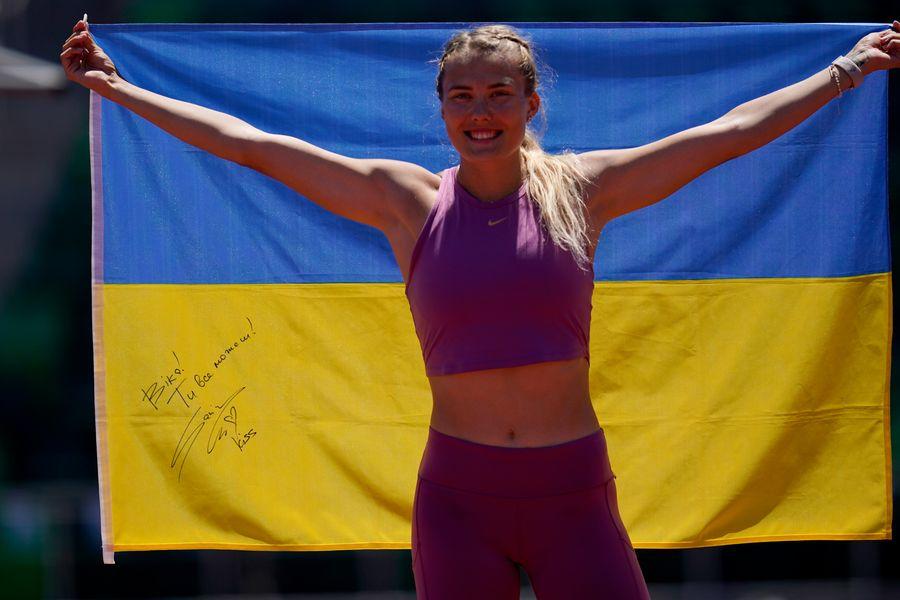
High jumper Yaroslava Mahuchikh, the Ukrainians’ best hope for gold in Eugene, recalled waking up to shelling in her hometown of Dnipro back in February and frantically calling her family to make sure they were okay. A month later, after a harrowing three-day, 1,200-mile car ride through Ukraine, Moldova, and Romania before arriving in Serbia, she won the indoor championship title.
“It was dangerous and scary because you don’t know where the next shelling will be,” she said. “It was terrible for us, the longest trip of my life, but we have to compete and show good results.”
After winning gold in Belgrade, Mahuchikh traveled to Germany, where she regrouped with her boyfriend and benefitted from assistance at the headquarters of her sponsor, Puma. She then trained in Turkey for two months, and will return to Germany after her time in the U.S. But Mahuchikh still longs for a return to Ukraine, where the photogenic gold medalist is a national hero.
“My father and grandmother are in Dnipro, and we keep in touch all the time because the other day there were six rockets [that hit] Dnipro, but my family is okay,” she said. “We always read the news, but we understand we are in competition, and we have to focus on our job for our country.”

Congress Doesn’t Need Another Blame Game. It Needs To Find What’s Broken
Jarrod Bernstein • RealClearPolitics
Democrats Won the Midterms. Common Sense Won, Too
Jordanne Kemper • RealClearPolitics
The 120th Congress Shapes Up
Carolina Lumetta • RealClearPolitics
Flooding GOP Primaries With Democrats
Robert Natelson • RealClearPolitics
Washington Keeps Rewarding Oracle—Veterans Keep Paying the Price
Darin Gaub • RealClearPolitics
The Seeds of Unrestricted Warfare
John Teichert • RealClearPolitics
RCP Today
Top stories on RealClearPolitics
The Takeaway
Polling intelligence and analysis delivered to your inbox
World News
Featuring the latest world news
Policy
Featuring the latest policy news
Support Our Mission
As part of RealClearPolitics, authors aim to provide balanced, non-partisan analysis by presenting top reporting and commentary from all sides of the political spectrum.
Trusted by policymakers and citizens alike since 2000