
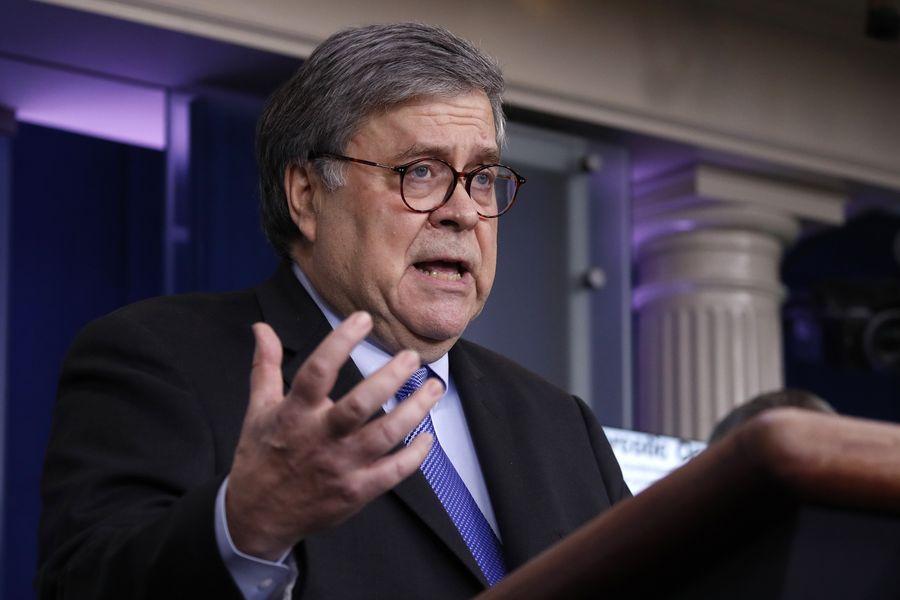
Attorney General William Barr speaks about the coronavirus in the James Brady Press Briefing Room of the White House, Wednesday, April 1, 2020, in Washington. (AP Photo/Alex Brandon)
Amid Church-State Frictions, DoJ Stresses Religions' Rights
Published April 15, 2020 • Read time: 5m
He was buried, and three days later was raised from the dead, according to Scripture. They went to church in celebration over this event two millennia later … and were fined $500, according to the authority of the mayor.
The first episode happened in Jerusalem. The second, Greenville, Miss. But ancient Rome is gone and this Easter story ends with the federal authorities on the side of the Christians. The Justice Department intervened on behalf of Temple Baptist Church on Tuesday, filing a statement of interest in a lawsuit against the city.
The church is suing Greenville after police officers walked car-to-car handing out tickets to congregants who refused to leave the parking lot during a drive-in Good Friday service, and the DoJ is siding with the church because “the allegations in the complaint strongly suggest that the city’s prohibition of drive-in church services, despite the inclusion of measures to reduce risk such as requiring people to remain in their cars, are neither neutral nor generally applicable.”
It is the latest in the delicate balancing of church and state during a pandemic, a consideration of government interest in combating a disease and matters of conscience. The deputy attorney general of the United States told RealClearPolitics the DoJ would defer to the First Amendment.
“When there is a national crisis, of one kind or another, we don't give up all of our liberties,” explained Jeff Rosen. Acts of God, plagues or pandemics or otherwise, require “short-term exigencies as to how expansive they are at a given time, but the Constitution remains in effect at all times.”
An Easter Lesson in Judging Not
Is ISIS Faithful to Islam?
Press Club Welcomes Rezaian Back Home
Hostility to Tradition
The interview came on the heels of that DoJ statement of interest and new guidance offered by Attorney General Bill Barr.
“Even in times of emergency, when reasonable and temporary restrictions are placed on rights, the First Amendment and federal statutory law prohibit discrimination against religious institutions and religious believers,” Barr wrote in a Tuesday statement. “Thus, government may not impose special restrictions on religious activity that do not also apply to similar nonreligious activity.”
The statement was not a revelation given how President Trump has catered to conservative evangelicals. It also wasn’t a surprise after DoJ spokeswoman Kerri Kupec warned that the attorney general would look unkindly at crackdowns on religious services.
“During this sacred week for many Americans, AG Barr is monitoring govt regulation of religious services. While social distancing policies are appropriate during this emergency, they must be applied evenhandedly & not single out religious orgs,” Kupec wrote on Twitter. “Expect action from DOJ next week.”
And it came, but not until after several states and other localities took their own actions against churches that met in person despite stay-at-home orders. In Florida, Hillsborough County Sheriff Chad Chronister issued a warrant for the arrest of a mega-church pastor who kept church doors open and pews full in defiance of social distancing orders from the state. Gov. Ron DeSantis, a Republican, later issued a directive exempting religious assemblies.
The Kansas Supreme Court upheld an executive order from Democratic Gov. Laura Kelly preventing the gathering of more than 10 people at religious services. Meanwhile, Kentucky’s largest city, Louisville, issued an order prohibiting religious services, including drive-in gatherings. A federal court later issued a blistering restraining order against Louisville, ruling that the directive from Democratic Mayor Greg Fischer “criminalized” Easter celebrations.
Such examples are few and far between at a moment when the overwhelming majority of America’s clergy have embraced social distancing guidelines and substituted a live-streamed sermon or a podcast for the pulpit. But the Justice Department wants to set some parameters on enforcement against houses of worship as all 50 states battle the coronavirus simultaneously. When some states begin to loosen restrictions and others extend them, congregations will gather and legal controversy will follow.
“Will there be more actions? I guess that depends,” Rosen told RealClearPolitics. “We would hope that they wouldn't be needed. We would hope that state, local, and the federal government would all be working in a respectful and collaborative way.”
“Much of the time, that has been our experience, and I hope we will see more of that where people, once sensitized to an issue, try to be respectful of the rights of our citizens.”
That process is ongoing.
“Government is clearly overstepping its authority when it singles out churches for punishment, especially in a ridiculous fashion like this,” said Ryan Tucker of the Alliance Defending Freedom, which is representing Temple Baptist Church. “In Greenville, you can be in your car at a drive-in restaurant, but you can’t be in your car at a drive-in church service. That’s not only nonsensical, it’s unconstitutional.”
Greenville Mayor Errick Simmons held a press conference on the steps of City Hall to respond. He was, he said, simply following orders from Mississippi Gov. Tate Reeves.
“These incidents have been taken out of context,” Simmons insisted. “This is not a time to play politics. This is not a time to inflame unprecedented and challenging times with unnecessary attacks and false narratives.” Anyone who received a citation, he continued, would not have to pay the fine.
Pandemics present a host of problems. This doesn’t mean, Rosen said, that church and state can’t come to certain understandings. Each circumstance, he noted, rests on specifics “as to how much the religious liberties are being burdened and for how long and to what justification -- so these things tend to get very fact-specific.”
The statement from the attorney general, he said, is meant “to say, ‘Here [are] the considerations that are in play and then let’s find ways to accomplish both the public health needs but in a way that is respectful and accommodating of religious liberties.’”
The closest Rosen would come to a blanket statement or a pandemic doctrine governing religious gatherings was to say that “our Constitution continues to apply at all times.”

Congress Doesn’t Need Another Blame Game. It Needs To Find What’s Broken
Jarrod Bernstein • RealClearPolitics
Democrats Won the Midterms. Common Sense Won, Too
Jordanne Kemper • RealClearPolitics
The 120th Congress Shapes Up
Carolina Lumetta • RealClearPolitics
Flooding GOP Primaries With Democrats
Robert Natelson • RealClearPolitics
Washington Keeps Rewarding Oracle—Veterans Keep Paying the Price
Darin Gaub • RealClearPolitics
The Seeds of Unrestricted Warfare
John Teichert • RealClearPolitics
RCP Today
Top stories on RealClearPolitics
The Takeaway
Polling intelligence and analysis delivered to your inbox
World News
Featuring the latest world news
Policy
Featuring the latest policy news
Support Our Mission
As part of RealClearPolitics, authors aim to provide balanced, non-partisan analysis by presenting top reporting and commentary from all sides of the political spectrum.
Trusted by policymakers and citizens alike since 2000