
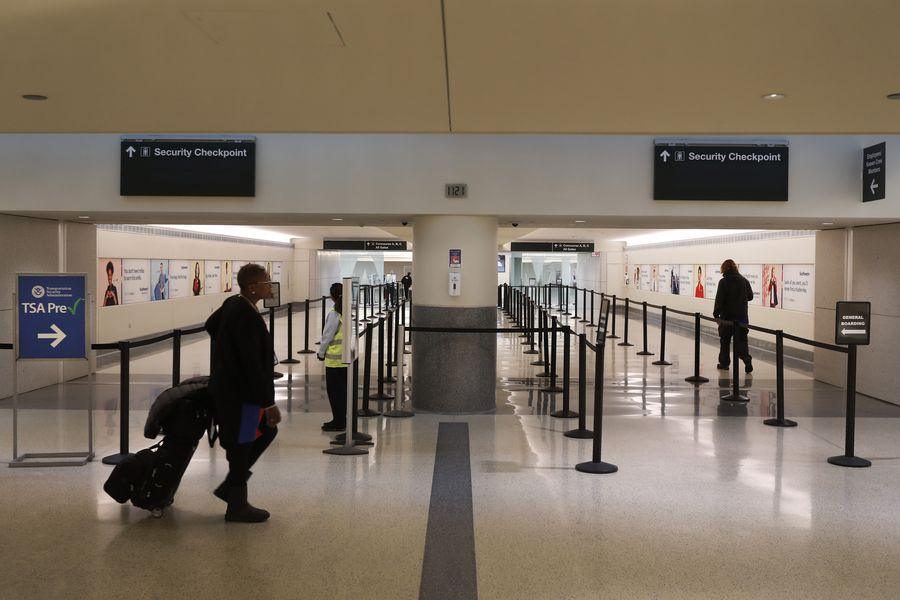
Two passengers head to the TSA security checkpoint at Midway International Airport Monday, March 30, 2020, in Chicago. The new coronavirus causes mild or moderate symptoms for most people, but for some, especially older adults and people with existing health problems, it can cause more severe illness or death. (AP Photo/Charles Rex Arbogast)
Time for a Second Opinion
COMMENTARY
Published March 31, 2020 • Read time: 6m
We are trying to stave off and arrest a pandemic. Given what is being recommended, we think we need some second or third opinions. This pandemic, now that it has reached America, has taken 3,173 lives here. This, from a tested population of 164,359 cases. That’s a mortality rate of 1.9%. But immediately, questions must be asked. We record every case of death from the coronavirus, but we have no idea how many people have had the coronavirus. Clearly, there are more than 164,359 cases because not everyone has been tested. That would put the mortality rate at less than 1.9%. That rate could be far, far less. As Eran Bendavid and Jay Bhattacharya, professors of medicine at Stanford, have written, based on their model of over 6 million cases they believe exist: “That’s a mortality rate of 0.01%, assuming a two-week lag between infection and death. This is one-tenth of the flu mortality rate of 0.1%.”
Again, as we pointed have out before: Each death is a tragedy and horrible, but the chance of it is also very small, depending on if you contract the virus and what your age and underlying medical conditions are. Will the numbers be much bigger than our annual rate of flu deaths? Already this year we have lost 24,000 to the flu and expect that number to rise at least another 24,000, probably more. Coronavirus deaths at half the flu number would also be much smaller than our annual rate of opioid overdose deaths—46,802—or annual deaths due to motor vehicle crashes, 33,654. For none of these problems—some anthropogenic and due to acts of volition, some caused by nature—have we or do we change, literally, everything, from stay in shelter orders and travel bans to the shuttering of almost all retail and service businesses.
President Calls Drug Addiction a Health Problem
Lawmakers Hail New Opioid Rules -- But Call for More
No Opiates for the Masses?
Obamacare's Tax-Time Torment
We have lost perspective. Epidemiologists and others in public health and medical professions have opined that the worst is yet to come. But already they, too, are offering their own second doctors’ opinions. Neil Ferguson and his Imperial College study gave us the March 17 headline “A chilling scientific paper helped upend U.S. and U.K. coronavirus strategies.” It warned of 2.2 million deaths in the United States. By last week, Dr. Ferguson changed his predictions and Dr. Deborah Birx of the White House Coronavirus Task Force said, “I’m sure you have seen the recent report out of the U.K. about them adjusting completely their needs. This is really quite important. … They’ve adjusted that number in the U.K. to 20,000. Half a million to 20,000. … So when people start talking about 20% of a population getting infected, it’s very scary, but we don’t have data that matches that based on our experience.”
The first analysis received a lot of headlines; the revisions downward, not so much. Dr. Anthony Fauci is now making headlines for saying what we’ve actually been warned about for weeks: bigger numbers, hypothesizing rates could reach the six figures. Sunday, he said, “Looking at what we're seeing now, I would say between 100,000 and 200,000 cases [of death]” and then he added, “But I just don't think that we really need to make a projection, when it's such a moving target, that you can so easily be wrong and mislead people.”
Though we were told we would see and hear of these larger numbers, as more and more testing became available, they are treated as new and alarming information. His qualifiers about being wrong will be ignored. His statement, “I've never seen a model of the diseases that I've dealt with where the worst-case scenario actually came out. They always overshoot,” from the same interview, will be equally ignored.
Because of all this, we have curtailed our freedoms and badly hurt our economy. How did we surrender so much, so fast? Perhaps we have gotten used to alarmism, or worse. What historian Richard Hofstadter once labeled the “paranoid style in American politics” to describe the Barry Goldwater movement of 1964 is now firmly at home in our political and social rhetoric today.
Hofstadter wrote he used the word “paranoid” “simply because no other word adequately evokes the sense of heated exaggeration, suspiciousness, and conspiratorial fantasy” he was describing in the American right of the early 1960s. From the moment of Donald Trump’s election, respected editorialists and political commentators said his election would ensure everything from a global recession to existential threats to our Constitution. Donald Trump, to too many members of Congress, was “a dictator” and someone who was “tyrannizing our communities.” He reminded them of “Germany in the 1930s.” The front-runner in the Democratic Party, Joe Biden, even said our president is “an existential threat to America.” This, all long before anyone knew where Wuhan was or what social distancing meant. That irresponsible rhetoric, analysis, and forecasting has helped pave the way for simply too much panic, or paranoia—a tendency to believe the worst, a disposition to overreact.
To help restore a sense of calm and normalcy, we ought to look at this disease at its center of harm and engage something like a more vertical strategy as Thomas Friedman recommended, “sequestering those among us most likely to be killed or suffer long-term damage by exposure to coronavirus infection … while basically treating the rest of society the way we have always dealt with familiar threats like the flu.” The horizontal strategy of “restricting the movement and commerce of the entire population, without consideration of varying risks for severe infection,” is too blunt, too paralyzing — and too haunting.
Barring that, Professor Hofstadter, though wrong about the 1960s, would be right about today: We truly are shutting down America and harming a great many Americans, based on the worst fears that have not been true and are not on the horizon. We are scaring the hell out of the citizenry. A few additional statistics help counsel a lowering of our national temperature: The vast majority of deaths from the virus are of people over the age of 70 with underlying frailties. The focus on New York where, of course, most of the media is based, is also flooding and distorting the picture for the rest of the country. Of course we need to pay attention to ground zero, which is New York. But what happens there is not what is happening everywhere. For example, our most populous state, California shows 149 deaths, 11% of the total in New York. Texas, our second most populous state, shows nothing like the death toll in New York, with 47 deaths, about 3.5% of the total in the Empire State.
Again, our plea: Look at the numbers, look at everything, rationally, and let us reclaim a sense of proportion. In the early 1990s, Daniel Patrick Moynihan warned that our country was defining deviancy down. Today, we are concerned about defining pandemonium up. We have a problem. Rather than engaging in “heated exaggeration, suspiciousness, and conspiratorial fantasy,” as Hofstadter warned, we should focus our solution on it without upending everything else. Paranoia and overreaction do not suit our democracy well.

Jon Finer’s Old and Dangerous ‘New Approach’ to Israel
Peter Berkowitz • RealClearPolitics
The President Deserves Better
John Ullyot • RealClearPolitics
Congress Doesn’t Need Another Blame Game. It Needs To Find What’s Broken
Jarrod Bernstein • RealClearPolitics
Democrats Won the Midterms. Common Sense Won, Too
Jordanne Kemper • RealClearPolitics
The 120th Congress Shapes Up
Carolina Lumetta • RealClearPolitics
Flooding GOP Primaries With Democrats
Robert Natelson • RealClearPolitics
RCP Today
Top stories on RealClearPolitics
The Takeaway
Polling intelligence and analysis delivered to your inbox
World News
Featuring the latest world news
Policy
Featuring the latest policy news
Support Our Mission
As part of RealClearPolitics, authors aim to provide balanced, non-partisan analysis by presenting top reporting and commentary from all sides of the political spectrum.
Trusted by policymakers and citizens alike since 2000