
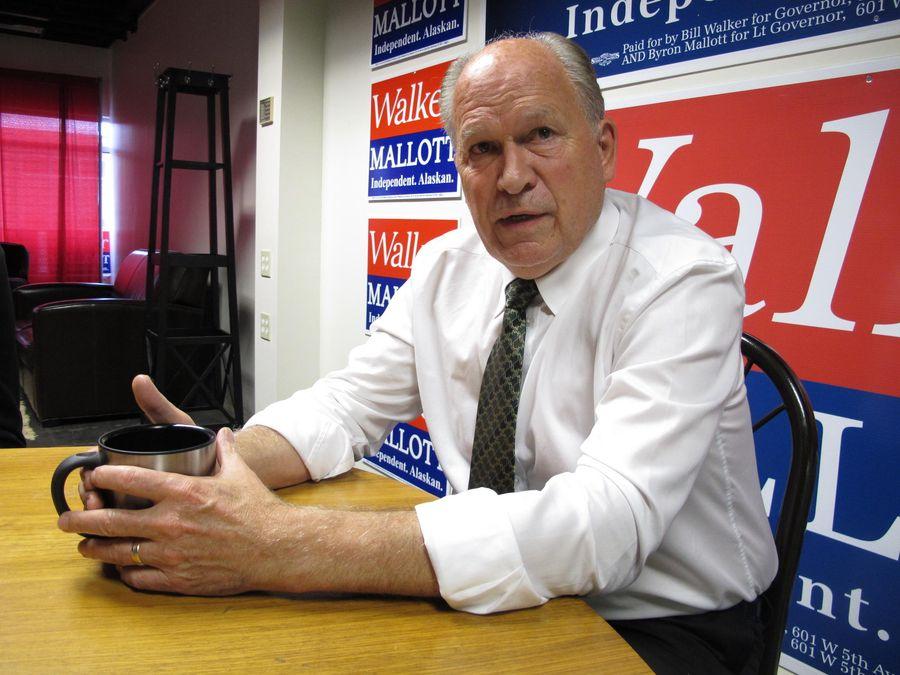
In this Monday, Aug.. 20, 2018 photo, Alaska Gov. Bill Walker is shown during an interview in his campaign office in Anchorage, Alaska. Walker, an independent, bypassed the primaries and instead gathered signatures to qualify for the general election in November, where he is expected to face Republican Mike Dunleavy and Democrat Mark Begich. (AP Photo/Becky Bohrer)
Alaska: Where Politics Is Flavored by Healthy Results
COMMENTARY
Published Sept. 26, 2018 • Read time: 4m
Alaska is a state to watch in the November elections, though not for the usual reasons. There is no Senate seat in play. The one House election won’t tell us much about the future of the Republican or Democratic parties; Alaska’s voters are too independent and quirky for that.
Instead, keep an eye on the governor’s race. Bill Walker, the nation’s only independent governor, is running for re-election after “giving a bear hug” to the third rail of Alaska politics: the Permanent Fund Dividend, otherwise known as PFD.
When the price of oil plummeted, taking Alaska state revenues with it, Gov. Walker cut the state deficit by more than half (from a peak of $3.4 billion to $700 million). He did that with over a billion dollars in spending cuts, but also by reducing the size of the check that goes out every year to every Alaska resident.
Will Alaska voters punish or reward an independent leader who served his state vegetables rather than ice cream?
My hope is that it will be the latter. In the realm of politics, we are perpetually attracted to those who tell us we can lose weight by eating ice cream. We would like to believe that tax cuts increase government revenue. (They don’t.) Or that we can balance the federal budget just by raising taxes on the rich. (Not even close.)
Republicans and Democrats offer different flavors, but the outcome is invariably the same: We get angry when the fatty diet doesn’t work. We say we want politicians who will “make hard decisions” even as we vote for painless solutions. I am originally from Illinois, where there has been a looming pension crisis for decades. From the beginning, the fix has been as obvious as it is painful: modify pension benefits and set aside more state revenue to pay for future obligations.
Kids' Lives Matter Too
In a Corner of Ohio, Lessons of 2016
2016 Presidential Election Could Decide State Legislative Races
McCaskill Says No to Run for Missouri Governor
Unfortunately that is broccoli, not ice cream. For decades, Illinois voters rewarded politicians who peddled every flavor of fake solution. One governor even offered a double scoop: borrow money and invest it in the stock market (shortly before the financial crisis) in the hope that the outsize returns would fix the pension problem. It didn’t, and that governor is now in prison (for unrelated reasons).
Illinois is now swamped in debt and has the lowest credit rating of any state in the country. Should we be surprised?
This is why the Alaska gubernatorial election is so interesting. Sending out checks to voters is popular. Reducing the size of size of those checks is unpopular, if entirely prudent. Every major American domestic policy challenge — from reducing the debt to dealing with traffic congestion — will require similarly prudent decisions.
How do we fix Social Security? With a combination of higher taxes, a higher retirement age, and lower benefits. How do we fix traffic congestion? Raise the cost of driving. How do we reduce the rate of growth in health care spending? Limit unnecessary but expensive care. Those kinds of policies are not ice cream. They’re not even nonfat frozen yogurt.
I often ask my students as we work our way through America’s myriad policy challenges: Why are there only hard choices? The answer is obvious only after the fact: If there were an easy solution, we would have done it already.
The irony is that Alaskans are still going to get a nice dessert. The PFD check that will go out to every Alaskan in October will be one of the largest ever ($1,600). As with programs like Medicare and Social Security, sometimes you have to reform a program in order to save it.
There is a second important question lurking in Alaska’s gubernatorial election. Might independent governors — and independent politicians more generally — offer a path through our partisan morass? In Alaska, neither party was willing to be the first to touch the PFD, even as both parties acknowledged that overspending from the account jeopardized Alaska’s most valuable asset.
Gov. Walker — not wearing a blue or a red jersey — vetoed a budget he believed made reckless use of the PFD. He told the Fairbanks Daily News-Miner that legislators were saying to him, “We’re going to make you do what we should be doing.” Which he did.
Here is the crucial part: Once Walker took the political hit, the two parties followed. The legislature passed bipartisan PFD reform the next year.
Walker has built a Cabinet and a governing coalition that includes Republicans, Democrats, and independents. Relative to the rest of the country, that is a bizarrely sane way to govern.
Watch Alaska on Nov. 6. The polls will close late for those of us in the Lower 48, but the outcome has national significance. Alaskans can remind us that the most logical remedy for partisan trench warfare is to elect leaders with the courage not to climb in one trench or the other.

Jon Finer’s Old and Dangerous ‘New Approach’ to Israel
Peter Berkowitz • RealClearPolitics
The President Deserves Better
John Ullyot • RealClearPolitics
Congress Doesn’t Need Another Blame Game. It Needs To Find What’s Broken
Jarrod Bernstein • RealClearPolitics
Democrats Won the Midterms. Common Sense Won, Too
Jordanne Kemper • RealClearPolitics
The 120th Congress Shapes Up
Carolina Lumetta • RealClearPolitics
Flooding GOP Primaries With Democrats
Robert Natelson • RealClearPolitics
RCP Today
Top stories on RealClearPolitics
The Takeaway
Polling intelligence and analysis delivered to your inbox
World News
Featuring the latest world news
Policy
Featuring the latest policy news
Support Our Mission
As part of RealClearPolitics, authors aim to provide balanced, non-partisan analysis by presenting top reporting and commentary from all sides of the political spectrum.
Trusted by policymakers and citizens alike since 2000