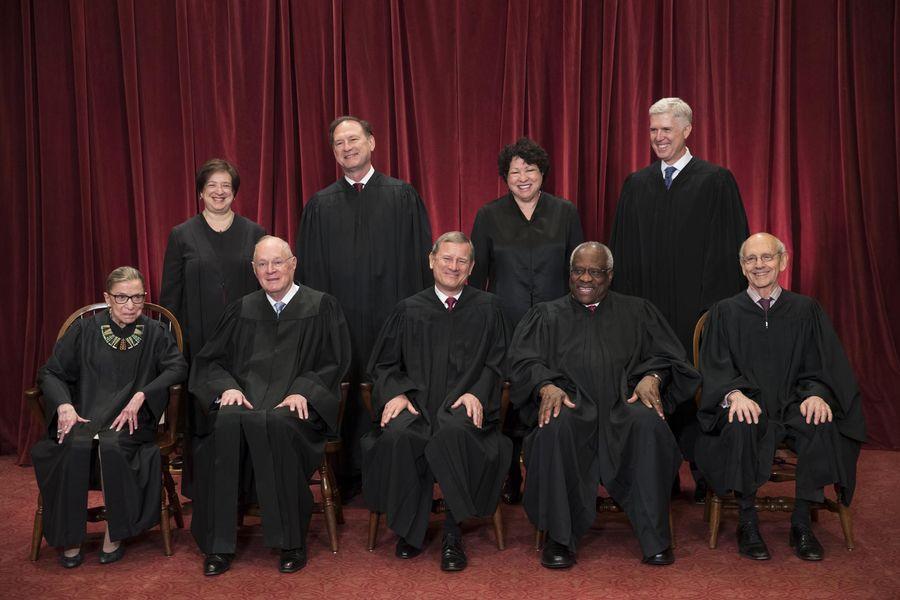
The justices of the U.S. Supreme Court gather for an official group portrait to include new Associate Justice Neil Gorsuch, top row, far right, Thursday. June 1, 2017, at the Supreme Court Building in Washington. Seated, from left are, Associate Justice Ruth Bader Ginsburg, Associate Justice Anthony Kennedy, Chief Justice John Roberts, Associate Justice Clarence Thomas, and Associate Justice Stephen Breyer. Standing, from left are, Associate Justice Elena Kagan, Associate Justice Samuel Alito Jr., Associate Justice Sonia Sotomayor, and Associate Justice Neil Gorsuch. (AP Photo/J. Scott Applewhite)
Labor Thuggery at the Supreme Court
Published Feb. 28, 2018 • Read time: 4m
Organized labor took off the gloves Monday, warning the justices of the U.S. Supreme Court that freeing public employees from mandatory union dues would lead to strikes and union violence. It was ugly.
The Court heard oral arguments challenging laws in 22 states and the District of Columbia that force public employees to pay unions to represent them, even if they disagree with the union's demands and politics. Mark Janus, a child support specialist and public employee in Illinois, claims his First Amendment free speech rights are being violated when he is forced to pay money to a union -- the American Federation of State, County and Municipal Employees. The union "uses my monthly fees to promote an agenda I don't support," Janus objects.
Lawyers advocating for the union resorted to bullying, threatening labor strife if the longstanding Supreme Court precedent favoring mandatory union fees (Abood, 1977) is overturned. Justices Elena Kagan and Sonia Sotomayor, who did most of the talking in support of the mandatory fees, grasped at straws rather than confronting head-on the free speech rights of public employees -- teachers, police officers, firefighters and more.
Justice Anthony Kennedy raised the critical issue in the case, explaining that AFSCME, like all public employee unions, negotiates wages, benefits and work rules that determine how much state and local governments cost taxpayers. Kennedy pointed out that public unions come down "against privatization, against merit promotion ... for massive government, for increasing bonded indebtedness, for increasing taxes." These are key political issues. Supporting the union means supporting big government, big budgets, big workforces, and a big tax bill.
He's Mean, But Is He at Least Bright?
Supreme Hypocrisy
It's Time to End ALL Lame-Duck Sessions
The Court Fight Is About Democracy
Kagan made a flimsy suggestion that these are not actually "matters of public concern." Huh? Anyone who pays taxes knows they are.
As Janus himself says, "At a time when Illinois is drowning in red ink ... the union is wrangling taxpayers for higher wages and pension benefits for state workers." He adds in disgust, "the union fight is not my fight."
So why should Janus be forced to pay fees to support the union? Amazingly, the lawyer for the state of Illinois argued that it's to avoid labor discord. When union membership is voluntary, he said, some members stop paying, and dues go up for the rest. That's when the unions "tend to become more militant, more confrontational."
New York City Mayor Bill de Blasio's administration made the same hardball argument in a brief filed with the court. The city's top lawyer argued that mandatory fees are needed to avoid "paralyzing public sector strikes," like those in the 1960s and 1970s, "that wreaked havoc on millions of city residents." Translation: If you don't allow us to keep demanding these involuntary union payments, expect trouble. The de Blasio administration reminded the justices that in the past, strikes in New York meant "garbage piled in the streets, children missed weeks of school, and subways ground to a halt."
A not so subtle threat. No wonder the lawyer for Janus labeled the mandatory fees "protection money." He asked, who can defend the "idea that the government needs to force its employees to subsidize unions or otherwise the unions will disrupt the government"?
The union threats are disgraceful, and they also ring hollow. After all, we don't have labor wars in states without compulsory public union fees.
Most disappointing, the same four justices who supported mandatory union fees two years ago, when the court split 4-4 in a similar case, sidestepped the core issue -- whether forcing public employees to pay money to an organization is as much a violation of their free speech as forcing them to utter words against their convictions.
Instead, Kagan fretted about the disruptive impact of striking down the mandatory fees. "Thousands of municipalities would have contracts invalidated. Those contracts probably cover millions, maybe up to over 10 million workers." Kagan asked, "What would be the justification for doing something like that?"
It's unlikely contracts will be invalidated. But to answer Kagan's question, the "justification" is called the United States Constitution.
COPYRIGHT 2018 CREATORS.COM

A RealClear Thanksgiving: Investing in a Better Future
David DesRosiers • RealClearPolitics
Trump’s Newsom Problem: Antagonist-in-Chief
Carolina Lumetta • RealClearPolitics
America’s Free Spirit
John Maxwell Hamilton • RealClearPolitics
The GOP Majority Should Go Out in Glory
Daniel McCarthy • RealClearPolitics
Republican Majorities Could Return Sooner Than Expected
J.T. Young • RealClearPolitics
The Danger Before the Attack
Leslie J. Sullivan • RealClearPolitics
RCP Today
Top stories on RealClearPolitics
The Takeaway
Polling intelligence and analysis delivered to your inbox
World News
Featuring the latest world news
Policy
Featuring the latest policy news
Support Our Mission
As part of RealClearPolitics, authors aim to provide balanced, non-partisan analysis by presenting top reporting and commentary from all sides of the political spectrum.
Trusted by policymakers and citizens alike since 2000