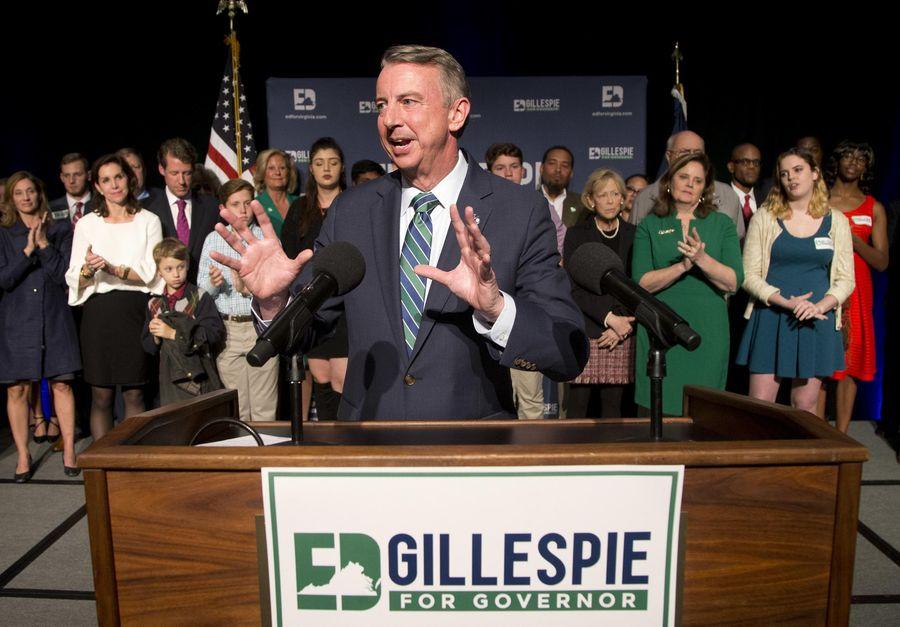
Republican gubernatorial candidate Ed Gillespie gestures as he delivers a concession speech during an election party in Richmond, Va., Tuesday, Nov. 7, 2017. Gillespie lost to Democrat Ralph Northam. (AP Photo/Steve Helber)
Lessons From Virginia for the GOP
COMMENTARY
Published Dec. 22, 2017 • Read time: 3m
The Commonwealth of Virginia is frequently at the center of American politics. It has played an outsized role in our nation’s history and, due to the unique, off-year timing of our gubernatorial campaigns, it tends to play an outsized role in current events. The statewide elections held here last month are a good example.
A solidly Democratic state during the mid-century Byrd Machine era, the Commonwealth tilted Republican in the ’80s and stayed that way through the turn of the century. But the pendulum has clearly now swung back as demographic trends have made Virginia an increasingly favorable environment for the modern Democratic coalition. Virginia was the only Southern state to vote for Hillary Clinton in 2016, by a margin larger than President Obama’s over Mitt Romney in 2012. I had the privilege to serve as the campaign manager on the last successful statewide race for Republicans – unfortunately for our party, that was eight years ago.
By any measure, 2017 was not a good time to be the Republican nominee for governor in Virginia. Terry McAuliffe, the outgoing Democratic governor, is popular. President Trump’s job approval hovers below 40 percent. The unemployment rate is historically low and a majority of Virginans believe the state is on the right track. Virginia also has a four-decade track record of voting against the party that won the White House in the preceding year’s presidential election, with only one exception in the last 11 gubernatorial contests.
Those factors all contributed to a partisan turnout advantage on Election Day that was Democrat +11 -- an unprecedented figure. In statewide races in 2009, 2013, and 2014, approximately 2.2 million Virginians went to the polls. In 2017, that number ballooned to more than 2.6 million. Approximately 300,000 “presidential year” Democratic voters showed up for the off-year races, producing a landslide that also wiped out 15 of the 17 Republican members of the House of Delegates (with one race still pending) who sat in districts won by Hillary Clinton in 2016. This wave did not discern or distinguish; it simply meant a long Election Day for any Republican in a swing district, or in the case of the statewide candidates, in a Clinton state. The wave was made even bigger due to a robust fundraising advantage that saw the Northam campaign and its allies outspend the Gillespie team by $11 million.
Kids' Lives Matter Too
In a Corner of Ohio, Lessons of 2016
2016 Presidential Election Could Decide State Legislative Races
McCaskill Says No to Run for Missouri Governor
In the face of these historic factors and significant headwinds, Ed Gillespie, a former RNC chairman and counselor to President Bush, ran a disciplined, substantive, and thoughtful campaign. He released 21 detailed policy proposals across a wide range of issues from jobs to education to transportation to criminal justice reform and the environment. That focus on policy is one reason why, even in a challenging political environment, he managed to get the most votes of any candidate for governor in Virginia history -- save one, the governor-elect, Ralph Northam. Ed received more votes than Gov. Bob McDonnell, who won by 17 points in 2009, and 100,000 more votes than McAuliffe, the winner in 2013. And he improved his performance among African-American voters by 20 percent from his U.S. Senate race in 2014. Those results shouldn’t be lost in the postmortems about the campaign.
Despite the outcome, Republican candidates in 2018 should not hesitate to borrow from Gillespie’s detailed, forward-looking policy proposals as a means to both help win elections and advance good government. Even in an age of 140 (or 280) characters, ideas matter. Regardless of which way the political winds are blowing, Republicans would be well advised to put forward new ideas and candidates and campaigns of real substance.

A RealClear Thanksgiving: Investing in a Better Future
David DesRosiers • RealClearPolitics
Trump’s Newsom Problem: Antagonist-in-Chief
Carolina Lumetta • RealClearPolitics
America’s Free Spirit
John Maxwell Hamilton • RealClearPolitics
The GOP Majority Should Go Out in Glory
Daniel McCarthy • RealClearPolitics
Republican Majorities Could Return Sooner Than Expected
J.T. Young • RealClearPolitics
The Danger Before the Attack
Leslie J. Sullivan • RealClearPolitics
RCP Today
Top stories on RealClearPolitics
The Takeaway
Polling intelligence and analysis delivered to your inbox
World News
Featuring the latest world news
Policy
Featuring the latest policy news
Support Our Mission
As part of RealClearPolitics, authors aim to provide balanced, non-partisan analysis by presenting top reporting and commentary from all sides of the political spectrum.
Trusted by policymakers and citizens alike since 2000