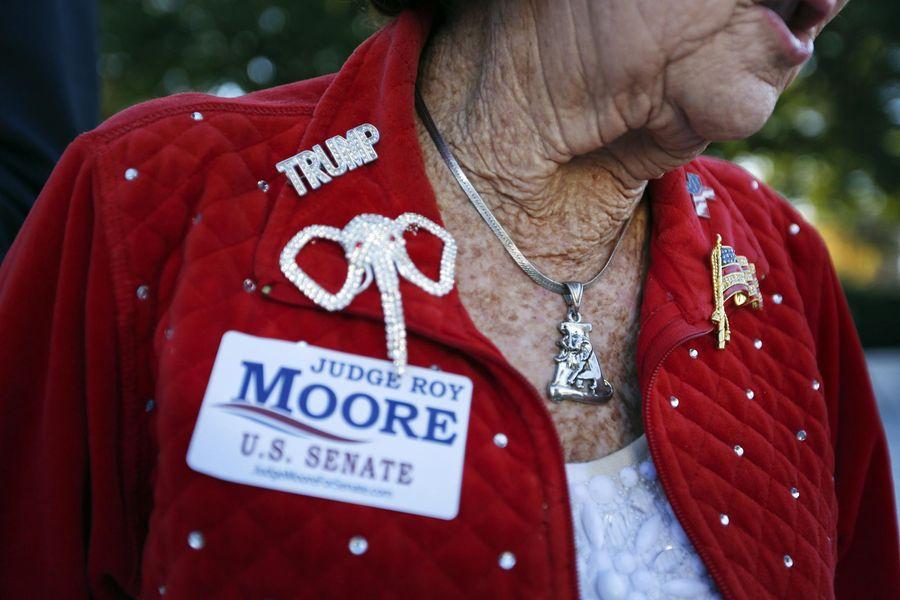
Martha Shiver, reacts to a reporter asking questions about former Alabama Chief Justice and U.S. Senate candidate Roy Moore, before a news conference, Friday, Nov. 17, 2017, in Montgomery, Ala. (AP Photo/Brynn Anderson)
Ala. Senate Race Shows National Parties' Waning Influence
Published Nov. 21, 2017 • Read time: 8m
In the Alabama Senate special election next month, the national political parties are either a punching bag or an anvil.
Republican Roy Moore is increasingly running against the GOP establishment in Washington after top elected officials called for him to exit the race amid allegations of sexual assault and improper relationships with teenagers decades ago.
Moore’s struggles and the shock of the allegations against him have tilted the race significantly, providing an opening for Democrat Doug Jones to compete in ruby red Alabama, which supported President Trump by nearly 30 points over Hillary Clinton last November. But in order to stay competitive, Jones is avoiding just about any association with the Democratic Party, aside from running as its nominee.
The parties’ situations differ enormously: The allegations against Moore -- which he has repeatedly denied -- have stirred an outcry within the GOP, and few Republicans outside of Alabama want to see him assume the seat vacated by now-Attorney General Jeff Sessions. Democrats across the country would cheer Jones’ victory, though they are strategically avoiding a public embrace of the candidate. What both parties do share, however, are images that are toxic to many voters, and increasingly limited sway outside the Beltway.
“The parties are dead, almost dead, or in a zombie state where they’re walking around but unrecognizable from their usefulness,” said Scott Jennings, a former George W. Bush White House official and political adviser to Senate Majority Leader Mitch McConnell.
Portman-Strickland Senate Race Finally Set in Ohio
Portman Wastes No Time Attacking Strickland
Strickland Skirts Primary Debates in Ohio Senate Race
Senate Says Climate Change Is Real
"Moore is running away from Republicans and Jones is running away from Democrats, and yet they’re running to be representatives of those parties. If this isn’t emblematic of the end of the two-party structure, I don’t know what is.”
The polling for both parties is grim: Gallup in September found Democrats underwater with 44 percent favorability and 51 percent unfavorability, and they haven’t been above water since immediately following President Obama’s re-election in 2012. Meanwhile, 36 percent of registered voters viewed the GOP favorably, and 59 percent viewed it unfavorably.
In a CNN poll in September, one-fourth of Democrats had a negative view of their own party; just below a quarter of Republicans said the same. Both parties were viewed favorably by less than one-third of independents.
The fallout of the allegations against Moore, which were first reported in The Washington Post two weeks ago, created a schism within the GOP -- national Republicans have, almost uniformly, criticized the nominee and called on him to exit the race (President Trump has notably avoided that, with the White House suggesting Alabama voters should decide his fate). House Speaker Paul Ryan said Moore should end his candidacy; Senate Majority Leader Mitch McConnell called on him to depart the race and has searched for ways to salvage the seat, including a write-in campaign for Sessions. The Republican National Committee and the National Republican Senatorial Committee both dropped fundraising pacts with Moore.
Still, the former state Supreme Court justice has refused to drop out. Instead, he has cast his campaign as countering a corrupt Washington establishment attempting to exert its will on Alabama.
“I believe with all of my heart that Mitch McConnell and the establishment are in cahoots with the Democrats to stop this campaign,” Moore told Breitbart News over the weekend. “They have taken a calculated risk for two years with a Democrat and try to elect another Republican in two years. And they want me out. So that’s what’s going on. And I think it is a travesty of justice. And I think it is certainly not Republican in nature.”
Alabama Republicans have, for the most part, stuck by the embattled candidate. The state party steering committee chose to back him last week; Kay Ivey, the governor, said she believes Moore’s accusers, but said she would vote for him anyway, citing his eventual votes for Supreme Court justices and other appointments.
The struggle is emblematic of a war that has raged within the Republican Party over past election cycles, and is likely to continue next year as well. Steve Bannon, the chairman of Breitbart News and Trump’s former chief strategist, has vowed to wage war against McConnell in Senate races across the country, which kicked off during the Alabama special election primary. If Moore wins while attacking McConnell, it would send shockwaves through the GOP heading into the 2018 cycle. Some Republicans also worry it would harm other party candidates by association.
“If Roy Moore wins, then the Republican Party and the president will be saddled with a brand anvil that is going to bring embarrassment to them both until such time as he’s no longer in the Senate,” Jennings said. “The Republicans lose by winning here.”
Moore’s controversial past -- he was twice removed from state Supreme Court -- led to an already closer than expected race for a Republican in Alabama. In the wake of the scandal about his alleged relationships with teenagers, the bottom has fallen out -- Jones has led in several recent polls, and narrowly leads in the RealClearPolitics average by 0.2 percentage points.
Even with the scandal, however, the window for Jones is narrow: Moore won nearly 100,000 more votes in his primary runoff against appointed Sen. Luther Strange than the number of total Democrats who voted in their primary. Jones’ ads have focused on nonpartisan issues, such as “kitchen table issues” or fixing health care (without mentioning he’s a Democrat, or discussing the Affordable Care Act). His latest ad highlighted Republicans saying they can’t support Moore.
“It’s less of a partisan question than we just don’t want anybody from out of state coming in and telling us who we should elect,” said Giles Perkins, a former state Democratic chairman and strategist for Jones, about the lack of outreach to the national party.
It’s not exactly a surprising turn of events -- candidates have long run on emphasizing their independence, or working across the aisle when facing an electorate out of balance with their own party. But it is increasingly pronounced as Democrats struggle to define themselves in the age of Trump, debating whether to turn further toward their liberal base and progressive issues, or whether they can reach out to disaffected voters who supported Trump last year.
John Anzalone, a Democratic pollster based in Alabama, said Jones’ campaign simply reflects that he’s attempting to ignite a small Democratic base while reaching moderates and “soft” Republicans turned off by Moore.
“He’s running a good campaign and because he’s an Alabamian, he knows culturally how to talk to these voters,” Anzalone said.
While the raw dynamics of the race are perhaps unique among all past Senate races, the broader dynamics will play out in multiple contests in 2018. Five Democrats are up for re-election next year in states Trump won easily (from 19 percentage points to more than 40) -- Claire McCaskill in Missouri, Jon Tester in Montana, Joe Manchin in West Virginia, Heidi Heitkamp in North Dakota and Joe Donnelly in Indiana. The national party’s brand is toxic in many of those areas, and will likely be a cudgel wielded by Republicans in their efforts to unseat these red-state Democrats.
In Indiana, for example, the NRSC sent out a release last month attacking Donnelly for having a “record of loyalty to his Democratic Party bosses” because Tom Perez, the DNC chair, was giving a speech in the state, even though Perez wasn’t appearing with Donnelly, campaigning with or fundraising for him.
“We’ve gotten into such a rut here that if you take a look at the sea of red ink across the middle of America, it tells you that our national political party has given up on a lot of that part of the country,” said former Sen. Byron Dorgan, a Democrat who served three terms representing North Dakota. “That’s terribly unfortunate because we have seen a good number of those states vote for Democrats and they should again.”
Still, there are signs that the party’s broader struggles may not doom its Senate races in difficult territory. Each of the red-state senators has won tough races before, and all are well known and liked by their constituents. A Morning Consult poll conducted over the summer found all five with positive approval ratings -- four of them by double digits. Democrats hope that this popularity, plus having the political wind at their backs, will help paper over problems within the party next year.
“As Democrats start winning, as we did in Virginia and some of these other places across the country, and as we kind of continue to win, some of that will self-correct,” Anzalone said.

A RealClear Thanksgiving: Investing in a Better Future
David DesRosiers • RealClearPolitics
Trump’s Newsom Problem: Antagonist-in-Chief
Carolina Lumetta • RealClearPolitics
America’s Free Spirit
John Maxwell Hamilton • RealClearPolitics
The GOP Majority Should Go Out in Glory
Daniel McCarthy • RealClearPolitics
Republican Majorities Could Return Sooner Than Expected
J.T. Young • RealClearPolitics
The Danger Before the Attack
Leslie J. Sullivan • RealClearPolitics
RCP Today
Top stories on RealClearPolitics
The Takeaway
Polling intelligence and analysis delivered to your inbox
World News
Featuring the latest world news
Policy
Featuring the latest policy news
Support Our Mission
As part of RealClearPolitics, authors aim to provide balanced, non-partisan analysis by presenting top reporting and commentary from all sides of the political spectrum.
Trusted by policymakers and citizens alike since 2000