
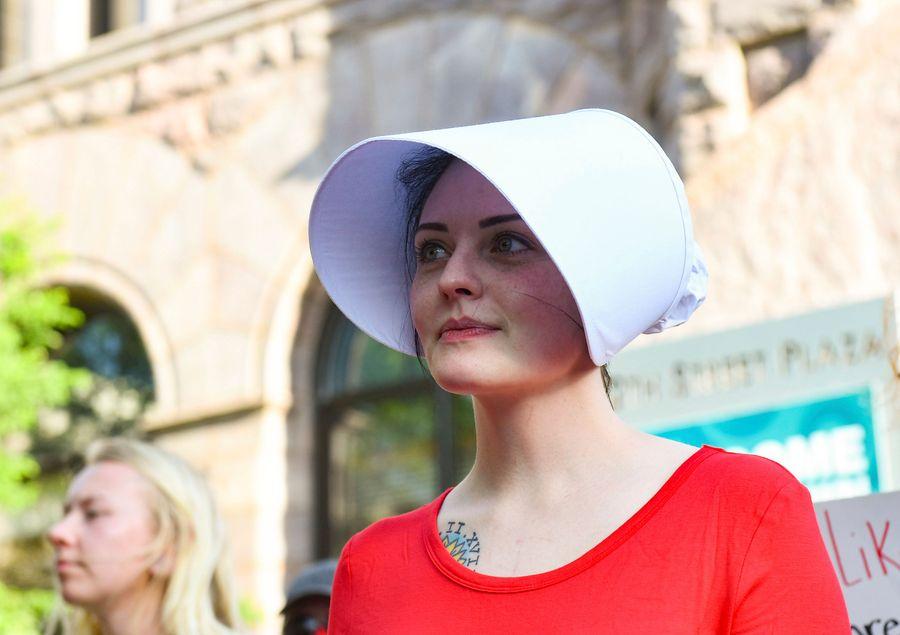
Abortion Sioux Falls Protest
U.S. Abortion Laws: An International Outlier?
COMMENTARY
Published July 6, 2022 • Read time: 5m
Shortly after the announcement from the Supreme Court on Friday that Roe v. Wade was overturned, President Biden decried the ruling, saying that it put the United States’ abortion law out of step with comparable countries.
“With this decision, the conservative majority of the Supreme Court shows how extreme it is, how far removed they are from the majority of this country,” he said. “They have made the United States an outlier among developed nations in the world.”
Whether the U.S. is an outlier among developed nations depends on which metrics one is using, making this claim somewhat a question of opinion as well as a fact. Nonetheless, fact-checkers at PolitiFact ranked Biden’s claim “Mostly True.”
“While the high court’s decision leaves in place state laws that permit abortion, it removes the national right to an abortion – something that is widely guaranteed by laws or court rulings in other developed nations,” wrote Madison Czopek and Tom Kertscher. They quoted Martha Davis, a law professor who filed an amicus brief with the court against overturning Roe, writing, “With few exceptions, legal abortion is available in ‘peer nations,’ including in countries comparable to the U.S. in terms of development or in their use of a common law system.”
Davis also argued that because states will now be allowed to set their own abortion policy, the U.S. will be alone among developed nations, specifically the G7 industrialized nations: Canada, the United Kingdom, France, Germany, Italy, Japan, and the United States.
GOP Abortion Bill Punt: Sell Out or Smart Politics?
Republicans Unanchored
What Is the GOP Thinking?
Republicans Surrender to Infanticide
From PolitiFact, “This lack of uniformity sets the U.S. apart from other countries. Most developed countries have a national standard for access to abortion or consistency across subnational entities rather than wide variations in laws amongst states, Davis said. In the U.S., 'we’re going to have some places that are at no abortion at all,' which is 'clearly an outlier' among other nations, she said.”
PolitiFact would’ve done well to consult anti-abortion experts on this topic as well, not just those who support abortion access such as Davis and the Center for Reproductive Rights. Or, they could have looked to their own archives.
In 2015, the conservative Family Foundation said, “The United States is one of only seven nations that allows elective abortions after 20 weeks post-fertilization.” PolitiFact found this claim to be “True.” PolitiFact confirmed that the only countries besides the U.S. to allow abortions this late in a pregnancy were China, North Korea, Canada, Netherlands, Singapore, and Vietnam. The Washington Post confirmed this in 2017 and noted, tellingly, that this claim “seemed a bit surprising.”
Is the U.S. an outlier because it no longer recognizes a federal right to an abortion, unlike the other G7 nations? Or is it an outlier because, unlike most of the world, some states allow abortions to occur more than 20 weeks after fertilization? The answer depends, at least in part, on one’s scientific and moral beliefs – and one’s view of American-style federalism.
In their fact-check, Czopek and Kertscher focused on the view of the liberal justices in the Dobbs minority who compared the U.S. to other western-style democracies. “The three dissenting justices argued that the global trend ‘has been toward increased provision of legal and safe abortion care,’” they noted.
But the issue may not be that cut-and-dried. A report for the Charlotte Lozier Institute, which opposes abortion, makes the case that the U.S. is an outlier because some states’ abortion policies are less restrictive than those of European countries. “No European nation allows elective abortion through all nine months of pregnancy, as is effectively permitted in several U.S. states, and America is one of only a small handful of nations, along with China and North Korea, to permit any sort of late-term elective abortion,” wrote Angelina B. Nguyen.
In a January 2022 New York Times article headlined “On Abortion Law, the U.S. Is Unusual. Without Roe, It Would Be, Too,” Claire Cain Miller and Margot Sanger-Katz take a more balanced approach than PolitiFact does. They wrote:
Any states that ban or severely limit abortion at all stages of pregnancy – as roughly half are expected to, if Roe is overturned – would join a minority of countries, 66 in all, that prohibit it.
With Roe in place, the United States has also been an international outlier on abortion rights, but in the other direction. Few countries allow abortion without restriction until fetal viability, the cutoff set by Roe v. Wade half a century ago — currently around 23 weeks, because of medical advances. That makes the United States one of just over a dozen countries that allow abortions for any reason beyond 15 weeks of pregnancy, the threshold in the Mississippi law that the Supreme Court considered in its private vote to overturn Roe. France and Colombia recently joined that group.
Given that there is a case to be made that the U.S. is an outlier either because its policies are too restrictive or because they are not restrictive enough, it’s strange that PolitiFact would treat Biden’s statement as a matter of objective fact. It would have been more scrupulous to consider objections from those who disagree with the president’s analysis.

Congress Doesn’t Need Another Blame Game. It Needs To Find What’s Broken
Jarrod Bernstein • RealClearPolitics
Democrats Won the Midterms. Common Sense Won, Too
Jordanne Kemper • RealClearPolitics
The 120th Congress Shapes Up
Carolina Lumetta • RealClearPolitics
Flooding GOP Primaries With Democrats
Robert Natelson • RealClearPolitics
Washington Keeps Rewarding Oracle—Veterans Keep Paying the Price
Darin Gaub • RealClearPolitics
The Seeds of Unrestricted Warfare
John Teichert • RealClearPolitics
RCP Today
Top stories on RealClearPolitics
The Takeaway
Polling intelligence and analysis delivered to your inbox
World News
Featuring the latest world news
Policy
Featuring the latest policy news
Support Our Mission
As part of RealClearPolitics, authors aim to provide balanced, non-partisan analysis by presenting top reporting and commentary from all sides of the political spectrum.
Trusted by policymakers and citizens alike since 2000