
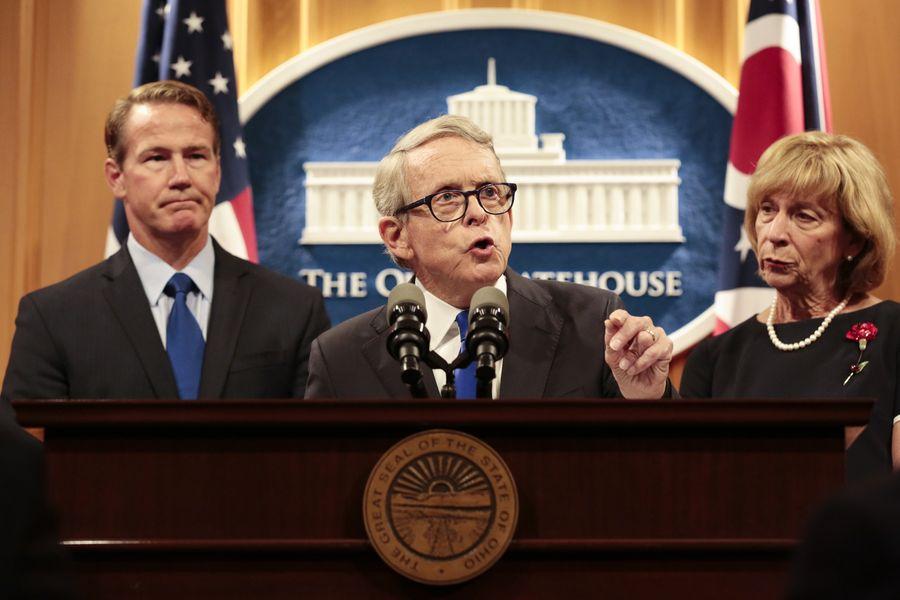
Ohio Gov. Mike DeWine delivers a statement with Lt. Gov. Jon Husted, left, and First Lady Fran DeWine, right, following the Dayton Mass Shooting on Tuesday, Aug. 6, 2019 at the Ohio Statehouse in Columbus, Ohio. Facing pressure to take action after the latest mass shooting in the U.S., DeWine urged the GOP-led state Legislature Tuesday to pass laws requiring background checks for nearly all gun sales and allowing courts to restrict firearms access for people perceived as threats. (Joshua A. Bickel /The Columbus Dispatch via AP)
Dayton Tragedy Restarts Push for 'Red Flag' Law in Ohio
Published Aug. 8, 2019 • Read time: 5m
Twenty-five years ago this November, a 37-year-old man named Keith Ledeger entered Wickliffe Middle School in northeast Ohio with a 12-guage shotgun and killed the custodian and wounded three other people. "It was grim. It was unspeakable," David R. Tanski, superintendent at the time, told The Plain Dealer that day. "We've never had anything like this with a random, senseless act of violence. Nothing like this has ever happened before."
America’s reaction to the recent shootings in El Paso and Dayton was very different. Keith Ledeger, who had once been a student at Wickliffe, was a paranoid schizophrenic and authorities did not dwell on the public implications of his crime, which occurred 4 ½ years before the Columbine High School massacre. After nine people died and 27 others were injured in Dayton, Ohio Gov. Mike DeWine made 17 proposals to address gun violence and increase education about, and treatment of, mental illness.
“The governor had spoken weeks ago about his interest in pursuing safety protection orders,” DeWine’s press secretary, Daniel Tierney, told RealClearPolitics. “In order to get something passed, the governor wanted to do some significant legwork before introducing his proposal to the legislature to try and allay concerns of groups that had previously opposed these types of laws being enacted in Ohio. … The tragedy in Dayton did accelerate the timeline on seeking their introduction.”
The safety protection orders, commonly referred to as “red flag” laws, would give family members and law enforcement in Ohio the ability to file a petition in court to remove firearms from a potentially dangerous individual and get them mental health treatment. Currently, 17 states – along with Washington, D.C. – have some form of extreme-risk protection orders.
Gun Control Supporters Facing Recall Bids in Colorado
God, Guns, and Suicide
The Right Way to Combat Gun Violence
On Guns, Obama Finally Talks About the Culture of Fatherlessness
While the procedures for issuing ERPOs differ by state, the proposed Ohio law stipulates that an initial hearing would be held within three days of a family member or law enforcement filing the petition. The court could grant a temporary order if there’s probable cause that the person is a danger to themselves or others and has access to firearms. If the temporary order is granted, the person in question would be required to surrender all firearms to law enforcement.
Further, another hearing would be held within 14 days where the person in question would be present to determine if an extended safety protection order should be granted. Allison Anderman, the senior counsel at Giffords Law Center – which specializes in researching, writing and defending laws to protect lives from gun violence – told RCP these hearings follow the same procedures as those for other types of restraining orders.
Previously, then-Ohio Gov. John Kasich had sought red flag legislation. Instead, the Republican controlled General Assembly passed a watered-down version of the bill, which Kasich vetoed. Because the GOP still controls both the state House and Senate, Tierney said DeWine’s proposals were written with three distinct principles in mind: that they will have a significant effect on the lives of Ohioans, be constitutional, and can pass in the General Assembly.
“Some of those proposals, if enacted, will be challenged in court,” Tierney said. “And the governor wants something enacted to make a real difference in the lives of [Ohioans], and that would mean making sure they can survive a court challenge.”
One of the biggest concerns among pro-gun groups in regard to ERPOs is ensuring that an individual’s due-process rights are protected. In a statement issued in January of this year, the NRA said that it supports ERPOs laws in states where due process is protected but opposes ones in states such as California, Oregon, and Vermont because that right is violated.
“The NRA believes that any effort should be structured to fully protect the Second Amendment rights of law-abiding citizens while preventing truly dangerous individuals from accessing firearms,” the NRA wrote.
Ohio state Rep. Fred Strahorn – a Democrat from Dayton – told RCP that there’s still an enormous trust issue dividing the pro-gun community and legislatures. “You’re going to have an environment where guns exist, so let’s do everything we can to make that a safer environment,” he said. “If we can crack the code on that trust issue and bring players to the table that are pro-gun, I think that could be a blueprint for other redder states that have a hard time dealing with that issue.”
Republican Sen. Rob Portman told RCP in a statement that many of the issues being addressed by Gov. DeWine’s “sensible” proposals also need to be addressed at the federal level. “I look forward to seeing the details of these proposals and working with my colleagues in Congress on both sides of the aisle on effective legislation,” Portman said.
In addition to safety protection orders, DeWine called for stronger background checks and a better effort by Ohio’s Department of Public Safety to monitor social media sites for any signs that someone is in need of mental health treatment. He also proposed increasing the penalties for individuals who commit felonies using guns and those who engage in illegal gun purchases.
Echoing a frustrated crowd in Dayton, Democratic Sen. Sherrod Brown told RCP in a statement: “I’m glad Governor DeWine has said he supports stronger background checks, but we need to see action.”
Although DeWine wrote proposals he believes can pass in the General Assembly, Strahorn said he’s not sure whether conservative members are ready to approve bills that include red flag laws. Strahorn pointed out that Dayton was not the first mass shooting Ohio has seen, citing a 2012 shooting at Chardon High School that left three dead and three more injured. Psychologist Peter Langman labeled the shooter – Thomas “T.J.” Lane – as “traumatized/psychopathic.”
“It’s sad that it would take something like [Dayton] to get [red flag] laws,” Strahorn said. “I hope we will pay more attention.”

Congress Doesn’t Need Another Blame Game. It Needs To Find What’s Broken
Jarrod Bernstein • RealClearPolitics
Democrats Won the Midterms. Common Sense Won, Too
Jordanne Kemper • RealClearPolitics
The 120th Congress Shapes Up
Carolina Lumetta • RealClearPolitics
Flooding GOP Primaries With Democrats
Robert Natelson • RealClearPolitics
Washington Keeps Rewarding Oracle—Veterans Keep Paying the Price
Darin Gaub • RealClearPolitics
The Seeds of Unrestricted Warfare
John Teichert • RealClearPolitics
RCP Today
Top stories on RealClearPolitics
The Takeaway
Polling intelligence and analysis delivered to your inbox
World News
Featuring the latest world news
Policy
Featuring the latest policy news
Support Our Mission
As part of RealClearPolitics, authors aim to provide balanced, non-partisan analysis by presenting top reporting and commentary from all sides of the political spectrum.
Trusted by policymakers and citizens alike since 2000