
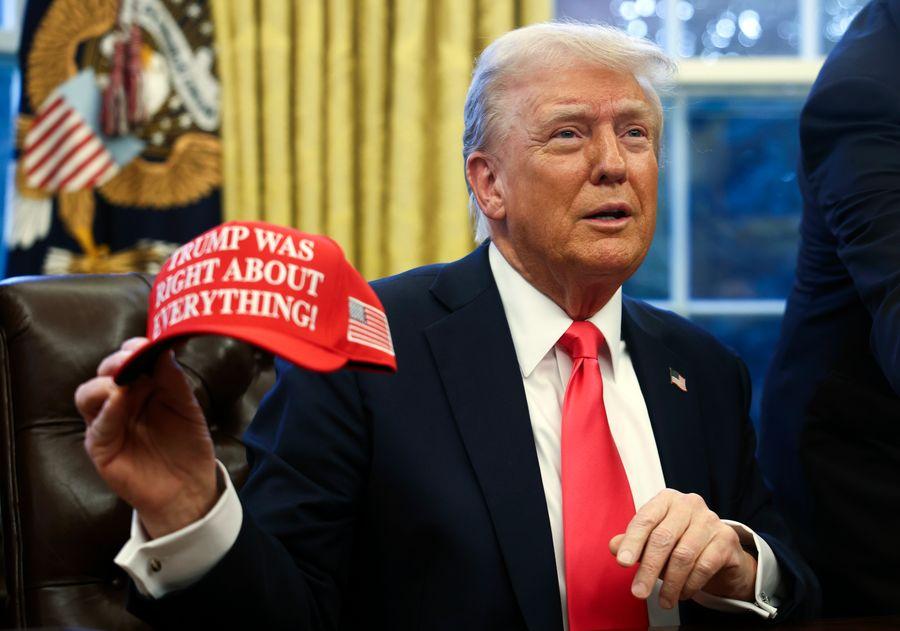
Trump
Trump's Penchant for Puffery Tests Israel's Trust
COMMENTARY
Published Feb. 28, 2025 • Read time: 4m
Weeks after vowing to “unleash hell” on Hamas, President Donald Trump’s threats appear to have worked, with Hamas continuing to release hostages. Yet, the Gaza ceasefire is crumbling as Hamas’ continuing attacks, humiliation of released captives, and revelations about the horrific murders of Kfir, Ariel, and Shiri Bibas have led Israel to delay releasing Palestinian terrorists. Meanwhile, the Trump administration is taking credit for the ceasefire’s progress and pushing for it to enter its second phase, as Arab leaders gather in Riyadh to discuss Trump’s controversial “Gaza-Lago” plan.
Although some might see these events as proof that Trump’s bullying, “art of the deal”-style approach to diplomacy gets results, they’re focusing on the wrong place.
To understand the consequences of Trump’s current foreign policy approach, don’t look at Hamas’ capitulation to Trump – look at Trump’s ongoing capitulation to Putin.
Trump’s approach to policy, both foreign and domestic, isn’t about strategy, alliances, or even ideology; it’s about ego. Trump is a highly transactional leader, and political favors are the coin of his realm. This is why so many of his cabinet picks are loyalists who lack relevant experience, but nonetheless gained Trump’s favor by publicly bending the knee (e.g., Tulsi Gabbard and RFK Jr.) or championing his favorite causes (e.g., Pete Hegseth and Matt Gaetz). Evidently, Trump’s leadership style prioritizes personal loyalty over strategy or efficacy.
Now the same man who threatened Gaza has signaled deference to Putin and essentially abandoned Ukraine, the latest example of Trump alienating long-term U.S. allies for no apparent strategic reason, including enraging Canada by suggesting they become the 51st state and worrying both the EU and UK with tariffs.
The FBI Gained Access; We'd Already Lost Our Privacy
Is Trump Right About NATO?
Arizona's Voting Rights Fire Bell
U.S. Officials Say 2 Americans Died in Brussels Attack
The Middle East is watching, and its key players are taking notes.
Trump has made it clear that historical alliances, human rights violations, and even strategic advantage don’t matter to him – all that counts is whether Trump likes you at the moment. This has certainly defined Trump’s relationship with Vladimir Putin. Trump has repeatedly praised Putin, even as Putin’s government invaded Ukraine, committed war crimes, and actively undermined American interests. Trump now says he wants to invite Russia back into the G7, has openly parroted Kremlin talking points blaming Ukraine for the war, and has even publicly suggested the U.S. should recognize Russia’s claim over Crimea, defying decades of U.S. foreign policy. Trump’s admiration for Putin and capitulation over Ukraine sends a message to the world: America’s alliances aren’t built on strategy or principle, but on making the president feel special.
Such an approach guarantees diplomatic instability, not strength. For example, while Trump might currently seem a better ally to Israel than Biden, Trump’s support – and thus the U.S.’ – is unreliable. Netanyahu knows this from personal experience. Trump already shifted his views on Netanyahu when the latter acknowledged Biden’s victory in 2020. Such mercurial leadership threatens America’s standing with Israel in particular as it signals to the entire Middle East that with the proper manipulation, Trump will betray Israel as easily as he did Ukraine.
Hamas and their Iranian handlers might be unwilling to play that game, but savvier actors like the Saudis and Qatar absolutely will. Qatar has already leveraged its influence in U.S. higher education and its broader social discourse, using investments, bribery, and sheer disinformation to ensure that many institutions ignore its rampant human rights abuses.
Meanwhile, the Saudis have no problem using oil production to influence U.S. politics, as during the 2022 midterms. They have even directly influenced Trump, who boasted that he “saved [the] a--” of Prince Mohammed bin Salman after the Saudi state-sponsored murder of Jamal Khashoggi. Now with Saudi Arabia increasing its U.S. investments, including in businesses tied to Trump’s allies, it’s clear they’re already working to ensure their place in his good graces.
Plenty of leaders in the Middle East and beyond will know how to work Trump’s ego, and while the likely result won’t be Trump outright abandoning Israel, it will be something almost as dangerous: the U.S./Israel alliance returning to the nebulous, lukewarm, speaking-out-of-both-sides-of-our-mouth relationship that it suffered under President Biden. To countries like Qatar and Saudi Arabia, that will be victory enough.
Israel will hate that. America’s allies all around the world will hate that. But Hamas, Iran, and many other authoritarian regimes will love it, and America’s standing as leader of the Free World will be in that much more peril. If the U.S. wants to maintain credibility, our allies and our enemies – especially in the Middle East – need to know our foreign policy is dictated by strategy, not the whims of our leaders. Right now, Trump is signaling the opposite. The world is taking notes.
Democrats Won the Midterms. Common Sense Won, Too
Jordanne Kemper • RealClearPolitics
The 120th Congress Shapes Up
Carolina Lumetta • RealClearPolitics
Flooding GOP Primaries With Democrats
Robert Natelson • RealClearPolitics
Washington Keeps Rewarding Oracle—Veterans Keep Paying the Price
Darin Gaub • RealClearPolitics
The Seeds of Unrestricted Warfare
John Teichert • RealClearPolitics
The Primary System Is Losing the Next Generation
Sean Trende • RealClearPolitics
RCP Today
Top stories on RealClearPolitics
The Takeaway
Polling intelligence and analysis delivered to your inbox
World News
Featuring the latest world news
Policy
Featuring the latest policy news
Support Our Mission
As part of RealClearPolitics, authors aim to provide balanced, non-partisan analysis by presenting top reporting and commentary from all sides of the political spectrum.
Trusted by policymakers and citizens alike since 2000