
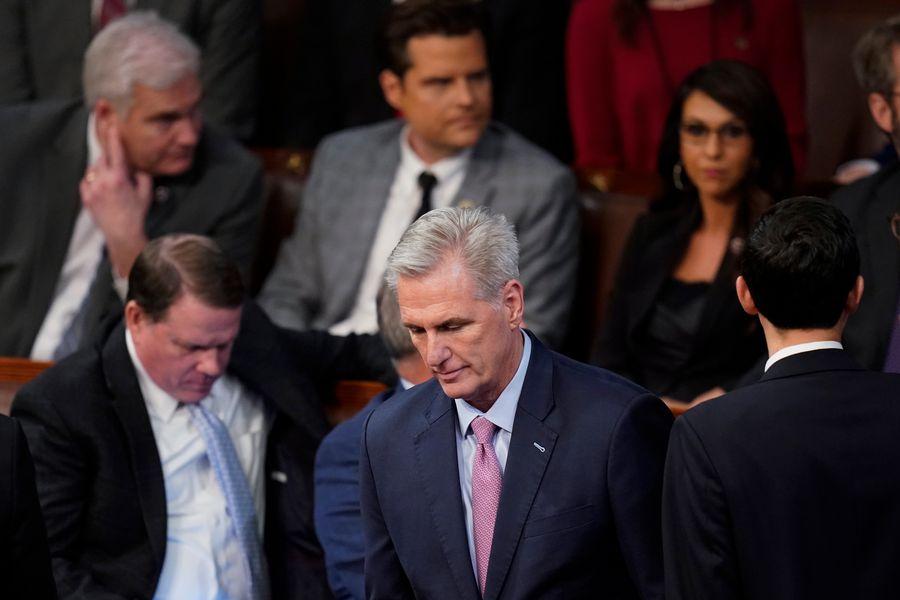
APTOPIX Congress
The Brain Trust Behind the McCarthy Mutiny
Published Jan. 12, 2023 • Read time: 7m
“I don’t know if you are clairvoyant,” Rep. Thomas Massie told Tucker Carlson last Friday night, just hours before the 15th and finally successful vote that made Kevin McCarthy speaker of the House, “or you just made the future happen.”
The future Massie believed the Fox News host spoke into existence: a special House Judiciary Committee subcommittee with a mandate to investigate any federal agency that collects information about Americans, but specifically what Carlson and many others see as domestic political meddling by the FBI.
McCarthy needed to win over conservative holdouts to become speaker. Carlson had floated the idea as an incentive. Three days later, before the final House vote, the GOP leader acquiesced.
“This was part of the package that McCarthy presented in order to secure his speakership,” Massie, the most outspoken libertarian in the House, told RealClearPolitics. But the special committee, which Republicans describe as a modern version of the famous 1970s-era “Church Committee” that uncovered decades of abuse by intelligence agencies, was more than a last-minute creation.
Just hours after the FBI raid on Mar-a-Lago in August, the idea for the commission was first floated by Russ Vought, President Trump’s OMB director and current leader of the ultra-conservative Center for Renewing America, which served as a nerve center for the foot soldiers of the McCarthy mutiny.
Most established conservative entities, such as the Heritage Foundation, kept their distance as the leadership fight played out. Others, like the conservative editorial board of the Wall Street Journal, were openly hostile. Even Trump lined up against the holdouts, endorsing McCarthy and urging squabbling Republicans, “DO NOT TURN A GREAT TRIUMPH INTO A GIANT & EMBARRASSING DEFEAT.”
The FBI Gained Access; We'd Already Lost Our Privacy
Is Trump Right About NATO?
Arizona's Voting Rights Fire Bell
U.S. Officials Say 2 Americans Died in Brussels Attack
Vought's group was one of the few who welcomed the GOP civil war in miniature on the House floor.
The Center for Renewing America joined an expanding constellation of conservative splinter groups in 2021 after the end of the Trump administration. Alumni of the Trump White House and veterans of the Tea Party movement, they became early apostles of rebellion.
In an interview, Texas Rep. Chip Roy, who often served as the face of the opposition, called Renewing America “critically important” to the overall effort, praising “the intellectual heft that comes along with Russ’ thinking and his experience as OMB director.”
Success was far from guaranteed, and the whole enterprise risked alienating their putative hero. Donald Trump had endorsed McCarthy for speaker and appeared to be grow increasingly impatient with the obstruction. “He didn’t understand necessarily the extent to which McCarthy represented the cartel,” a source familiar with the calculus behind the rebellion said, insisting the gamble was worth the chance to push the party further to the right. But a source familiar with the president’s thinking told RCP that, in the end, “he's excited about the agreement that was reached.”
The rebels, paradoxically, had been emboldened by their own failures. When the predicted Republican “red wave” didn’t arrive on Election Day 2022 – partly because so many Trumpy candidates underperformed – Vought was one of the first to publicly identify the election returns as an opportunity for his side. A smaller Republican majority made McCarthy more, not less, beholden to demands of those on his right flank. A determined voting bloc could extract concessions in exchange for their votes or scuttle his bid for speaker altogether. Less than 24 hours after the midterms, Vought tweeted that the House Freedom Caucus, a loose coalition of hardline conservatives, “was made for this moment.”
Republicans have 222 seats in the House. McCarthy could only lose four and still become speaker. If a handful held out, Vought wrote as midterm results were still being tabulated, they could force the Republican leader’s hand and “insist on a paradigm shift.”
A run-and-gun playbook was published online two days later. “House conservatives will not need a majority to prevail. They merely need to block & veto until they get an acceptable candidate,” he wrote in a lengthy Twitter thread, arguing that McCarthy amounted to “a peace-time leader” unfit for the current moment when the right was “in a cold civil war” and what was needed was to seize conflict “by the throat.”
"The fundamentals present a cartel-busting vote, and all you need is a few members to go public,” Vought concluded. He tagged Reps. Matt Gaetz of Florida, Bob Good of Virginia, and Chip Roy of Texas as members who would be willing go for the jugular. He was right.
A senior congressional staffer involved in the struggle called Vought’s group “the earliest and most public advocate of a determined negotiating position against McCarthy” and credited them for making “an early investment that paid off in a transformative set of rules.”
"My job through this whole process was asking ‘what do we do to transform this place to fight for the American people in the best way,’” Roy told RCP. “And all of that distilled for me boils down to one simple concept: Stop spending money we don't have to fund the very bureaucrats who are tyrannically undermining our freedom or civil liberties.”
Rebukes and threats came before any concessions. Rep. Tony Gonzalez of Texas and other McCarthy allies started referring to the House Freedom Caucus as “the insurgency caucus,” even though roughly half of that group never broke ranks with GOP leadership. President Biden called the fight on the House floor “embarrassing.” The Wall Street Journal wondered in an editorial “Who is crazy enough to be a Republican speaker?”
Outside pressure didn’t dislodge the holdouts. “It was our third rodeo,” a source familiar with the mutiny told RCP, referring to previous uprisings against Republican Speakers John Boehner and Paul Ryan. This time though, it wouldn’t be ad-hoc. There wouldn’t be a lone member of Congress frantically whipping votes against leadership with an iPad the way former Rep. Tim Huelskamp fruitlessly had in 2013. The mutiny would be organized (much of it televised, too, via C-SPAN) with plans laid down weeks and months in advance. “We’d done this before, right,” the source said. “We understood exactly how leadership would play it.”
They knew leadership would mobilize GOP donors, so holdouts prepared for angry calls. They expected the argument that there was no alternative candidate, so detractors prepared a roster of names to nominate for speaker rather than just voting “present.” They anticipated attacks that their revolt didn’t have merit, so members presented McCarthy a list of proposals.
According to a source familiar, the goal in the end was “a coalition-style government where the junior partner is treated with respect and deference because they represent the vast majority of your voters.” And it worked: McCarthy became speaker on the 15th ballot – after making almost as many compromises.
The mutineers secured concessions on top-line budget figures, seats on powerful committees, and guarantees that the House would vote on constitutional amendments to impose term limits. The motion-to-vacate, which allows the speaker to be challenged at any moment, was restored. The special subcommittee that Massie celebrated on Fox News was created.
"I am grateful that Speaker-designate McCarthy has been so receptive to each and every change that we have demanded,” Gaetz told Fox News’ Sean Hannity, before admitting “we're at the stage right now where I'm running out of stuff to ask for.”
A source familiar with those negotiations marveled after the fact that “we haven’t seen a power sharing agreement like this since Sam Rayburn.” Now all Republicans have to do is keep the peace amongst themselves long enough to govern.

The Danger Before the Attack
Leslie J. Sullivan • RealClearPolitics
Jon Finer’s Old and Dangerous ‘New Approach’ to Israel
Peter Berkowitz • RealClearPolitics
The President Deserves Better
John Ullyot • RealClearPolitics
Congress Doesn’t Need Another Blame Game. It Needs To Find What’s Broken
Jarrod Bernstein • RealClearPolitics
Democrats Won the Midterms. Common Sense Won, Too
Jordanne Kemper • RealClearPolitics
The 120th Congress Shapes Up
Carolina Lumetta • RealClearPolitics
RCP Today
Top stories on RealClearPolitics
The Takeaway
Polling intelligence and analysis delivered to your inbox
World News
Featuring the latest world news
Policy
Featuring the latest policy news
Support Our Mission
As part of RealClearPolitics, authors aim to provide balanced, non-partisan analysis by presenting top reporting and commentary from all sides of the political spectrum.
Trusted by policymakers and citizens alike since 2000