
Georgia-Senate-Conservative Group
Parties See Election Law Through Different Lenses
COMMENTARY
Published May 2, 2022 • Read time: 5m
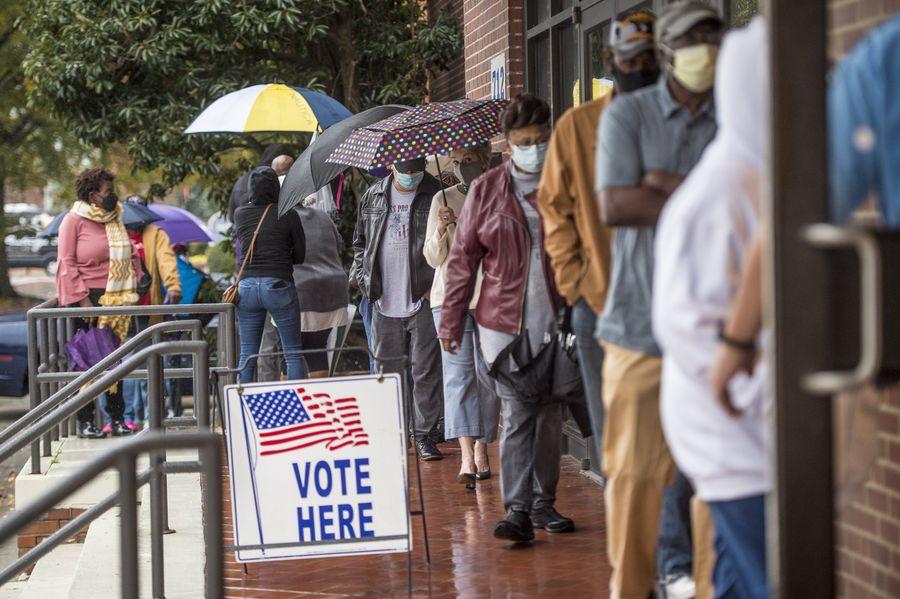
Democrats and Republicans today find each other on opposing sides of many electoral reform issues. Democrats love mail ballot elections, ballot harvesting, and long deadlines for returned ballots; Republicans are generally hostile. Republicans support stricter voter identification requirements, restrictions on private funding of election administration, and (as in a recent Arizona law) requirements that potential voters prove U.S. citizenship before registering to vote; Democrats usually recoil at such devices. What explains the seemingly dichotomous views?
The first thing that should be noted is that initial appearances are somewhat deceiving. The parties do indeed exhibit these tendencies, but they are only tendencies, not hard and fast rules. Utah, one of the most Republican states in the Union, uses mail ballot elections, while Joe Biden’s home state of Delaware has long had relatively strict election rules. Some of the controversial bills adopted by Republican legislatures in the last year actually contained elements of both approaches; Georgia, for example, toughened rules surrounding mail ballots but expanded in-person early voting.
Nevertheless, the tendencies are real enough. Cynics assume the differences can be explained mainly (or perhaps entirely) by the parties’ perceived electoral interests. Democrats believe they are the “party of the people,” and that therefore the more people who vote, the better their chances. The corollary in this interpretation is that Republicans are simply engaged in voter suppression, particularly suppression of poor minority voters who are likely to vote Democratic. Republicans, for their part, assume that Democrats want to dismantle ballot security measures because they want and intend to cheat. From their perspective, they may be acting out of self-interest, but it is a virtuous self-interest: They do not want to be defrauded out of elections they legitimately win.
The FBI Gained Access; We'd Already Lost Our Privacy
Is Trump Right About NATO?
Arizona's Voting Rights Fire Bell
U.S. Officials Say 2 Americans Died in Brussels Attack
There is undoubtedly a secondary political motivation lurking on each side: maintaining the internal cohesion of each party’s coalition. In that sense, making the argument is more important than the technical effect of any election legislation on voting. Republican officeholders everywhere are contending with a party base that has largely internalized Donald Trump’s outsized claim that the 2020 election was “stolen.” Those Republican primary voters want something done about ballot security. Republican elected officials can ignore that demand only at their own peril. Democrats, on the other hand, see only political downside in acknowledging that there were any irregularities at all in 2020 that require correction. Moreover, they are increasingly nervous about their hold on minority voters. If they have a choice between meeting Republicans in the middle on voting concerns and escalating their racial demagoguery about “Jim Crow 2.0,” they know where their political bread is buttered.
It is a mistake, however, to see in this picture nothing more enduring than momentary perceptions of political advantage or need. Underlying the partisan divide on voting reforms lies a two-part philosophical divide which informs the parties.
One underlying philosophical division is that Democrats tend to be outcome-oriented and Republicans process-oriented or rules-oriented. To put it another way, Democrats want to enhance the number of voters, and are not particular about how it is done. Republicans instinctively say that how it is done is one of the most important questions. To Democrats, the Republican orientation is a barrier to progress; some on the left are so thoroughly enmeshed in an outcome orientation that they cannot fathom that Republicans are actually serious in their protestations about process. Republicans, for their part, think that the rule of law cannot survive if outcomes replace process as the measure of things. One can certainly think of counterexamples where Democrats raise procedural concerns or Republicans behaved, shall we say, situationally. Nevertheless, if there are rules governing voting eligibility – and there are – it is completely within the general philosophical character of the parties for Republicans to insist on strict enforcement of those rules and for Democrats to relegate that to a secondary, tertiary, or even non-existent concern.
The second underlying philosophical disposition that manifests itself in partisan divisions over voting reforms is this: Democrats see voting almost entirely as a right, while Republicans tend to see it as both a right and a responsibility. This helps to explain why Democrats have such an intense aversion to any measure, such as voter ID or restrictions on ballot harvesting, that may interfere with the ability of people to vote. It also helps to explain why Republicans are not troubled by the possibility that some small proportion of voters may be prevented from voting due to such measures. If voting is a responsibility, it is not unreasonable to ask voters to obtain a valid ID or to return their own ballot, especially if those requirements are deemed necessary to maintain confidence in the integrity of the election. In fact, for both parties, the second predisposition is intertwined with the first. That Democrats see voting as a pure right makes any rule-based concerns seem all the more petty to them. That Republicans see strict enforcement of voting rules as essential to valid elections makes them even more likely to emphasize voters’ responsibilities.
We can expect division over voting laws to continue even after some of the specific controversies or political interests of the moment have subsided. The dispositions underlying the divisions run deep. And while one might ultimately be able to find at least theoretical agreement that we should all want both good outcomes and sound process, the second axis may be a zero-sum proposition. Either serious responsibilities are reasonably connected to the right to vote, or they aren’t.

Democrats Won the Midterms. Common Sense Won, Too
Jordanne Kemper • RealClearPolitics
The 120th Congress Shapes Up
Carolina Lumetta • RealClearPolitics
Flooding GOP Primaries With Democrats
Robert Natelson • RealClearPolitics
Washington Keeps Rewarding Oracle—Veterans Keep Paying the Price
Darin Gaub • RealClearPolitics
The Seeds of Unrestricted Warfare
John Teichert • RealClearPolitics
The Primary System Is Losing the Next Generation
Sean Trende • RealClearPolitics
RCP Today
Top stories on RealClearPolitics
The Takeaway
Polling intelligence and analysis delivered to your inbox
World News
Featuring the latest world news
Policy
Featuring the latest policy news
Support Our Mission
As part of RealClearPolitics, authors aim to provide balanced, non-partisan analysis by presenting top reporting and commentary from all sides of the political spectrum.
Trusted by policymakers and citizens alike since 2000