
Obama Urged to Create Broad Plan on Veterans Issues
Published May 17, 2013 • Read time: 5m
A former infantry platoon leader in Iraq who now heads a veterans group said Friday that while positive steps have been taken to reintegrate America’s veterans into the workforce, there’s still a “long way to go.”
Paul Rieckhoff, the CEO of Iraq and Afghanistan Veterans of America -- the largest nonpartisan organization serving the newest generation of veterans -- offered his observations during a forum hosted by RealClearPolitics at the Newseum in Washington.
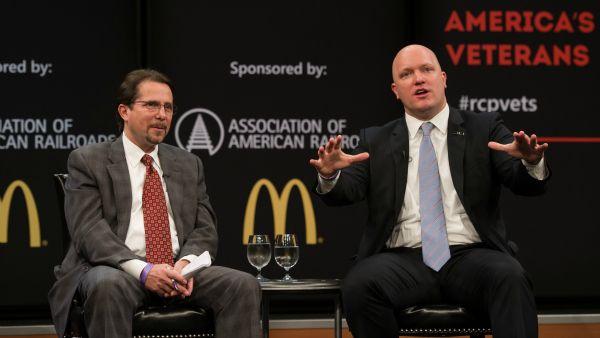
Rieckhoff (pictured, right, with RCP's Carl Cannon) said that after returning from Iraq in 2004, he found a fragmented veterans community too often disconnected from the government that was supposed to care for them. Some members of his unit struggled to make the transition to civilian life, grappling with emotional and physical wounds of war while searching for a job to start a new career.
As confusing as the transition was for those veterans, Rieckhoff discovered that many Americans were equally confused about how to relate to their returning heroes, apparently a product of the fact that only a tiny percentage of Americans have borne the burden of the country’s wars. Many people wanted to help, but few knew how.
Nine years later, Rieckhoff told RCP Washington Editor Carl Cannon that veterans are still struggling with issues of “translation” and preparation: Civilian employers often do not understand military terminology and culture, what the former service members actually did in their jobs, and how those skills translate to the workplace. Compounding the problem is that veterans are not prepared for the transition; serving in the military entails frequent training, but almost none dedicated to eventually pursuing work in a competitive job market.
The FBI Gained Access; We'd Already Lost Our Privacy
Is Trump Right About NATO?
Arizona's Voting Rights Fire Bell
U.S. Officials Say 2 Americans Died in Brussels Attack
Rieckhoff praised efforts by Michelle Obama and Jill Biden to boost the hiring of veterans through their Joining Forces initiative. He also applauded recent steps taken by the Veterans Affairs and Defense departments, including their work to improve the Transition Assistance Program.
While these efforts and numerous corporate and non-profit initiatives have helped reduce the veteran unemployment rate, Rieckhoff pointed to the task remaining in educating employers about veterans as more come home from Afghanistan. For example, he said, many businesses harbor fears of the “damaged veteran” who suffers from post-traumatic stress, someone who they worry could turn violent. Rieckhoff called that notion little more than an inaccurate stereotype that must be debunked through vigorous advocacy.
Beyond the employment picture, the veterans advocate commented on a number of pressing issues for current and former service members.
His organization’s top legislative priority is addressing the so-called “VA Backlog” -- more than 600,000 VA disability claims that have been waiting longer than 125 days for processing. The backlog is the one scandal not getting enough attention from President Obama, Rieckhoff said. He called on the commander in chief to step forward publicly on the issue, establish a presidential commission, and propose a plan to reduce the backlog. He emphasized that such a plan must be comprehensive, unlike the intermittent steps taken by the VA that are merely “meddling around the edges.”
Rieckhoff also called on the White House to bring national energy to bear on the issue of military suicide, which is occurring at an unprecedented rate. He faulted the stigma attached to seeking psychiatric and medical help along with the patchwork of mental health services available to veterans, including inadequate screening for traumatic brain injury and post-traumatic stress.
Rieckhoff reiterated his organization’s support for legislation (introduced Thursday by Democratic Sen. Kirsten Gillibrand) addressing sexual assault. He called the problem “pervasive and damaging,” adding that “when you don’t feel safe in uniform, you can’t defend your country.”
The RealClearPolitics event, dubbed “Employing America’s Veterans” and sponsored by the Association of American Railroads and McDonald’s, also featured a panel discussion with four experts on the topic.
Lisa Rosser, CEO of The Value of a Veteran (an organization dedicated to the recruitment and retention of former service members), discussed her experiences convincing businesses of the “value proposition” of hiring veterans. One common issue is the clash of military and civilian terminology. Rosser used the example of a business examining what level of productivity they could expect from a “50 percent disabled” veteran. It’s this linguistic divide that so often frustrates even the most well-meaning of hiring managers.
Difficulty re-entering the civilian workforce could lead to a serious recruitment and retention issue for the military itself, warned Kevin Schmiegel, executive director of the U.S. Chamber of Commerce’s Hiring Our Heroes initiative. As a new generation evaluates a career in military service, Schmiegel fears diminished opportunities in the private sector could be a deterrent to enlistment. A 20-year Marine veteran himself, Schmiegel said this issue would give him pause in advising his own son to join the Marine Corps.
Curtis Coy, who heads the Office of Economic Opportunity at the Department of Veterans Affairs, said the private sector needs to rethink the way it evaluates veteran job prospects. Coy contrasted the military’s “hire-train” model with the private sector’s “train-hire.” While the military takes in fresh recruits and then subjects them to rigorous training for their role in the service, businesses frequently expect most or all training for a position to have occurred before hiring a candidate. Such a model leads businesses to ignore the applicable skills possessed by veterans that may require a small amount of training in order to maximize them.
A common struggle for veterans is the interview process. Major Brian Bilski, who leads the Marine Corps Wounded Warrior Regiment, offered this advice to veteran job seekers: emphasize leadership, character, and discipline. For service members accustomed to a team mentality, Bilski said they must learn to tout their individual accomplishments.
And if there’s anything unnatural for veterans of the U.S. military, it’s taking credit for accomplishments they invariably attribute to the men and women with whom they served.

Jon Finer’s Old and Dangerous ‘New Approach’ to Israel
Peter Berkowitz • RealClearPolitics
The President Deserves Better
John Ullyot • RealClearPolitics
Congress Doesn’t Need Another Blame Game. It Needs To Find What’s Broken
Jarrod Bernstein • RealClearPolitics
Democrats Won the Midterms. Common Sense Won, Too
Jordanne Kemper • RealClearPolitics
The 120th Congress Shapes Up
Carolina Lumetta • RealClearPolitics
Flooding GOP Primaries With Democrats
Robert Natelson • RealClearPolitics
RCP Today
Top stories on RealClearPolitics
The Takeaway
Polling intelligence and analysis delivered to your inbox
World News
Featuring the latest world news
Policy
Featuring the latest policy news
Support Our Mission
As part of RealClearPolitics, authors aim to provide balanced, non-partisan analysis by presenting top reporting and commentary from all sides of the political spectrum.
Trusted by policymakers and citizens alike since 2000