
Election 2024 Utah Senate Romney
Mitt Romney and the Demise of Regular Order
COMMENTARY
Published Sept. 18, 2023 • Read time: 5m
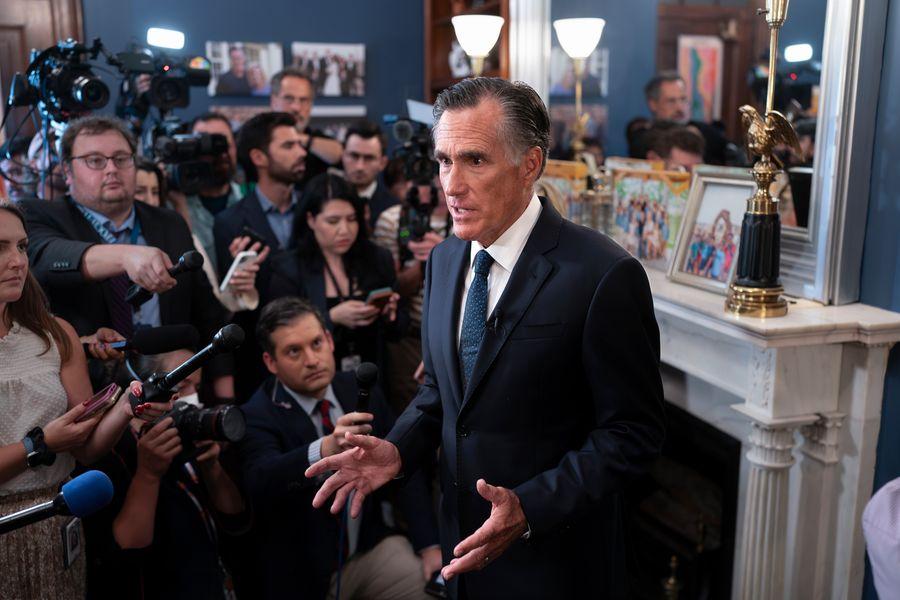
Sen. Mitt Romney announced last week that he would not run for reelection in 2024. Excerpts from a forthcoming biography of Romney, also made public last week in the Atlantic Monthly, tell us why this is a loss for citizens who hold out hope for regular order in Congress.
Regular order is the idea that legislators adhere to established procedures for hearings and debate in order to shape consensus. Behind the idea is another, bigger idea: Partisanship should not supersede civility and respect for democratic processes.
Sen. Romney has earned a reputation for living these ideals. His biography, “Romney: A Reckoning,” by journalist McKay Coppins, benefits from hours of interviews with the senator and access to his journals. These show a man worn down by colleagues who refuse to put the institution ahead of their own narrow interests.
“A very large portion of my party,” Romney told Coppins, “really doesn’t believe in the Constitution.”
Before going much further in this paean to Romney it is worth saying that he was not at the top of my list of preferred presidential candidates when he ran for the White House in 2012. I often am disappointed by his votes as a senator. One does not know whether to admire Romney’s much too long to-do list for legislation when he entered the Senate in 2018 or to wince at his hubris. But the issue here is the dignity with which Romney has gone about his job.
Contrary to a strong sentiment in American politics today, it is possible to admire leaders with whom you disagree.
The FBI Gained Access; We'd Already Lost Our Privacy
Is Trump Right About NATO?
Arizona's Voting Rights Fire Bell
U.S. Officials Say 2 Americans Died in Brussels Attack
Following the House impeachment of President Donald Trump in 2019, Romney agonized over how to vote in the Senate trial. Majority Leader Mitch McConnell lobbied him to vote to end the trial quickly, thus saving Republican senators from having to make a series of votes that might jeopardize their reelection. The Republicans, McConnell warned Romney, could become the minority party in the Senate. Paul Ryan, the former House speaker who is often seen as a statesman, tried a different partisan argument. He told Romney that he would be a pariah in the Senate and unable to get anything done. After poring over the evidence, as well as historical and contemporary studies of impeachment, Romney heeded the admonition that senators were obliged to put partisanship aside. He cast the lone Republican vote for conviction.
It is easy to rationalize getting along. Why should I lose my seat over my support of Trump? If I am out, someone worse will be in. But routinized collective capitulation leads a political institution into a downward spiral where nothing counts and no truth matters.
Think of House Speaker Kevin McCarthy blaming Trump for the Jan. 6 riots. Then a few days later, without even a vague explanation, he traipsed to Trump’s Mar-a-Lago Xanadu to tug at his forelock.
Or try this one for naked cynicism. It involves one of the Senate Republicans’ weekly caucus lunches, which Trump attended in 2019. As Romney described it in his journal, the senators gave the president a standing ovation, listened to his disjointed political comments, and as soon as Trump departed laughed uproariously at his expense.
Many reasons are advanced for how we came to this unsavory crook in the road of democracy. Presidential primaries, for instance, are designed to give extremists a greater say in picking a nominee. Congressional districts are drawn to make sure that legislators win with large majorities that insulate them from having to seek compromise.
The press deserves blame, too, for giving so much ink and airtime to legislators like Democrat Alexandria Ocasio-Cortez and Republican Matt Gaetz. The former’s reductionist views of economics – capitalism is “the absolute pursuit of profit at all human, environmental, and social cost” – are not representative of the majority of her party. She is a big help to Republicans, who use her comments to paint all Democrats as socialists.
Gaetz, the subject of a House ethics committee investigation over possible sexual misconduct and illegal drug use, is a good source of dishing on Speaker McCarthy, but a poor choice for sage advice on problem-solving. It would be useful to give more attention to fellow Republicans who abhor his enthusiasm for bringing down the GOP leader unless he agrees to spending cuts that will put the budget process into a tailspin.
Such reckless thinking led to the decision by Democrats, when they were the majority in the House, to take committee assignments away from Rep. Marjorie Taylor Greene. Her irresponsibly incendiary rhetoric is disgraceful, but taking her off committees deprived her Georgia constituents of full representation in Congress, made her a martyr to them, and alienated them further from democracy.
And, of course, once the process is started, the passion for irregular order picks up momentum. As soon as the Republicans were in the majority, they removed Minnesota congresswoman Ilhan Omar from the Foreign Affairs Committee on account of her anti-Israel comments.
The person who has energized – and legitimized – these tendencies more than any other is President Trump. He could not be further from Romney. His upcoming criminal trials are the culmination of years denigrating American institutions that operated in ways he found inconvenient. The electoral process, which he is charged with attempting to subvert, is the most sacred of all our democratic institutions.
Trump has fueled so much hate and discontent that members of Congress told Romney they feared that their family could be at risk if they angered Trump with a vote or a comment. After the Jan. 6 riots on Capitol Hill, Romney paid $5,000 a day to provide security for his family. A wealthy man, Romney can afford it.
Democracy, however, cannot afford a dysfunctional system that condones violence in place of constructive discourse, something the great majority of Americans want.
One legislator cannot change this system, as Romney learned. Each election cycle brings similar defections by decent, frustrated legislators. It would be a worthwhile democratic experiment to see what would happen if a bipartisan group collectively put regular order at the top of their agenda.

Democrats Won the Midterms. Common Sense Won, Too
Jordanne Kemper • RealClearPolitics
The 120th Congress Shapes Up
Carolina Lumetta • RealClearPolitics
Flooding GOP Primaries With Democrats
Robert Natelson • RealClearPolitics
Washington Keeps Rewarding Oracle—Veterans Keep Paying the Price
Darin Gaub • RealClearPolitics
The Seeds of Unrestricted Warfare
John Teichert • RealClearPolitics
The Primary System Is Losing the Next Generation
Sean Trende • RealClearPolitics
RCP Today
Top stories on RealClearPolitics
The Takeaway
Polling intelligence and analysis delivered to your inbox
World News
Featuring the latest world news
Policy
Featuring the latest policy news
Support Our Mission
As part of RealClearPolitics, authors aim to provide balanced, non-partisan analysis by presenting top reporting and commentary from all sides of the political spectrum.
Trusted by policymakers and citizens alike since 2000