
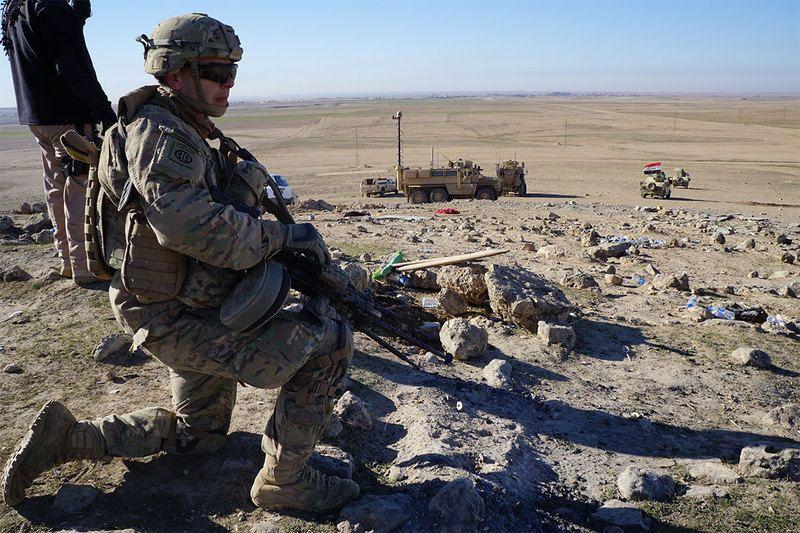
Specialist Matt Schultz, a member of the U.S. Army advise and assist team and members of the 9th Iraqi Army Division watch a tactical unmanned aerial system while commanding and controlling air strikes and tracking the progress of brigades clearing the village of Bakhaira, Iraq, on the first day of the battle to liberate West Mosul, Feb. 19, 2017. Combined Joint Task Force-Operation Inherent Resolve is the global Coalition to defeat ISIS. (U.S. Department of Defense photo by U.S. Marine Corps Capt Timothy Irish)
Measure Would Require New War Authorization from Congress
Published July 1, 2017 • Read time: 4m
WASHINGTON (AP) -- A stunning move this week by a House panel to force a debate on new presidential war powers revealed mounting frustration that Congress has for too long dodged one of its most important responsibilities: to decide whether to send American fighting forces into harm's way.
The measure crafted by Rep. Barbara Lee of California, an anti-war Democrat and the only member of Congress to oppose the post-Sept. 11, 2001, authorization, demands a debate on new war powers to reflect how the dynamics of the battlefield have shifted. For example, American troops are battling an enemy -Islamic State militants - that didn't exist 16 years ago in a country - Syria - that the U.S. didn't expect to be fighting in.
And there are concerns the U.S. is being tugged more deeply into Syria.
President Donald Trump warned Monday that Syria will pay a "heavy price" if it carries out another chemical weapons attack. In April, Trump ordered the firing of dozens of Tomahawk missiles at an air base in central Syria, marking the first time the U.S. has directly struck President Bashar Assad's forces during the country's six-year civil war.
The U.S. military earlier this month shot down a Syrian Air Force fighter jet, and the U.S.-led coalition fighting the Islamic State has hit pro-government forces in Syria with airstrikes.
The Trump administration also is sending close to 4,000 additional American forces to Afghanistan, America's longest war.
Members of the Republican-led House Appropriations Committee voted overwhelmingly Thursday to add Lee's amendment to its version of the 2018 military spending bill. Her measure would repeal the 2001 authorization - it has been broadly interpreted by President Donald Trump and his predecessors to permit military operations beyond those envisioned at the time - 240 days after the spending bill is enacted.
The FBI Gained Access; We'd Already Lost Our Privacy
Is Trump Right About NATO?
Arizona's Voting Rights Fire Bell
U.S. Officials Say 2 Americans Died in Brussels Attack
Lee said the eight months "would allow plenty of time for Congress to finally live up to its constitutional obligation to debate and vote on any new AUMF," using the acronym for authorization for the use of military force. To underscore how the 2001 authority has been stretched beyond its intended limits, she said the authorization has been invoked to deploy troops to eight different countries, including Yemen and Syria.
"Any administration can rely on this blank check to wage war," Lee said.
Lee won the vocal backing of several conservative lawmakers, highlighting the breadth of support for debating new war powers. Rep. Tom Cole, R-Okla., said Congress has avoided its war-making responsibilities for years.
"We've had leadership honestly on both sides that have put off this debate again and again and again," Cole said. "If we're going to send people to war, we owe them the support of the Congress of the United States."
Rep. Chris Stewart, R-Utah, and Lee are about as far apart on the political spectrum as two people could be. But Stewart, a former Air Force B-1B bomber pilot, voted for her amendment. He said U.S. service members are watching Congress.
"They notice that Congress doesn't have the guts to stand up and have this debate," Stewart said.
Yet if history is a guide, the amendment to cut off the 2001 authorization for the use of military force against the terrorist groups who carried out the 9/11 attacks will be scratched from a Pentagon spending bill before the legislation ever reaches the House floor.
Robert Chesney, an expert on national security law and a professor at the University of Texas law school, said there's little incentive for congressional leaders and the Trump White House to open the 2001 authorization to changes. Properly or not, he said, the law has been read expansively to cover all current military operations, whereas a rewrite may put limits and barriers on what the Pentagon can do.
"There's nothing forcing their hand," Chesney said. "The concern is that no one is quite sure what might come out of the revision process."
Rep. Kay Granger of Texas, the chairwoman of the panel's defense subcommittee, opposed the measure and warned her colleagues they were making a serious mistake. She called the amendment a "dealbreaker" that would tie the hands of the U.S. to act on its own or with other countries to attack and defeat terrorist groups.
Granger added that Lee's provision would make a major policy change and doesn't belong in legislation designed to fund the armed forces.
AshLee Strong, a spokeswoman for House Speaker Paul Ryan, said of Lee's amendment: "There is a way to have this debate, but this, which endangers our national security, is not it."
---
© 2017 The Associated Press. All rights reserved. This material may not be published, broadcast, rewritten or redistributed. Learn more about our Privacy Policyand Terms of Use.

Jon Finer’s Old and Dangerous ‘New Approach’ to Israel
Peter Berkowitz • RealClearPolitics
The President Deserves Better
John Ullyot • RealClearPolitics
Congress Doesn’t Need Another Blame Game. It Needs To Find What’s Broken
Jarrod Bernstein • RealClearPolitics
Democrats Won the Midterms. Common Sense Won, Too
Jordanne Kemper • RealClearPolitics
The 120th Congress Shapes Up
Carolina Lumetta • RealClearPolitics
Flooding GOP Primaries With Democrats
Robert Natelson • RealClearPolitics
RCP Today
Top stories on RealClearPolitics
The Takeaway
Polling intelligence and analysis delivered to your inbox
World News
Featuring the latest world news
Policy
Featuring the latest policy news
Support Our Mission
As part of RealClearPolitics, authors aim to provide balanced, non-partisan analysis by presenting top reporting and commentary from all sides of the political spectrum.
Trusted by policymakers and citizens alike since 2000