
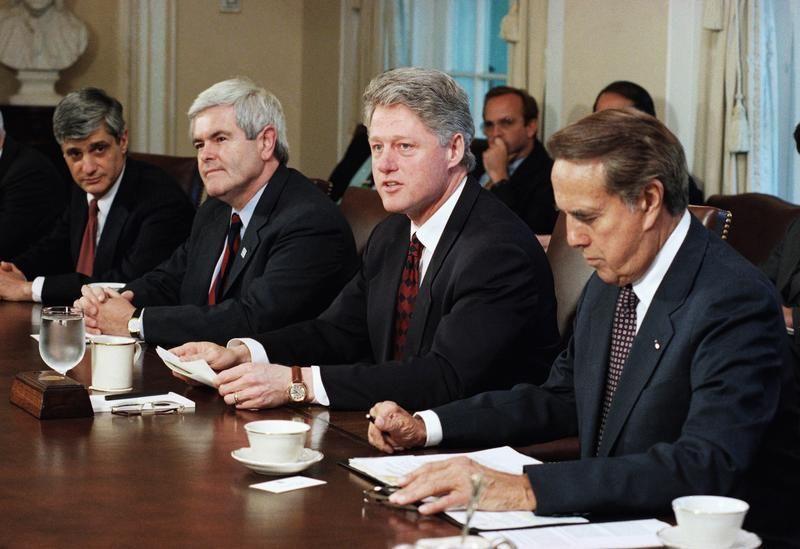
FILE - In this April 26, 1995 file photo, President Bill Clinton meets with congressional leaders in the Cabinet Room of the White House in Washington. From left are, Treasury Secretary Robert Rubin, House Speaker Newt Gingrich of Ga., the president, and Senate Majority Leader Bob Dole of Kansas. Disputes over spending and health care in a divided Washington have triggered shutdowns of the federal government in recent years. Republicans now control the White House and Congress, and if lawmakers and President Donald Trump fail to agree on a spending bill by midnight Friday, a shutdown of an all-GOP government would occur for the first time in modern history. (AP Photo/Marcy Nighswander, File)
Lessons From the Clinton Impeachment Trial
Published Dec. 20, 2019 • Read time: 4m
The U.S. Senate’s impeachment trial of President Clinton in January 1999, in which I sat as a “juror,” ended in a predictable partisan vote of acquittal, as will the impeachment trial of President Trump this January.
However, the Clinton trial was conducted in a way that struck all sides as fair and even increased public respect for Congress. Perhaps there are lessons to be learned from the 1999 Senate that will be helpful to the 2020 Senate, notwithstanding the fact that partisanship is much worse now than it was then.
First, and probably most important, was the fact that the two Senate leaders--Republican Majority Leader Trent Lott and Democratic Minority Leader Tom Daschle--each believed that the impeachment of President Clinton in the House had been troublingly partisan. They resolved to work together to do better in the Senate. Even though they knew that in the end the votes would be divided largely along party lines, they agreed that the process of the trial should not be partisan.
Senators Lott and Daschle worked to come up with rules for the trial that could be unanimously adopted. It wasn’t easy. My Republican colleague and friend Slade Gorton of Washington and I, both former state attorney generals, simultaneously reached out to each other and began to draft a proposal for a trial in which the House managers and the president would each be given ample opportunity to present their case and answer questions and then the Senate would vote whether to begin a full trial. In effect, it would be a vote on a motion to dismiss the articles of impeachment. If that motion passed, as we expected it would, the Senate would proceed to consider a motion to censure President Clinton.
The FBI Gained Access; We'd Already Lost Our Privacy
Is Trump Right About NATO?
Arizona's Voting Rights Fire Bell
U.S. Officials Say 2 Americans Died in Brussels Attack
Senators Lott and Daschle liked the proposal, but the House managers did not because they thought it gave too short consideration to their articles of impeachment. So, as we approached the date in January when the trial was to begin, the Senate had not reached a consensus on rules and procedures. In fact, Chief Justice William Rehnquist convened the trial and recessed it because we had no rules. Someone suggested that the 100 senators hold a special bipartisan closed caucus in the Old Senate Chamber and talk it out as colleagues and friends. That historic place reminded us that we were making history ourselves and each of us had an interest in making it in a way that would help the country then and the Senate in the future. Several senators offered their ideas and at one point, Senators Lott and Daschle said, “It sounds to us like Phil Gramm and Ted Kennedy have just made essentially the same points. If these two of our colleagues can agree, certainly the rest of us should be able to.”
And that is what happened. It is also how a mutually respectful tone was created. Every senator voted for the proposed impeachment trial rules that Senator Lott brought before the Senate that day. It was an encouraging way to begin a difficult time in the Senate.
A longer schedule for presentations by the House managers and the president’s counsel and time for questions and motions was agreed to. Eventually, the Senate also agreed that no live witnesses would be called but there would be taped deposition-–which would be viewed by the senators. The consensus among us was that live witnesses would disrupt the dignity and unity we were aspiring to on the way to a partisan vote that would not be changed by having witnesses come before the Senate and be examined and cross-examined.
There was a separate debate and vote on whether to close the Senate during debate before the votes on the articles of impeachment. The motion to close passed 53-47. The debate in private that followed was one of the most thoughtful and dignified I ever participated in during my 24 years in the Senate. I found myself thinking how constructive it would have been if the American people could have seen it. I know some would say the Senate debate on why senators were voting for or against removing the president from office would not have been as thoughtful if had been done in public, but I would urge the present members of the Senate to keep their
debates open and prove the skeptics wrong by acting in a way that improves the public’s opinion of Congress, and perhaps even creates some bridges between the parties that can help them go on to solve some of our national problems and seize some of the great opportunities ahead of us.

Jon Finer’s Old and Dangerous ‘New Approach’ to Israel
Peter Berkowitz • RealClearPolitics
The President Deserves Better
John Ullyot • RealClearPolitics
Congress Doesn’t Need Another Blame Game. It Needs To Find What’s Broken
Jarrod Bernstein • RealClearPolitics
Democrats Won the Midterms. Common Sense Won, Too
Jordanne Kemper • RealClearPolitics
The 120th Congress Shapes Up
Carolina Lumetta • RealClearPolitics
Flooding GOP Primaries With Democrats
Robert Natelson • RealClearPolitics
RCP Today
Top stories on RealClearPolitics
The Takeaway
Polling intelligence and analysis delivered to your inbox
World News
Featuring the latest world news
Policy
Featuring the latest policy news
Support Our Mission
As part of RealClearPolitics, authors aim to provide balanced, non-partisan analysis by presenting top reporting and commentary from all sides of the political spectrum.
Trusted by policymakers and citizens alike since 2000