
Defense Budget Follies
Published April 15, 2013 • Read time: 4m
It's hard not to despair about the irresponsibility of politicians in Congress, the White House, and the Pentagon (suited and uniformed) watching the FY2014 budget process unfold. The good news is that for the first time in four years, the Senate passed a budget; the bad news is that budget never brings our deficit spending under control, much less develops a plan for reducing our national debt. The president's budget likewise elides the major national security threat to our country, which is our own inability to bring spending into line with revenue. And the Pentagon continues to operate as though their preferred outcome is all that requires planning for, to enormous detriment for our military strength.
The president's budget contains only $174 billion in deficit reduction, and would actually increase our debt ratio to a dangerous 79 percent of GDP. Under the president's proposed budget, federal debt wouldn't return to its current level until 2023, and that is contingent on the timeless budget mirage of spending now and discipline later. Even Steven Rattner, the President's "czar" for the auto industry bail out, concludes that "we will need to make more tough choices - tougher choices than we are inclined to make today -- if we are to avoid burdening future generations with massive unfunded obligations."
There's simply no way that Republicans will vote for a budget that so fundamentally ignores the problem of our national debt. Which means sequestration will effectively be our federal budget until either Republicans lose the house or Democrats lose the Senate.
The FBI Gained Access; We'd Already Lost Our Privacy
Is Trump Right About NATO?
Arizona's Voting Rights Fire Bell
U.S. Officials Say 2 Americans Died in Brussels Attack
The Department of Defense has likewise abrogated budget responsibility, turning in a budget that wholly ignores the reality of sequestration. DoD's $527 billion baseline budget doesn't even contain an excursion considering sequestration's effects, either repairing those from current sequestration or anticipating continued sequestration in FY2014. But it does contain a White House mandated $150 billion reduction across ten years (weighted heavily to the out-years, like all other cuts in spending from the president's budget).
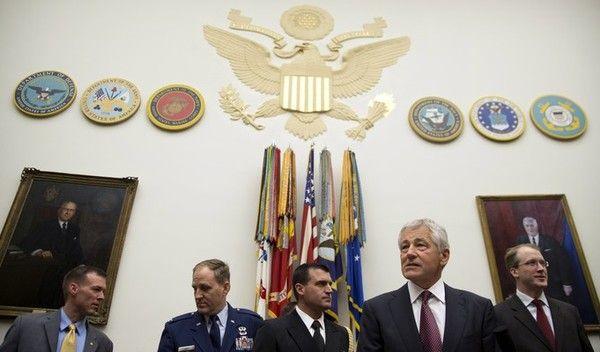
Secretary Hagel is on the spot to defend a budget he didn't develop. His position will be made even more unenviable since the process of revising the strategy will lag by at least several months, and more likely a year. The chairman of the Joint Chiefs of Staff stated repeatedly that the strategy would be unexecutable if further cuts were made, and the budget Hagel submitted contains further cuts. Leading administration figures are insisting the pivot to the pacific continues and cuts have no effect on our ability to defend against North Korean provocation. Congress rightly wants to know what gives.
Hagel testified in contravention to his own budget, affirming to the Congress that sequestration will be taken into account. General Dempsey tried to square the circle, testifying yesterday that any further cuts would be Armageddon, but that the president's budget postpones any cuts for at least five years, so we can currently execute the strategy. Which might be true, if only sequestration hadn't already occurred and remains the likeliest budget outcome for FY2014, as well.
DoD will probably be given latitude to reprogram FY2013 money within the topline; if reports of a massive $41 billion reprogramming request are true, it will mean DoD is effectively operating without a budget. Congress will have allowed DoD to spend as it sees fit, provided it does not breach the sequestration topline. And that may be the best answer we can expect for the coming period of austerity.
But the Pentagon is held in higher esteem than other departments of government because of its reputation for planning responsibly. It has damaged that reputation with its last two budgets. The Pentagon ought to be much more worried than it appears to be about the self-inflicted damage to its credibility for not managing this time of austerity well.
This article originally appeared in Foreign Policy on April 12. It is reprinted with permission from the Hoover Institution.

Jon Finer’s Old and Dangerous ‘New Approach’ to Israel
Peter Berkowitz • RealClearPolitics
The President Deserves Better
John Ullyot • RealClearPolitics
Congress Doesn’t Need Another Blame Game. It Needs To Find What’s Broken
Jarrod Bernstein • RealClearPolitics
Democrats Won the Midterms. Common Sense Won, Too
Jordanne Kemper • RealClearPolitics
The 120th Congress Shapes Up
Carolina Lumetta • RealClearPolitics
Flooding GOP Primaries With Democrats
Robert Natelson • RealClearPolitics
RCP Today
Top stories on RealClearPolitics
The Takeaway
Polling intelligence and analysis delivered to your inbox
World News
Featuring the latest world news
Policy
Featuring the latest policy news
Support Our Mission
As part of RealClearPolitics, authors aim to provide balanced, non-partisan analysis by presenting top reporting and commentary from all sides of the political spectrum.
Trusted by policymakers and citizens alike since 2000