
AP Week in Pictures Photo Gallery
Beyond the Headlines: The Global Struggle for Prisoner Release
Published Feb. 9, 2025 • Read time: 4m
As President Trump was inaugurated on Jan. 20, outgoing Special Presidential Envoy for Hostage Affairs Roger Carstens reportedly flew to Doha with Afghani citizen Khan Mohammed, who had been captured in Nangarhar province and convicted in 2008. His mission – to exchange the prisoner for two Americans held by the Taliban – was reportedly a success, and Ryan Corbett and William McKenty were returned home.
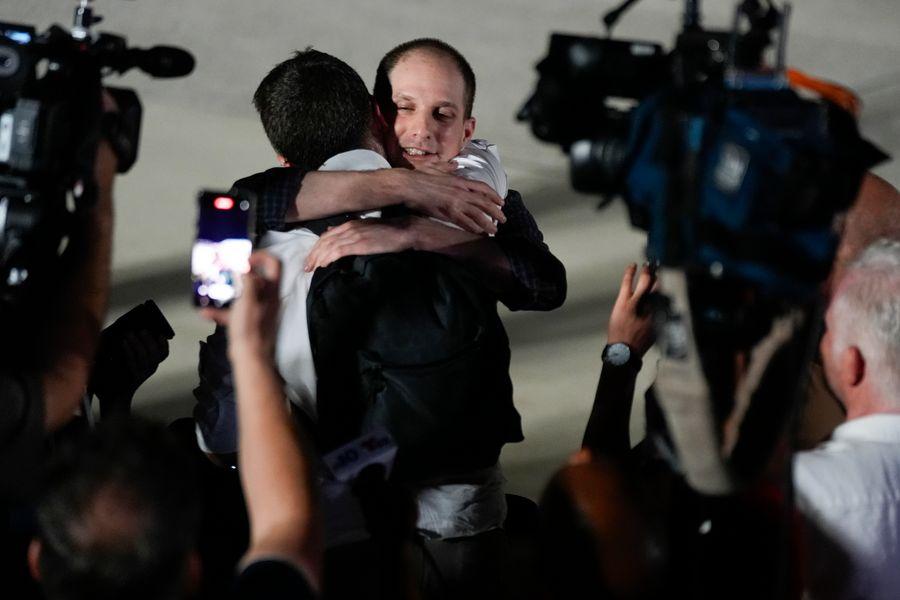
Given the timing, this prisoner swap went relatively unnoticed, unlike the historic exchange completed last August. That exchange involved 24 individuals from seven countries and included the release of prominent prisoners, notably The Wall Street Journal reporter Evan Gershkovich and U.S. Marine Paul Whelan.
Each time I hear that a political prisoner was released, I pause. Efforts to secure the freedom of individuals unjustly detained require intricate coordination and cooperation among parties with often vastly different objectives. Political prisoners and their families wait for months and years, often with hardly a trickle of updates from authorities, their lives upended.
The release of even one political prisoner means more attention for those still detained.
Gershkovich and Whelan were held as hostages – detained by Russia to exert pressure on the United States; Corbett and McKenty were as well. This unique form of interstate antagonism has been recognized as contrary to international law and undermining international relations in the Declaration Against Arbitrary Detention in State-to-State Relations. In the United States, governmental efforts to secure the freedom of our citizens held hostage are longstanding and bipartisan: the Office of the Special Presidential Envoy for Hostage Affairs was established by President Obama, and the immediate past head, Carstens, was appointed by President Trump and served through the Biden administration. The office plays a vital role in working to secure the release of U.S. citizens wrongfully detained abroad and providing support to their families.
The FBI Gained Access; We'd Already Lost Our Privacy
Is Trump Right About NATO?
Arizona's Voting Rights Fire Bell
U.S. Officials Say 2 Americans Died in Brussels Attack
However, most of those released in August, such as Russian dissident Vladimir Kara-Murza, were more typical political prisoners – those detained by their own governments for political opposition, critical reporting, or even satirical blog posts. There are more than a million such prisoners worldwide. Political prisoners held by their own government have few tools to advocate for their release. Few hold U.S. citizenship, so they rely on a combination of legal tools, international diplomacy, and sometimes sheer luck to return home.
Some prisoners have vocal advocates on their side. Political opposition leaders often draw the attention of the public, such as those in Belarus, where opposition leaders expressed discontent with this swap, upset that Belarusian prisoners were excluded. Freedom Now represents Belarusian activist and journalist Igor Losik, who was sentenced in 2021 to 15 years for reporting on anti-government protests. Despite strong calls for his release by the U.S. State Department, the Tom Lantos Human Rights Commission, and others, Losik remains in detention.
In Thailand, Tantawan Tuatulanon faces charges under “lese majeste” and sedition laws for criticizing the head of state and protesting against the monarchy. She has been in and out of pretrial detention and was released to house arrest only after a fellow anti-monarchy activist died in detention.
There are some bright spots. Sisters Lisdani and Lisdiani Rodriguez Isaac were imprisoned in Cuba for peaceful participation in the July 11, 2021, protests. While Lisdani had previously been granted a temporary release to complete her pregnancy, she would have eventually returned to serve the remainder of her eight-year sentence alongside her sister. Last weekend, both were paroled and Lisdiani was released, part of a reported plan for Cuba to release more than 500 prisoners in exchange for the U.S. removal of Cuba’s designation as a State Sponsor of Terrorism; on his second day in office, President Trump reinstated the designation, and the implications for the prisoners remain unclear.
Political prisoners like Igor Losik or Tantawan Tuatulanon may never gain the level of international attention that former hostages like Evan Gershkovich received. But their struggle for freedom is no less vital. We must honor the victories of those released by continuing to advocate for the many who remain imprisoned, demanding their release, and holding governments accountable for abuses. This means seizing every opportunity, whether global events like UN climate conferences and world sporting events or the day-to-day engagement of government officials, to demand the release of political prisoners and an end to arbitrary detention worldwide. Though there is much to fear from a Trump administration when it comes to human rights, under the last Trump administration, nearly 40 U.S. citizens held abroad were released. The U.S. can still play a vital role in seeking an end to unjust detention, and civil society should demand nothing less.
Democrats Won the Midterms. Common Sense Won, Too
Jordanne Kemper • RealClearPolitics
The 120th Congress Shapes Up
Carolina Lumetta • RealClearPolitics
Flooding GOP Primaries With Democrats
Robert Natelson • RealClearPolitics
Washington Keeps Rewarding Oracle—Veterans Keep Paying the Price
Darin Gaub • RealClearPolitics
The Seeds of Unrestricted Warfare
John Teichert • RealClearPolitics
The Primary System Is Losing the Next Generation
Sean Trende • RealClearPolitics
RCP Today
Top stories on RealClearPolitics
The Takeaway
Polling intelligence and analysis delivered to your inbox
World News
Featuring the latest world news
Policy
Featuring the latest policy news
Support Our Mission
As part of RealClearPolitics, authors aim to provide balanced, non-partisan analysis by presenting top reporting and commentary from all sides of the political spectrum.
Trusted by policymakers and citizens alike since 2000