
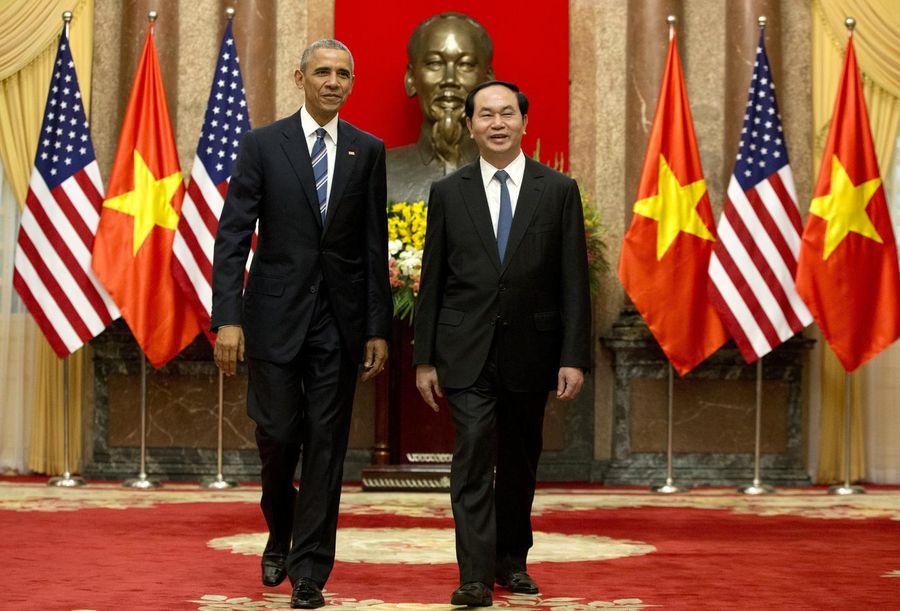
FILE - In this Monday, May 23, 2016 file photo, U.S. President Barack Obama, left, and Vietnamese President Tran Dai Quang walk to a meeting after shaking hands at the Presidential Palace in Hanoi, Vietnam. Improved relations between the U.S. and Vietnam must not lead to greater pressure on China or threats to its interests, an official Chinese newspaper said Tuesday, May 24. (AP Photo/Carolyn Kaster, File)
As Obama Tightens His Pivot to Asia, the Philippines Spring a Leak
Published June 3, 2016 • Read time: 3m
President Obama's visits last week to Vietnam and Japan served as a reminder of the administration's oft-publicized "pivot" to Asia as well as a deepening of ties between the United States and the disparate network of states looking to balance against Chinese aggression in the region.
Although Obama was unable to deliver a ratified Trans Pacific Partnership to Vietnam, other items on the visit’s agenda--in particular, an end to the long-standing arms embargo by the U.S.--helped to further growing relations between the two states. But as Time’s Rishi Iyengar reports, Beijing was displeased by the developing ties:
“The Chinese leadership has long resented the U.S. presence in the South China Sea — a region it considers its sovereign territory despite claims by Taiwan, Malaysia, Brunei, the Philippines and Vietnam — and has accused the Obama Administration of ‘militarizing’ the expansive water body and key international trade route.
That line of thinking was reinforced last week ahead of Obama’s visit, when Xu Bu, China’s ambassador to the Association of Southeast Asian Nations (ASEAN) accused the U.S. of turning the South China Sea into a ‘disturbing regional hot spot’ in an op-ed for Singapore’s Straits Times newspaper.”
American balancing in the South China Sea is a delicate act; long-standing historical and economic tensions among states threatened by Chinese territorial claims often preclude formalized cooperation against the PRC. The U.S. is therefore especially dependent on cultivating individual, bilateral relationships with regional governments.
The FBI Gained Access; We'd Already Lost Our Privacy
Is Trump Right About NATO?
Arizona's Voting Rights Fire Bell
U.S. Officials Say 2 Americans Died in Brussels Attack
Comments made last Tuesday by the Philippines’ flamboyant President-elect Rodrigo Duterte are therefore reason for concern to American lawmakers. Reuters’ Neil Jerome Morales writes,
“Duterte said on Tuesday his country would not rely on long-term security ally the United States, signaling greater independence from Washington in dealing with China and the disputed South China Sea.
The Philippines has traditionally been one of Washington's staunchest supporters in its standoff with Beijing over the South China Sea, a vital trade route where China has built artificial islands, airstrips and other military facilities…
Asked by reporters if he would push for bilateral talks with China, Duterte replied: ‘We have this pact with the West, but I want everybody to know that we will be charting a course of our own.
‘It will not be dependent on America. And it will be a line that is not intended to please anybody but the Filipino interest.’”
Although Duterte has already made a name for himself as an freewheeling, wild talker, a Philippine drift outwards would be a major blow from the network of economic and defense integration that the Obama administration has pursued over the last eight years. It would be a particularly bitter pill to swallow in the Philippines, where President Obama just two years ago signed a ten-year defense pact and two months ago Defense Secretary Ash Carter visited to sign off on the construction of American facilities at five Philippine military bases.
The shift would also symbolize a major reversal in Philippine-American ties, which have for several years been characterized by warm relations between Obama and outgoing President Benigno Aquino. Alongside an unclear future for the TPP in Congress, it may leave the next president overseeing an only half-realized “pivot” to the region.

Jon Finer’s Old and Dangerous ‘New Approach’ to Israel
Peter Berkowitz • RealClearPolitics
The President Deserves Better
John Ullyot • RealClearPolitics
Congress Doesn’t Need Another Blame Game. It Needs To Find What’s Broken
Jarrod Bernstein • RealClearPolitics
Democrats Won the Midterms. Common Sense Won, Too
Jordanne Kemper • RealClearPolitics
The 120th Congress Shapes Up
Carolina Lumetta • RealClearPolitics
Flooding GOP Primaries With Democrats
Robert Natelson • RealClearPolitics
RCP Today
Top stories on RealClearPolitics
The Takeaway
Polling intelligence and analysis delivered to your inbox
World News
Featuring the latest world news
Policy
Featuring the latest policy news
Support Our Mission
As part of RealClearPolitics, authors aim to provide balanced, non-partisan analysis by presenting top reporting and commentary from all sides of the political spectrum.
Trusted by policymakers and citizens alike since 2000