
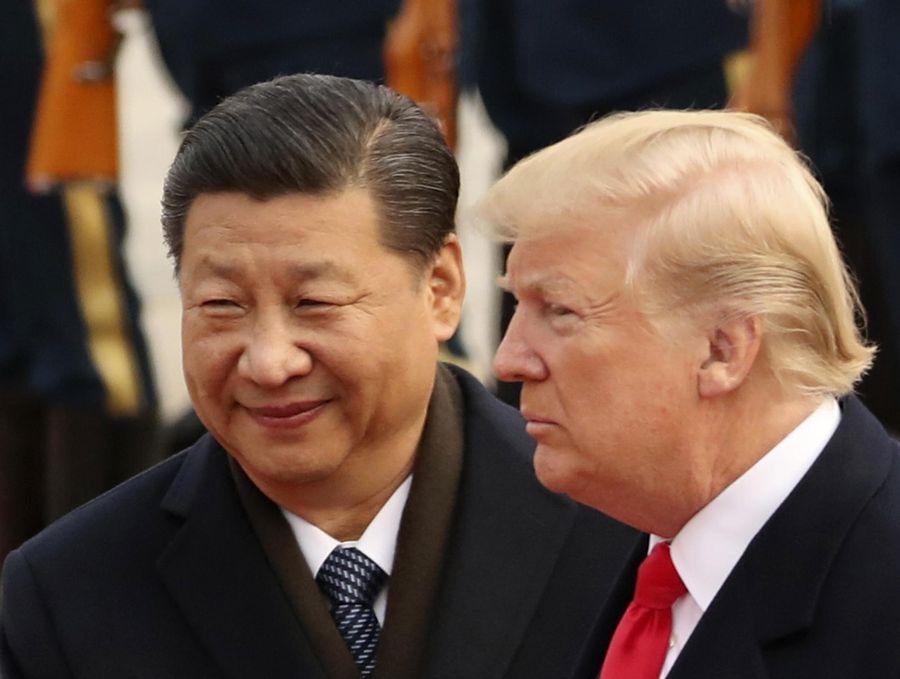
FILE - In this Nov. 9, 2017, file photo, U.S. President Donald Trump and Chinese President Xi Jinping participate in a welcome ceremony at the Great Hall of the People in Beijing, China. This last week, China demanded the United States stop sending ships and military aircraft close to its South China Sea island claims during talks to prepare for a meeting between President Donald Trump and President Xi Jinping later this month. (AP Photo/Andrew Harnik, File)
A Bull in the China Shop
COMMENTARY
Published Feb. 7, 2019 • Read time: 4m
The Department of Energy is going to prohibit its scientists from participating in programs sponsored by foreign countries suspected of trying to steal sensitive technology.
Of course the obvious target of the policy is China; of course the policy is the correct one, and of course it should have been implemented long ago.
President Trump has made countering China the top priority of America's national security establishment, and he has managed the powers of his office so that the organs of American government are, each in their own areas, operationalizing that priority. In my judgment, it's been Trump's greatest foreign policy success, particularly in contrast to his predecessors.
By its second term, the George W. Bush administration should have realized that China was not evolving the way our government had hoped. The failure to acknowledge that and prioritize a response was perhaps understandable, in light of the challenges America was facing at the time in the Iraq War. Leaders always tend to focus on the wolf closest to the sled. But whatever may be said in mitigation of President Bush, the authority was his to exercise, and he must bear the responsibility for the failures on his watch.
As for President Obama, his foreign policy was far better as regards China than any other country or region. His pivot, or "rebalance," to Asia in 2011 was the right strategy at the right time, and it began to turn the ship of the American state in the necessary direction. The rebalance failed to have much effect, however, for two reasons:
The FBI Gained Access; We'd Already Lost Our Privacy
Is Trump Right About NATO?
Arizona's Voting Rights Fire Bell
U.S. Officials Say 2 Americans Died in Brussels Attack
First, Obama and the Congress were decimating American military strength when they should have been rebuilding it. It is impossible to overstate the effect of this on the perceptions of the Chinese (and for that matter the Russians). Authoritarians measure power and purpose primarily in military terms, at least in the first instance. Their takeaway from America's defense cuts was that the United States was weak and in decline -- the worst possible impression to convey.
Second, even apart from the military factor, Obama never brought America's economic power fully to bear. His diplomacy produced some victories, but he was not bold enough in using the economic tools at his command.
Needless to say, boldness is not a problem for Donald Trump. The fact that Trump enjoys being a bull in the China shop has served him well. Trump was willing to do what, in all likelihood, no other president of either party would have done: shake the global trading establishment out of its stupor, apply fully the existing tools of economic power, and get his administration to be innovative in creating other tools. That's an enormous achievement in two years.
To be sure, the ride has been and will continue to be bumpy, but that was inevitable, given that never before has the world faced a huge economy run by a regime that is actively trying to subvert the world trading system. Trump is going where nobody has ever gone before because he is facing a challenge no one ever faced before.
Yet it’s worth repeating that Obama at least saw and articulated the challenge. His country owes a debt to him for that. The groundwork laid by the Obama administration in Asia has made it much easier for Trump to do what he has done. There was and is a basis for bipartisanship in America's China policy.
Unfortunately, President Trump has not been as successful to this point in rebuilding the armed forces. The progress has been much slower there because, while intention is easy to change, capability is not.
When Trump assumed office, America had the ability to compete effectively with China in the economic domain. Trump just needed to energize and organize it, which was difficult but doable. The brutal fact is that the United States doesn't currently have an industrial base capable of producing ships, planes, aircraft, artillery, tanks, missiles, and missile defense -- not all at the same time in the numbers we need.
That too, it must be said, is the result of failures Trump inherited. The question now is whether the current administration can manage to hold the line in Asia, while preserving the peace, until the plan to rebuild America's defenses begins to bear real fruit. There are times of testing ahead, but at least America is heading in the right direction.

The Danger Before the Attack
Leslie J. Sullivan • RealClearPolitics
Jon Finer’s Old and Dangerous ‘New Approach’ to Israel
Peter Berkowitz • RealClearPolitics
The President Deserves Better
John Ullyot • RealClearPolitics
Congress Doesn’t Need Another Blame Game. It Needs To Find What’s Broken
Jarrod Bernstein • RealClearPolitics
Democrats Won the Midterms. Common Sense Won, Too
Jordanne Kemper • RealClearPolitics
The 120th Congress Shapes Up
Carolina Lumetta • RealClearPolitics
RCP Today
Top stories on RealClearPolitics
The Takeaway
Polling intelligence and analysis delivered to your inbox
World News
Featuring the latest world news
Policy
Featuring the latest policy news
Support Our Mission
As part of RealClearPolitics, authors aim to provide balanced, non-partisan analysis by presenting top reporting and commentary from all sides of the political spectrum.
Trusted by policymakers and citizens alike since 2000