
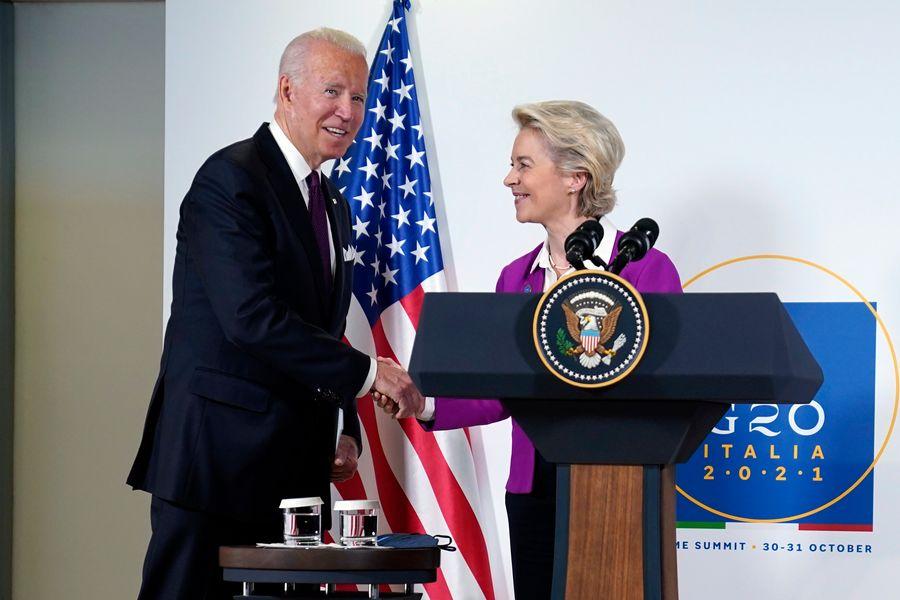
Biden Italy G20 Summit
Biden Administration Got Its EU Steel Tariff Deal Right
COMMENTARY
Published Nov. 4, 2021 • Read time: 4m
The United States and the European Union reached a détente last weekend regarding the American steel and aluminum tariffs that so angered our European trading partners that they raised duties in 2018 on American whiskey, orange juice and motorboats.
The new arrangement will exempt a portion of European steel and aluminum imports from the tariffs imposed by the last administration under Section 232 of our trade laws. It will improve Washington’s relationship with the EU; President Biden’s national security adviser called the tariffs “one of the biggest bilateral irritants” between the sides.
But in satisfying a major trading partner and innocent bystander industries – Harley-Davidson, whose motorcycles are no longer facing steep EU tariff increases, is calling it “a big win” – the Biden administration managed to negotiate an agreement the domestic steel industry believes is fair.
The steel tariff has worked, and the thousands of steel jobs created since it was imposed and the billions in new capital investment are proof positive. But this past weekend’s deal is still a good one for American steelworkers, because two important trade enforcement tools have been imposed on the EU. The first is a “tariff rate quota” that will guard against future import deluges from Europe by automatically enacting a duty once a certain import volume has been achieved. The second is a “melted and poured” requirement that will guarantee any steel imported to the U.S. from Europe is actually made there – and not in Russia or a state-owned mega mill in northeastern China.
Trade Myths and Realities
The Mistaken Bipartisan Attack on Free Trade
A Breakthrough on Trade
Derail Fast Track!
That requirement is informative because it gets at the problem that caused the Trump administration to justifiably raise this tariff in the first place: the persistent production overcapacity in the global steel industry that is mostly driven by the gargantuan, state-controlled steel industry in China. For well over a decade, China has made far more steel than even its voracious domestic construction industry can consume, and it sells its heavily subsidized surplus around the world. That has driven down prices everywhere as steelmakers whose bills aren’t paid by their governments have scrambled to stay competitive. And, as a new white paper points out, this flood of steel is a feature and not a bug of its industrial policy; the Chinese government is purposefully doing this to both capture market share and position its champion companies at the top of lucrative value chains. It’s very deliberate. They say it out loud.
Take, for example, the deal struck by NSM Steel, a small Italian steel processing company, and Baosteel, a Chinese state-owned enterprise that is the world’s largest steelmaker. The latter’s 2011 investment in the former gave NSM a serious shot in the arm and access to a reliable supply of cheap steel. But Baosteel got far more: It gained market access. In addition to access to NSM’s client list, which includes names like Fiat and Maserati, it could now circumvent EU trade laws and, through this foothold, compete with other European steelmaking rivals that can’t match the cost advantages associated with being explicitly backed by the Chinese state.
That kind of capture should be a concern to European regulators but, with the melted-and-poured rule now in place between the U.S. and EU, it will now be less of one for American policymakers because lightly touched steel that was made elsewhere won’t qualify for duty-free status on its way to the American market.
Put another way: The Baosteels of the world won’t be able to use Europe as a steppingstone to avoid richly earned U.S. anti-dumping and anti-subsidy measures.
It should be noted that nothing in the arrangement modifies the dozens of existing anti-dumping and countervailing duty cases on EU metals, which have also been richly earned in recent years, and the deal still permits new unfair trade cases to be initiated against the EU.
It will, however, create the space to allow the U.S. and EU to turn toward the problem of overcapacity and the goal of less carbon-intensive steel trade. That – and the quota, and the rule ensuring that only European-made steel qualifies for duty-free treatment – make this a fair agreement for the American steel industry.
The Biden administration could have reflexively rejected an import restriction erected by its predecessor. To its great credit, it instead acknowledged the underlying premise that steel is vital to our national security and has now enlisted the EU in efforts to contain China’s destructive steel strategy.

Jon Finer’s Old and Dangerous ‘New Approach’ to Israel
Peter Berkowitz • RealClearPolitics
The President Deserves Better
John Ullyot • RealClearPolitics
Congress Doesn’t Need Another Blame Game. It Needs To Find What’s Broken
Jarrod Bernstein • RealClearPolitics
Democrats Won the Midterms. Common Sense Won, Too
Jordanne Kemper • RealClearPolitics
The 120th Congress Shapes Up
Carolina Lumetta • RealClearPolitics
Flooding GOP Primaries With Democrats
Robert Natelson • RealClearPolitics
RCP Today
Top stories on RealClearPolitics
The Takeaway
Polling intelligence and analysis delivered to your inbox
World News
Featuring the latest world news
Policy
Featuring the latest policy news
Support Our Mission
As part of RealClearPolitics, authors aim to provide balanced, non-partisan analysis by presenting top reporting and commentary from all sides of the political spectrum.
Trusted by policymakers and citizens alike since 2000