
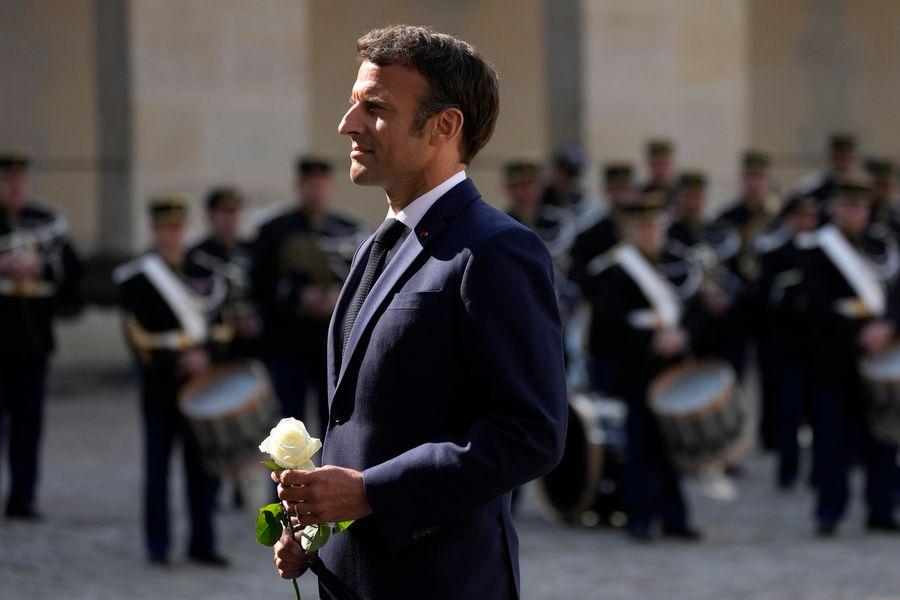
France Obit Bouquet
An Independent for U.S. President: Macron Is the Model
COMMENTARY
Published May 3, 2022 • Read time: 4m
Exhausted by partisan conflict, Americans often ask: Can we ever elect an independent for president?
Only George Washington won the presidency without party affiliation. He called parties “potent engines, by which cunning, ambitious, and unprincipled men will be enabled to subvert the power of the people and to usurp for themselves the reins of government.”
Washington may have trained as a land surveyor, but he was no slouch when it came to political science.
As we look to 2024, there may be an opportunity for a third-party candidate to run for president. A Harvard CAPS/Harris poll finds that 58% of U.S. voters would consider a moderate independent if Democrat Joe Biden and Republican Donald Trump were the major party nominees.
But let’s get real. Electing an independent is a long shot. There is no existing organization or fundraising apparatus for such a candidacy, election laws work against it, and few political pros would take it seriously. So how does an independent make up for these structural disadvantages?
You do it with message. The strongest independent in modern times was Ross Perot in 1992, who won 19% of the vote after withdrawing from the race and getting back in five weeks before Election Day. For a while, Perot ran first in the polls on the basis of a nonpartisan, centrist message that focused on fixing broken government and reducing budget deficits.
Of course, Perot ultimately lost. And the nagging question remains: Can an independent ever win a U.S. presidential election?
A Better Choice
A Third Party Emerges
Idea of Third-Party Option to Trump Loses Steam
Libertarian Lite
To find an answer, we must cross the Atlantic. It’s springtime, so let’s go to Paris.
In 2016, a young former investment banker named Emmanuel Macron resigned his cabinet ministry to run for president of France. He eschewed party affiliation and launched an independent movement, En Marche! (translation: “On the move!”).
To craft a platform and message, Macron’s campaign recruited 4,000 volunteers to conduct door-to-door surveys of 100,000 people to better understand the public mood.
Macron urged a "democratic revolution" and pledged to "unblock France.” He published a best-selling book, entitled "Révolution," which took on both sides of the political spectrum and warned French voters against continuing the country’s “slow downward slide.” He attacked the old left vs. right “game of political juggling.” About his opponents, he said, “they are all wrong.”
Proving himself a smart, effective campaigner in 2017, Macron led a large field of first-round candidates. In the runoff, he handily defeated populist right-winger Marine LePen with 66% of the vote.
At 39, Macron became the youngest French head of state since Napoleon. In legislative elections following his victory, his En Marche! movement – which didn’t even exist before his campaign – won a majority of National Assembly seats.
Who says you can’t upend an existing party structure?
As president, Macron has defied ideological labels. He’s taken a leadership role on global issues and pushed a reform agenda: tax and labor law changes, anti-corruption measures, and a streamlining of the pension system. Some of his policies have sparked strong opposition, including the “yellow jacket” protests, but he’s continued to push on and, when needed, negotiate compromises.
Last week, Macron won re-election to a second five-year term, becoming the first French president to do so in 20 years. Though the media tried to turn this year’s election into a “close call,” Macron ultimately won the runoff by 17 points. He outperformed the polls and again beat LePen, who this time was cleverly rebranded as less extreme.
There are differences between French and American politics: The U.S. has two entrenched parties, while France has a multi-party system. French presidents are directly elected by the people in two-round elections, rather than by an electoral college. While the U.S. is a presidential republic, France has a president independent of the legislative branch and a prime minister subject to legislative confidence.
Similar to the U.S., French presidential elections are also about candidates, parties, and issues. Frustrated voters in both countries respond to compelling pro-change messages.
For the U.S. to elect an independent president would take the right situation and candidate. Look at how Emmanuel Macron did it; he provides the best model.

Democrats Won the Midterms. Common Sense Won, Too
Jordanne Kemper • RealClearPolitics
The 120th Congress Shapes Up
Carolina Lumetta • RealClearPolitics
Flooding GOP Primaries With Democrats
Robert Natelson • RealClearPolitics
Washington Keeps Rewarding Oracle—Veterans Keep Paying the Price
Darin Gaub • RealClearPolitics
The Seeds of Unrestricted Warfare
John Teichert • RealClearPolitics
The Primary System Is Losing the Next Generation
Sean Trende • RealClearPolitics
RCP Today
Top stories on RealClearPolitics
The Takeaway
Polling intelligence and analysis delivered to your inbox
World News
Featuring the latest world news
Policy
Featuring the latest policy news
Support Our Mission
As part of RealClearPolitics, authors aim to provide balanced, non-partisan analysis by presenting top reporting and commentary from all sides of the political spectrum.
Trusted by policymakers and citizens alike since 2000