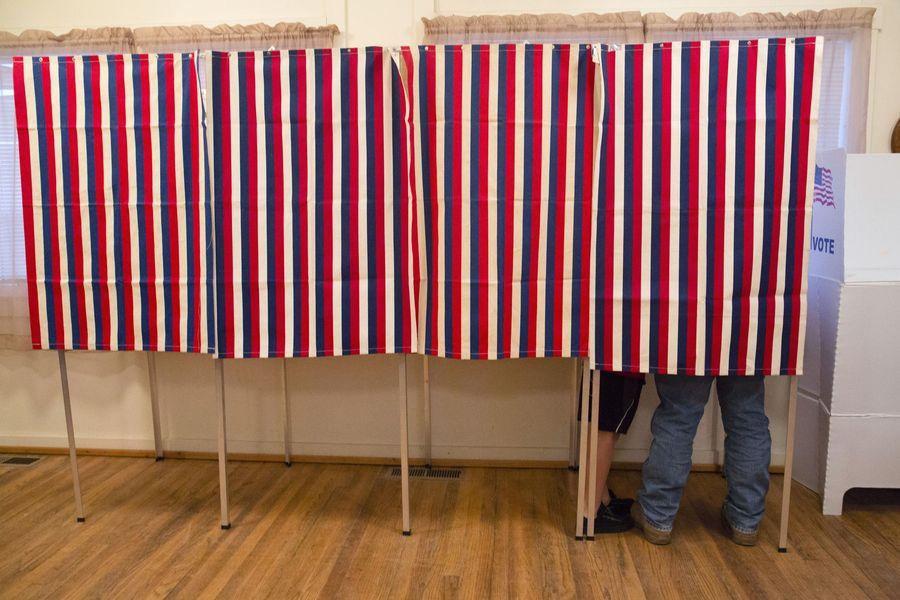
In this Nov. 8, 2016, photo, a voter fills out his ballot at the Wilson School House in unincorporated Wilson, Idaho. Donald Trumpâs victory came as a surprise to many Americans, the nationâs pollsters most of all. Heading into Election Day, most national surveys overstated what will likely be a narrow popular vote advantage for Hillary Clinton and led many to believe she was a shoo-in to win the Electoral College. (AP Photo/Otto Kitsinger)
The Takeaway: Polling Accuracy Holds Steady, Study Finds
Published March 16, 2018 • Read time: 3m
Join the Conversation
0Intriguing tidbits from the week in election surveys and public opinion polls.
Some Perspective on Polls: A new study shows that despite some recent high-profile misses, polls are as accurate as they’ve ever been. Co-authors Will Jennings of the University of Southampton and Christopher Wlezien of the University of Texas at Austin looked at more than 30,000 polls conducted in 351 elections in 45 different countries between 1942 and 2017. They found that polling errors during that period have held fairly constant at around 2 percent. The authors note their study only analyzed national surveys and did not include referenda (like the Brexit vote). Nevertheless, the study provides a valuable corrective to recent claims that polls have become inherently unreliable.
Confrontation Nation: A new survey released by the Polling Institute at St. Leo University reveals some discouraging trends. While it’s not news that America is a deeply divided country, many of us appear to be losing hope we can reduce those divisions. Just 33 percent say they’re “optimistic” about reducing political discord in America, a significant drop from the 49 percent who expressed optimism in March of last year. Even more disturbing: People appear to be more accepting of stifling speech and committing crimes on behalf of their political beliefs. Forty-two percent of those surveyed said “not all free speech patterns should be protected,” up almost seven points from last year. Nineteen percent said that “at times, physical violence during demonstrations is justified,” up one point from last year. And 17 percent said that damaging property is also sometimes justified during demonstrations, up three points from the previous year.
The Media Did Not Create the Trump Phenomenon
O.J. and Trump: Celebrity Victims
Media Malpractice 2016
Oscar Night: Hypocrisy Dressed to the Nines
The View From the Ivory Tower: A recent survey of 618 presidents of colleges and universities in the U.S. shows that more than half agree that the 2016 election “exposed that academe is disconnected from much of American society.” One-third of those surveyed agreed with the statement that “the perception of colleges as places that are intolerant of conservative views is accurate.” On the positive side, four out of five university presidents say that race relations on their campuses today are either “excellent” (19 percent) or “good” (61 percent).
Moving the Needle on Guns: Public opinion on gun control appears to have shifted significantly in the wake of the Parkland, Fla., shooting last month. A new Gallup survey shows that 67 percent of Americans favor making laws covering the sale of guns “more strict,” while 28 percent say they should be “less strict.” That 67 percent figure is a 12-point increase from October of last year and represents the strongest public support for more restrictive gun sales since 1993.
On a related note, a separate Gallup online survey showed teachers in the U.S. do not favor being armed. Seventy-three percent oppose the idea of special training that would allow them to carry guns in school, and 71 percent say the proposal would be “not too effective” or “not effective at all.” And only 20 percent say arming teachers would make schools safer, while nearly three times that amount, 58 percent, say the plan would make schools less safe.
Speed vs. Accuracy: As the scourge of “fake news” continues to frustrate consumers, a new Rasmussen poll shows that 62 percent of Americans believe “most major news organizations are more concerned with getting a story first than getting it right.” That number is unchanged versus a year ago but, perhaps surprisingly, is down significantly from 2013 when the question was first asked. At that time, 84 percent said they believe news outlets were more concerned with speed than accuracy.

A RealClear Thanksgiving: Investing in a Better Future
David DesRosiers • RealClearPolitics
Trump’s Newsom Problem: Antagonist-in-Chief
Carolina Lumetta • RealClearPolitics
America’s Free Spirit
John Maxwell Hamilton • RealClearPolitics
The GOP Majority Should Go Out in Glory
Daniel McCarthy • RealClearPolitics
Republican Majorities Could Return Sooner Than Expected
J.T. Young • RealClearPolitics
The Danger Before the Attack
Leslie J. Sullivan • RealClearPolitics
RCP Today
Top stories on RealClearPolitics
The Takeaway
Polling intelligence and analysis delivered to your inbox
World News
Featuring the latest world news
Policy
Featuring the latest policy news
Support Our Mission
As part of RealClearPolitics, authors aim to provide balanced, non-partisan analysis by presenting top reporting and commentary from all sides of the political spectrum.
Trusted by policymakers and citizens alike since 2000