
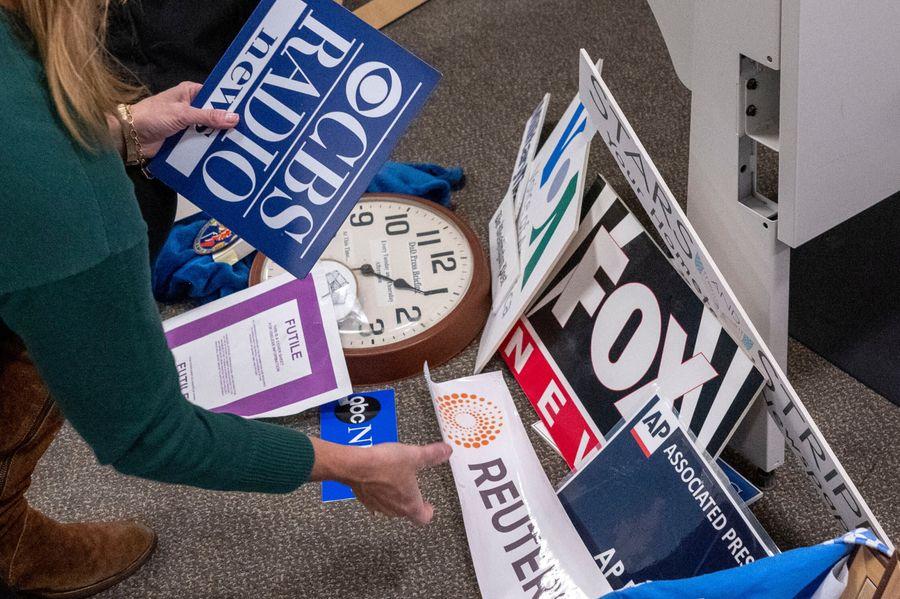
APTOPIX Media Pentagon Rules
Stop the Presses – And Start Telling the Truth About Bias
COMMENTARY
Published Nov. 19, 2025 • Read time: 4m
Is a culture change coming to the news media?
So it might seem, now that Bari Weiss has been appointed editor-in-chief of CBS News. Another sign is Jeff Bezos’s decision to reorient the Washington Post’s opinion page. The hope is that both outlets will move away from their blatant far-left coverage, not only bringing in some right-leaning voices, but restoring some measure of objective journalism. Other outlets are wondering if they should follow suit.
Spoiler alert: It won’t work.
That’s not the kind of culture change the media needs. Instead of fighting bias, media outlets should admit their bias, and frankly, they should own their bias. That’s the only way to make the media honest – and it’s what Americans actually want.
Make no mistake: The media landscape in this country is broken. A miniscule 8% of Americans have strong trust in the media, according to Gallup. People can’t abandon legacy outlets fast enough. But they’re not fleeing because so many outlets are biased. Everyone knows they are, and for the record, they always have been. Most outlets are strongly biased toward to the left. A few are strongly biased toward the right. What Americans don’t like is that all these bias outlets pretend to be unbiased and objective.
Americans are reacting to the media’s hypocrisy. And notice where they’re heading. It’s not to some up-and-coming or diamond-in-the-rough “objective” news sites – those don’t exist. No, Americans are rushing to outlets that are brutally honest about their political biases.
The Media Did Not Create the Trump Phenomenon
Media Malpractice 2016
Oscar Night: Hypocrisy Dressed to the Nines
Media Cowards and the Cartoon Jihad
In a sense, the media landscape is reverting to the mean. The whole concept of “objective journalism” was created in the 1920s and 30s, but before then, newspapers were proud of their biases and very public about it. They were explicitly affiliated with political parties, movements, ideologies, or even individual leaders. Virtually every media outlet advanced a party line – and Americans loved it. For the record, it also strengthened America, by contributing to the vigorous clash of ideas that defines our pluralistic experiment in self-government.
By contrast, supposedly “objective” media is a historical anomaly, and it makes a mockery of our vibrant democracy. It pretends like a small group of well-educated journalists have a corner on the truth – and the wisdom to tell truth from lies. Ultimately, it says that journalists can put aside their biases. But none of this is true. Journalists are human, and humans have opinions. We should test those opinions by clashing them against each other, not give the false impression that some opinions are really objective truth.
Alas, the legacy media is too bought in to the idea of objective journalism, even as journalists report in profoundly biased ways. It’s killing them. So, on Nov. 19, I’m launching a project that will tell Americans exactly how biased reporters are – and I believe it will help the media.
It’s called MediaPedia, and its centerpiece is a bias rating system for American journalists. We developed an artificial intelligence model that ranks how liberal or conservative reporters are, based on their coverage. The AI system looks at eight criteria, from the sources they use to the tone they take, then gives them a score. A score between 0 and -50 means a reporter is liberal. A score between 0 and +50 is conservative. For the record, my team is resisting our own biases by using an AI model. Unlike other ranking systems, we don’t want biased humans making biased calls.
MediaPedia will start by ranking journalists at five major legacy outlets: the Wall Street Journal, the New York Times, the Washington Post, the Associated Press, and Reuters. We have plans to add more outlets, including broadcast media and podcasts. Ultimately, we want to give Americans a window on as many journalists as possible, so they know exactly what angle the media’s coming from.
No doubt, some journalists will view MediaPedia as an attack, but it’s really an attempt to help them. Journalists should be honest about their biases, and it’s the only way to regain Americans’ trust. As counterintuitive as it seems, people are more willing to trust an openly biased reporter than a journalist who covers his bias under a cloak of objectivity.
At the end of the day, trust depends on honesty, and honesty is the real culture change that media needs. It’s not simply a matter of moving outlets in a different direction. What matters far more is admitting that every media outlet already has a direction – because America moves forward when the media is honest.
Support Our Mission
The Internet provides an endless stream of content. Not all of it is worth your time. That's why, every day, RealClearPolitics curates the most essential news and information—from all sides and across mediums. The links, videos, and podcasts curated here are the product of human judgment, not algorithms or AI. Please help power our mission of presenting a thoughtful, balanced public discourse through a tax-deductible donation.
Would you consider supporting us today?

The Danger Before the Attack
Leslie J. Sullivan • RealClearPolitics
Jon Finer’s Old and Dangerous ‘New Approach’ to Israel
Peter Berkowitz • RealClearPolitics
The President Deserves Better
John Ullyot • RealClearPolitics
Congress Doesn’t Need Another Blame Game. It Needs To Find What’s Broken
Jarrod Bernstein • RealClearPolitics
Democrats Won the Midterms. Common Sense Won, Too
Jordanne Kemper • RealClearPolitics
The 120th Congress Shapes Up
Carolina Lumetta • RealClearPolitics
RCP Today
Top stories on RealClearPolitics
The Takeaway
Polling intelligence and analysis delivered to your inbox
World News
Featuring the latest world news
Policy
Featuring the latest policy news
Support Our Mission
As part of RealClearPolitics, authors aim to provide balanced, non-partisan analysis by presenting top reporting and commentary from all sides of the political spectrum.
Trusted by policymakers and citizens alike since 2000