Spotlight on Journalism
Published Nov. 29, 2015 • Read time: 6m
Join the Conversation
0Popular impressions to the contrary, a free press helped create this country—not the other way around.
Colonial newspapers agitated for disunion with Britain before the fight was joined in Concord and Lexington. When the Declaration of Independence was signed on July 4, 1776, Philadelphia’s broadsheets—including Ben Franklin’s old paper—risked the crown’s wrath by publishing it. Patriotic printers also provided copies to George Washington, who had it read aloud to his troops encamped in New York City. This was 15 years before the First Amendment was codified in the Constitution.
Today, mere mention of newspapers induces snide digs about the “lame-stream media” or “dead tree” journalism. Those in the print profession are faced with the constant specter of buyouts and bankruptcies, the fallout from a business model undermined by newer technologies. All of us in journalism cringe at the examples of sensationalism and sloppiness, liberal bias, or scandals involving plagiarism or fabulism. The legendary editors of the late 20th century have retired or passed on: John Carroll, Eugene Patterson, Gene Roberts, Benjamin C. Bradlee.
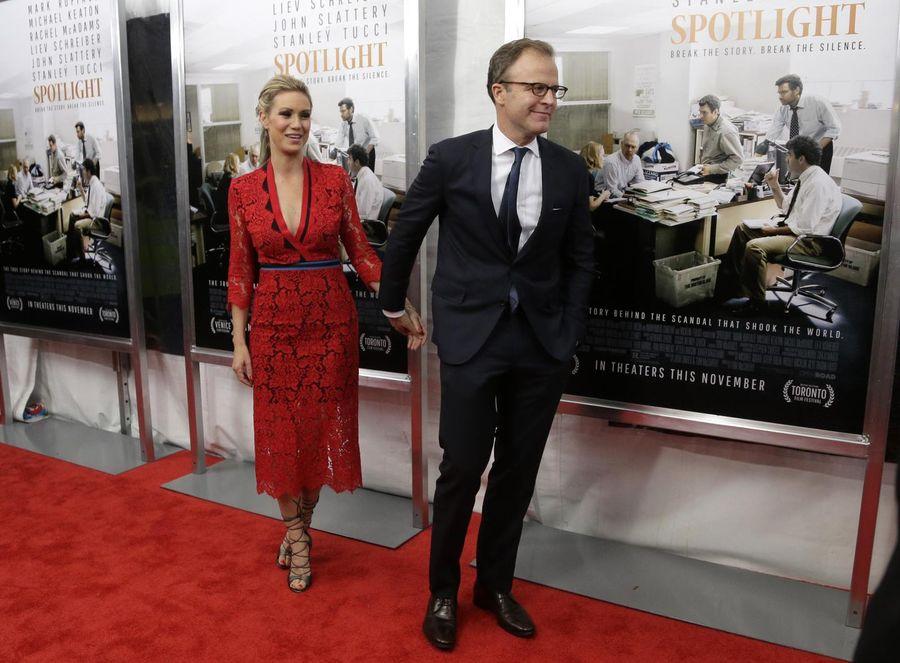
This is the backdrop for “Spotlight,” a terrific new movie directed by Tom McCarthy (pictured) with a talented ensemble cast—Mark Ruffalo, Michael Keaton, Rachel McAdams, Liev Schreiber, John Slattery—all of whom took this film and its subject matter seriously. That subject matter is not light fare: It’s the Boston Globe’s investigative efforts into the priest sex abuse scandal that shook the Roman Catholic Church to its core.
The Media Did Not Create the Trump Phenomenon
O.J. and Trump: Celebrity Victims
Media Malpractice 2016
Oscar Night: Hypocrisy Dressed to the Nines
The reviews have been universally positive. Film critics have compared it to the best newspaper movies of all time, including “Citizen Kane” and “All the President’s Men.” Many of those reviewers are veterans of the dead tree business themselves, so their judgments may be tinged with nostalgia. But the reporting depicted in this film is not a myth. It took place every day—and still is, albeit with less frequency—at the Boston Globe and many other places.
I didn’t intend to write about “Spotlight.” I wondered about possible conflicts of interest. It also brought back ghosts. As a reporter for the San Jose Mercury News in the 1980s, I wrote a series drawing national attention to the molestation scandal starting to envelope the church. It was, I wrote, “a time bomb waiting to detonate within American Catholicism.” Interviewing young men who had been molested by parish priests as altar boys was wrenching, as “Spotlight” shows with skillful sensitivity. In 1988, I appeared on “The Phil Donohue Show,” a precursor to Oprah Winfrey’s talk show. The producers persuaded a victim in his early 20s to appear. He was reticent before a studio audience, but in a New York bar afterward, he wept as he recalled what had happened to him.
My paper submitted the stories for a Pulitzer Prize the same year Jason Berry, the journalist who originally sounded the alarm, was nominated for pieces he wrote from Louisiana. Neither of us won. Fifteen years later, the Boston Globe did win a Pulitzer for public service—the highest category—for its relentless reporting on how the Boston archdiocese handled the scandal. It was a richly deserved honor.
The coverage was done by the Globe’s full-time investigative unit, the “Spotlight Team,” hence the film’s name. Spotlight’s reporters and editors were some of the best journalists in a talent-rich newsroom. I know some of them personally: Michael Rezendes, a former San Jose colleague; Walter “Robby” Robinson, a political writer I met covering presidential campaigns; Benjamin C. Bradlee Jr., a longtime friend.
As a young man, Mike Rezendes was quirky and hyper-kinetic. Judging by Mark Ruffalo’s interpretation, he still is. He’s also a terrific reporter, and remains on the Globe’s Spotlight staff. Michael Keaton should win an Oscar for his portrayal of Robby. As for Ben, I mentioned “All the President’s Men” earlier. In that Watergate drama, Washington Post editor Ben Bradlee was played by Jason Robards. It’s one of the rare instances in American cinema when the movie star is less handsome than the real-life person he portrays. Nothing against John Slattery, my favorite “Mad Men” character, but the same can now be said about the actor who plays Ben Bradlee Jr., who was the deputy managing editor overseeing the Spotlight team.
The other key players in the film version of this story are Sacha Pfeiffer, portrayed superbly by Rachel McAdams, and Martin Baron, the Globe’s top editor, played with exquisite moral gravitas by Liev Schreiber. That the ethical focal point of a drama about the Catholic Church is the office of a newspaper editor—and that a respected cleric is the heavy—is what makes this movie so important. It also shows that all the great newspaper editors have not passed from the scene. Marty Baron, incidentally, is now the Washington Post’s top editor. He has Ben Bradlee’s old job.
Cardinal Bernard Law was Boston’s archbishop when the Globe documented the church hierarchy’s pattern of stonewalling and cover-up—and re-cycling pedophiles back into parish life where they could re-offend. Law resigned under pressure in response to the Globe’s reporting. They don’t necessarily teach this in journalism school, but bullies come in all forms. They can be beat cops, religious leaders, or student protesters. Often, they’re preening politicians.
This last category puts me in mind of two other newspaper friends, Marcus Stern and George Condon. They worked in the Washington bureau of Copley newspapers when Marc found something suspicious in financial reports filed by a congressman from San Diego, home of the Copley chain’s flagship newspaper.
The congressman was Randy “Duke” Cunningham. As Condon wrote recently, he was “the flamboyant ace fighter pilot who went to Congress as a hero in 1991 and left in 2005 as a disgraced felon.” By the sheer dollar amount of bribes he admitted taking, Cunningham was the most corrupt member of Congress in history. But here’s the rub. Copley closed its Washington bureau after the 2008 presidential election. The chain was subsequently dismantled and sold. The cities it served no longer have a Washington presence, meaning that if Cunningham had escaped detection for a couple more years he’d still be in Congress besmirching democracy.
Newspaper profits are in decline, as readers of the Orange County Register and its sister papers know. Investigative reporting, done properly, is expensive, which means that cutting back on it has proved an irresistible cost-cutting step almost everywhere.
What “Spotlight” shows is that effective self-government requires such watchdogs. This Thanksgiving, I said a quiet prayer of gratitude for those Globe journalists. I lit another candle for the publisher and director of Freedom Communications, guys who cut their own salaries and folded and delivered newspapers themselves. It’s a great name, Freedom Communications, and I hope it survives—because without newspapers, we wouldn’t be free.

A RealClear Thanksgiving: Investing in a Better Future
David DesRosiers • RealClearPolitics
Trump’s Newsom Problem: Antagonist-in-Chief
Carolina Lumetta • RealClearPolitics
America’s Free Spirit
John Maxwell Hamilton • RealClearPolitics
The GOP Majority Should Go Out in Glory
Daniel McCarthy • RealClearPolitics
Republican Majorities Could Return Sooner Than Expected
J.T. Young • RealClearPolitics
The Danger Before the Attack
Leslie J. Sullivan • RealClearPolitics
RCP Today
Top stories on RealClearPolitics
The Takeaway
Polling intelligence and analysis delivered to your inbox
World News
Featuring the latest world news
Policy
Featuring the latest policy news
Support Our Mission
As part of RealClearPolitics, authors aim to provide balanced, non-partisan analysis by presenting top reporting and commentary from all sides of the political spectrum.
Trusted by policymakers and citizens alike since 2000