
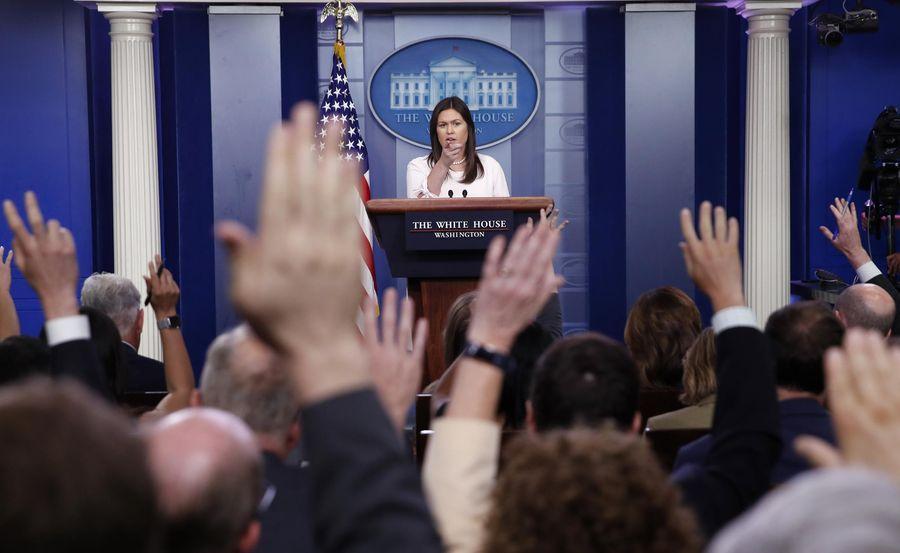
White House press secretary Sarah Huckabee Sanders points to a reporter for a question during a press briefing at the White House, Monday, July 2, 2018, in Washington. (AP Photo/Alex Brandon)
It's Time for the Fourth Estate to Heed the Fifth
COMMENTARY
Published July 26, 2018 • Read time: 4m
Journalists serve an integral function in democratic societies by informing the public on issues central to democracy, thus helping them hold powerful officials and institutions accountable. They defend what is true and right, or call attention to what is wrong, in the world.
The work isn’t easy, and admittedly requires a thick skin, especially given the scathing criticism they now receive just for doing their jobs. To compound the challenges they face, they also are up against the master of the “fake news” insurrection.
When President Trump tweets, people listen. His @realdonaldtrump account has approximately 53.2 million followers, and counting. And the most influential and least well-known group of followers are actually the reporters assigned to cover him.
Trump’s use of Twitter draws a lot of attention, positive or not, and my research shows that his influence and reach outstrip many in the media. I found that while political journalists seldom mentioned Trump’s tweets directly, numerous online news reporters regularly react to, correct, contextualize, or otherwise amplify something the president says.
A report by the New York Times concluded that Trump received nearly $2 billion worth of free media coverage during the 2016 presidential primary race alone. If his tweets are media spectacle designed to draw attention to, or away from, various issues, then many reporters appear to have taken the bait.
His fake news, scorched earth approach worries many who feel democracy, the belief in empirical facts and a commitment to good-faith dialogue are under attack. But there are many efforts to strengthen the work of journalism, rebuild trust, and better respond to public criticism. In fact, the news media have long had mechanisms, such as op-eds, letters to the editor, and media ombudspersons, designed for this very purpose.
The Media Did Not Create the Trump Phenomenon
Media Malpractice 2016
Oscar Night: Hypocrisy Dressed to the Nines
Media Cowards and the Cartoon Jihad
My fear is that because the news business has been on the defensive, reporters may be dismissing honest criticism and ignoring real shortcomings.
A few months ago, I attended a public forum where a reporter and a network executive took questions and comments from the audience about their work. They were confronted with thoughtful, empirically grounded, biting critiques from both sides of the aisle, but especially those on the left. For example, one member of the audience summarized their own analysis of the outlet’s reporting on national security issues, which, they found, rarely questioned claims by government officials and systematically ignored marginalized voices. While the hosts listened intently to the critique, their response fell back on well-worn talking points that effectively dismissed the concerns as too idealistic, especially in the current political climate.
Even as news institutions adopt more sophisticated tools for tracking audiences’ likes and dislikes, they’re often remiss in taking negative feedback on board, or treat it as constructive. Of course, social media channels and comment sections—the channels through which media outlets are most likely to receive public comment—often don’t represent the American public, but rather are filled with political operatives, bots, trolls, and foreign disinformation armies.
Still, the media must listen to those well-intentioned people, as best they can, and respond accordingly. The “fifth estate” helps keep watch over journalism’s gates. They notice when an issue is underreported, or when there are blind spots in coverage, and they’re not shy about saying so. They often help amplify the news and views that deserve greater attention.
Yet, given how often they’re ignored or drowned out by the latest spectacle, perhaps many feel, like their professional counterparts, as if they’re shouting into the void.
There is no denying that it can be difficult to distinguish the legitimate, honest voices from the bots, trolls, and overly partisan hacks. But it is not impossible. Perhaps the solution starts with letting go of the assumption that receiving criticism from “both sides” means you’ve gotten it right. Of course, news organizations should continue to be fair and fact-based, but they should also be more considerate of those issues and communities that find themselves, all too often, on the margins.
Finally, the news media could continue their efforts to increase transparency about their values and professional practices. Doing so would go a long way in rebuilding the trust Americans have lost in journalism.
Lest we forget, the American public, like our journalists, has a long history of working together to address thorny problems. It is high time we get back to doing that important work—listening to, and supporting, one another. Only then can we work together to defend, even strengthen, our nation’s best journalism, and by extension, our democracy.

Jon Finer’s Old and Dangerous ‘New Approach’ to Israel
Peter Berkowitz • RealClearPolitics
The President Deserves Better
John Ullyot • RealClearPolitics
Congress Doesn’t Need Another Blame Game. It Needs To Find What’s Broken
Jarrod Bernstein • RealClearPolitics
Democrats Won the Midterms. Common Sense Won, Too
Jordanne Kemper • RealClearPolitics
The 120th Congress Shapes Up
Carolina Lumetta • RealClearPolitics
Flooding GOP Primaries With Democrats
Robert Natelson • RealClearPolitics
RCP Today
Top stories on RealClearPolitics
The Takeaway
Polling intelligence and analysis delivered to your inbox
World News
Featuring the latest world news
Policy
Featuring the latest policy news
Support Our Mission
As part of RealClearPolitics, authors aim to provide balanced, non-partisan analysis by presenting top reporting and commentary from all sides of the political spectrum.
Trusted by policymakers and citizens alike since 2000