Music Spotify
'Hey Hey,' Joe Rogan, 'My My,' Neil Young
Published Feb. 24, 2022 • Read time: 35m
Join the Conversation
0The advantage of streaming music instead of playing compact discs or vinyl is convenience. Our favorite songs are available with a click or a voice command: “Hey, Google, play ‘Out of the Blue.’” The downside is that it’s another way Big Tech tracks us – and markets accordingly. And because the Great Algorithm in the Sky knows the songs I play, Spotify sent me an unsolicited Dec. 10 email about a new Neil Young album.
The algorithm spoke too soon. Three days after that, a Joe Rogan podcast on Spotify – and another controversial conversation two weeks later – would prompt Neil Young to issue an ultimatum to the streaming service: Ditch “The Joe Rogan Experience,” Young said, or take my music off your platform.
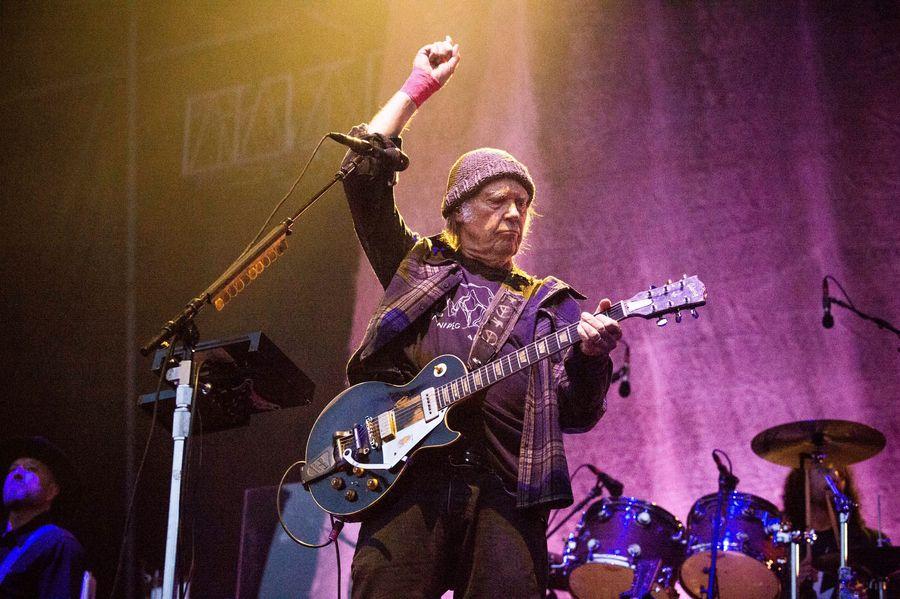
Neil Young and Joe Rogan are at the center of a Spotify controversy.
AP Photo
Young’s demand was copied by several old friends in the music business, starting with Joni Mitchell, who, like Young, was born in Canada, and Nils Lofgren, who played with Young 50 years ago and later became a fixture in Bruce Springsteen’s E Street Band. Then came the other three members of Crosby, Stills, Nash & Young. R&B star India Arie joined them the same week. So did Donald Trump’s resentful niece, though most Americans didn’t know Mary Trump had a Spotify podcast. More recusals followed. More are surely coming.
Rogan’s sin, as the world now knows, was hosting two medical doctors who dissent from the health establishment’s consensus on coronavirus vaccines and treatment. “We support Neil and we agree with him that there is dangerous disinformation being aired on Spotify’s Joe Rogan podcast,” David Crosby, Stephen Stills, and Graham Nash said in a written statement. “Until real action is taken to show that a concern for humanity must be balanced with commerce, we don’t want our music – or the music we made together – to be on the same platform.
COVID makes strange bedfellows, doesn’t it? Until last week, Neil Young was a known Luddite who had long been a font of dubious scientific theories of his own. For starters, he crusades against big-scale agriculture and genetically modified organisms, which is an especially curious quirk for a diabetic. Young has been kept alive for many years by insulin supplements, which are GMOs. Yet in his telling – and Young produced an entire album about it in 2015 – genetically modified crops are responsible for all kinds of “terrible diseases.” Moreover, he asserts that herbicides (he calls them “pesticides” for some reason) have caused a spike in childhood autism. These are fringe notions, with no accepted scientific basis, and first cousin to a related conspiracy theory, which is that childhood vaccines cause autism.
In 2016, Young appeared on CBS’s late-night show with Stephen Colbert, who played Young’s GMO obsession for laughs to the point of surprising Young with some dufus dressed in the costume of an oversized ear of corn. Young didn’t seem to know how to take the spoof, just as Colbert didn’t know what to make of Young’s obsessions. The host only mildly challenged his guest, and said nothing when Young blithely asserted that modern farming practices “are dangerous to me personally, and my family, and the rest of the planet.”
The Media Did Not Create the Trump Phenomenon
O.J. and Trump: Celebrity Victims
Media Malpractice 2016
Oscar Night: Hypocrisy Dressed to the Nines
Folk music legend Joni Mitchell pulled her music from Spotify in solidarity with Neil Young and others.
AP Photo/Carolyn Kaster
Is this “disinformation”? That would seem to be the current scientific consensus. The considered opinion of the National Academy of Sciences, the World Health Organization and The New York Times is that genetically altered corn and other produce is generally safe. Yet no one has called for censorship against Young (or attacked Stephen Colbert for letting such errant nonsense be disseminated on his show).
Although cancel culture and second-party boycotts are a new wrinkle in his repertoire, Young has always used his art to make political statements. In the early 1970s, his haunting Kent State-inspired “Ohio” became an instant antiwar classic. After 9/11, he produced “Let’s Roll,” an ode to Todd Beamer and other courageous passengers on doomed United Airlines Flight 93. (Although this ditty put him in Toby Keith’s political zip code for a while, Young reclaimed his progressive cred with a 2006 song aimed at George W. Bush, “Let’s Impeach the President.”)
At 76, Neil Young is also one of the most prolific performers in rock history with 41 studio albums to his credit, along with eight live albums and some 1,300 live concerts. One dubious contribution to his impressive body of work is his 2015 album “The Monsanto Years.” It consists of a nine-song, error-filled attack on the agribusiness giant, along with shots at Walmart, Big Oil, Big Pharma – and, for reasons known only to himself – Starbucks, which has nothing to do with GMOs. (“I want a cup of coffee, but I don’t want a GMO,” he sings. “I’d like to start my day off without helping Monsanto.”)
In America’s civic tradition, the preferred antidote to ill-informed political speech is not censorship. It’s well-reasoned rebuttal. Monsanto attempted just that, albeit with limited success, as the keepers of rock ’n’ roll’s flame aren’t necessarily scientifically literate and have political outlooks similar to Neil Young’s. But Monsanto and Starbucks survived, while Young sold a few records. But the broader concept here – that open discourse is superior to censorship – is not an ancillary point. The fate of the free world may hinge on it.
How to Handle Heretics
For two years now, an impossibly heavy burden has fallen on this nation’s health care workers. They are the first responders – and last responders – fighting a viral pandemic that has claimed some 940,000 American lives in just two years and resulted in many more hospitalizations. Joe Rogan’s defenders would be well served to keep that in mind. It has been soul-crushing for nurses and doctors to hear the same plaintive pleas from grievously ill coronavirus patients they cannot save, patients begging for a free and easily available vaccine that might well have saved their lives had they taken it two months earlier.
Free speech champions also should not gloss over how dispiriting, and infuriating, it is for these health professionals – and the doomed patients’ families, friends, and clergy – to hear quack medical theories disseminated on talk radio, social media, and certain quarters of the press.
In addition, as some Neil Young defenders have pointed out, both he and Joni Mitchell suffered from polio as children growing up in Canada. The presumption here is that they are understandably grateful to a medical establishment that cared for them. One of Young’s most evocative songs, “Helpless,” begins with the simple line, “There is a town in north Ontario…” Readers of his 2012 memoir understand what that place means to him. For one thing, it was where his family faced the dreaded specter of childhood polio. “It was where I remember being when the doctor, Dr. Bill, came one day with his black bag and told my mom and dad something important out in the hallway,” Young wrote. “I was about five years old. My mommy was crying, and my daddy said, ‘Sure, doc, right away. We’ll go today.’ Then, after breakfast, I was taken to the car. It was hard for me to walk for some reason.”
So, here is a man – despite being a naturally rebellious rock ’n’ roll persona – with a hard-won appreciation of health care workers: a man offended by anyone who would put them at risk.
A cynic might point to another trait Neil Young shares with Joni Mitchell – and Nils Lofgren: a lack of formal education. Young never finished high school. Nor did Lofgren, who ditched Walt Whitman High School in Bethesda, Maryland in his senior year – and soon wound up playing with Young’s legendary band Crazy Horse. Mitchell, who describes herself as a “bad student” in high school, went to art school and dropped out after a year.
So, who are they to arbitrate the truth of competing coronavirus theories, therapies, or mitigation efforts, let alone arbitrate the perilous path of regulating free expression? By contrast, the two Joe Rogan guests who prompted such a backlash are highly credentialed. The first was Dr. Peter McCullough, a prominent Dallas cardiologist who has authored hundreds of scholarly articles, co-edited a cardiovascular journal, and chaired an early evaluation program for the National Kidney Foundation. He was on Rogan’s podcast for two hours and 45 minutes on Dec. 13, 2021.
McCullough routinely questions the efficacy of COVID vaccines for healthy people under age 50, touts ivermectin as a coronavirus treatment (he says early effective treatments were suppressed) and termed fourth doses of the vaccine a “wild” idea. McCullough also discussed with Joe Rogan something he called “mass formation psychosis” to explain why nearly the entire medical establishment thinks he’s off his rocker.
Dr. Robert Malone, controversial podcast guest on "The Joe Rogan Experience."
AP Photo/Steve Helber
On December 31, Rogan hosted another apostate, Dr. Robert Malone. Malone has impressive academic qualifications in this field – and then some. Before his Twitter account was vaporized, Malone framed his achievement immodestly on that platform: “I literally invented mRNA technology when I was 28.” This is an exaggeration, but not as much as one might think. Now 61, Malone is not only a medical doctor and infectious disease expert. He is credited in the scientific literature with being the first researcher to inject genetic material into lab mice in hopes their cells would produce new proteins. This was the Holy Grail, a whole new type of vaccine, and it worked. That was in the late 1980s, and this work became the foundation for “mRNA technology” leading to the development of coronavirus vaccines – just as Malone had predicted.
Malone’s banning from Twitter and LinkedIn didn’t spook Joe Rogan. It piqued his interest. Rogan’s politics are difficult to pigeon-hole. Although he espouses conventional liberal views on most public policy questions, Rogan chafes at political correctness and possesses a conspicuous contrarian streak. He detests “cancel culture,” and was understandably curious why a man so knowledgeable about immunology had become a pariah. The answer was revealed in their three-hour conversation.
It was Robert Malone who first popularized the phrase “mass formation psychosis,” which is more metaphor than science. Not a formally recognized medical term, the idea is that groupthink can overwhelm individuals’ ability to think for themselves and result in lemming-like behavior associated with cults. “A third of the population is basically being hypnotized and totally wrapped up in whatever Tony Fauci and the mainstream media feeds them, whatever CNN tells them is true,” Malone told Rogan.
As true believers often do, Malone then compared the modern era to the rise of Naziism in Europe before World War II. “What the heck happened in Germany in the Twenties and Thirties – you know, very intelligent, highly education population and they went barking mad,” Malone said. “And how did that happen? The answer is mass formation psychosis.”
Malone also told Rogan that up to half a million American lives were lost because U.S. authorities dismissed “out of hand” potential therapies such as ivermectin and hydroxychloroquine without studying them properly, and that the determination by the FDA that the latter drug was ineffective, and perhaps dangerous, was “just patently false.” Malone insinuated a dark alliance between the government and a pharmaceutical industry motivated by profit, while insisting India got COVID under control with drug treatments banned in the U.S. He also suggested that COVID death statistics can’t be trusted because hospitals receive a higher rate of reimbursement from Medicare for patients who are determined to have died from COVID than for those who die from normal pneumonia.
Malone also told Rogan that people who’ve previously contracted COVID have a higher risk of suffering adverse effects from the vaccine than those who hadn’t previously been infected. His point is that those with natural immunity are right to be leery of being coerced into getting vaccinated. The CDC recommendation of vaccines for those previously infected left him “aghast,” he said, because the basis for the government’s recommendation was “a very small study with intrinsic bias all over the place.” This was an apparent reference to a study done three months earlier involving only 72 patients.
But Dr. Malone was just getting going. At a Jan. 23 rally against COVID-19 vaccine mandates, he expressed sweeping doubt on both the effectiveness and safety of the COVID-19 vaccines. “Regarding the genetic COVID vaccines, the science is settled,” Malone said. “They’re not working. They are not completely safe.”
Separating Wheat From Chaff
Is any of what Drs. McCullough and Malone say factual? The answer is that some of it is. For starters, both doctors complain that being anti-mandate is not the same as being anti-vax, and that their critics conflate the two positions. This is obviously happening. Likewise, they complain that apostates like them are being muzzled. This is self-evidently true: The gatekeepers at Twitter and LinkedIn boast about it.
It is also accurate, once the omicron variant took hold, to say that vaccines do not prevent vaccinated people from contracting COVID, or from passing it along to others and – contrary to official assertions – even die from it. And, yes, Medicare does reimburse COVID deaths at a higher rate than other cases, although that is hardly proof hospital administrators are routinely defrauding taxpayers. Even the Minnesota state senator, a physician, who drew attention to the issue in 2020, didn’t think COVID deaths were being overcounted. He assumed, due to the dearth of early testing, that they were being undercounted.
In addition, according to a November piece in The Lancet, a prestigious British medical journal, several studies have suggested that recovered COVID patients who were unvaccinated have low rates of reinfection, which McCullough and Malone stress. Does this “natural immunity” protect people more than vaccines? The Lancet authors said it’s too early to tell. But this debate is hardly beyond the pale of constructive conversation.
On the other hand, several of the claims Malone and McCullough made on “The Joe Rogan Experience” and in other venues were exaggerated, misleading or simply wrong. McCullough said that people infected with COVID have “permanent immunity,” that the virus “is not spread asymptomatically,” and that once somebody takes the vaccine, hospitals don’t test them for COVID. McCullough told Rogan that coronavirus vaccines have caused at least 18,000 deaths in the U.S. There is no evidence for any of this. His claims about vast numbers of children suffering from myocarditis have been specifically debunked.
Other assertions fall in the middle or are simply hyperbolic. Take Malone’s declarations about the vaccines “not working” or being “not completely” safe. Medical authorities insist that people with two vaccines and a booster are much less likely to be hospitalized or to die from COVID. Is this true? One certainly hopes so, although the CDC has been slow to produce the data that would prove it. But “completely safe” is a rhetorical straw man. About what drug can such an absolute claim ever be made with certainty? Have adverse effects been under-reported by the medical establishment and the media? Probably, but 18,000 is a sloppy misreading of the data.
Even in areas in which there is no consensus – and where Malone’s views may turn out to be right or partially right – he has an ad hominem way of characterizing those with whom he disagrees that is more like slander than argument. He calls Pfizer a “criminal” enterprise and says our “lawless” government is “out of control” and “completely disregard[s] bioethics.” He added that vaccination requirements “are explicitly inconsistent with the Nuremberg code,” which is a crock and (once again) gratuitously brings Nazis into the discussion.
“There are two hills I’m willing to die on,” Malone told Rogan. “One is stopping the jabs in the children. And one is resisting the erosion of free speech, which is the fundamental principle on which our democracy and our society – civilized Western Culture – is built.”
To say that this man confounds the medical establishment is an understatement. Most medical people simply can’t fathom where he’s coming from. “On the one hand, he argues, ‘I’m the inventor of this technology,’” Professor Paul Offit, chairman of vaccinology at Penn’s medical school told PolitiFact. “On the other hand, he's telling you that the technology is doing an enormous amount of harm.”
Par for the Course
Conservatives who feel targeted by the establishment media’s fact-checking operations often complain about the designation “missing context,” which they consider a ruse used to undermine voices who don’t necessarily have their facts wrong, but who won’t adhere to the prevailing establishment narrative on any given subject. Although this is a valid point in some cases, context is critically important in political communication.
And yet, most of the criticism of skeptics like Robert Malone and Joe Rogan has itself been context-free. Is it showing ignorance – or a sign of being well-informed – to note that the CDC made a cascading series of failures regarding testing when the virus first hit? And who has really spread the most “disinformation” about masks? Can it be Anthony Fauci, who has admitted he lied in the early days of the pandemic – at a time Americans were deciding who they could believe – because he feared a shortage of masks for hospital workers? Even today, the CDC is cherry-picking data and issuing misleading press releases both about the efficacy of childhood vaccines and about mask mandates for kids to support the Biden administration’s COVID policies.
Vice President Kamala Harris, one of several Democrats who voiced concerns about a vaccine during the Trump administration.
AP Photo/Andrew Harnik, Pool
Last July, President Biden said that Facebook and other social media platforms were “killing people” by allowing vaccine nay-sayers access to their platform. “I mean…the only pandemic we have is among the unvaccinated,” Biden told reporters at the White House. “And they’re killing people.” To be fair, those statements came before omicron, but even then, is it spreading “misinformation” to question whether the pandemic is really “only” among the unvaccinated? Or to point out that while campaigning in 2020, Kamala Harris and Joe Biden stoked vaccine hesitancy themselves by suggesting that President Trump would be rushing them to market for his own political benefit without adequate evaluations of their safety? Does any serious person doubt that as COVID exploded during the 2020 election season, both sides played rhetorical games for their own advantage?
Speaking of personal motivations, Dr. Malone has an axe to grind, maybe two. First, he believes he’s been short-changed throughout his career regarding his contributions to mRNA vaccines. The phrase he has used is “intellectual rape.” He thinks he’s been deprived of the prestige, and financial remuneration, that would accompany proper recognition. A Nobel Prize, maybe. Millions of dollars in royalties, perhaps. Does such bitterness make him a less credible critic? Perhaps. But this cuts both ways: Any examination of Malone’s professional background reveals an inconvenient truth for his critics, which is that he’s deeply knowledgeable in virology and vaccinology.
Malone has another bone of contention, too. Far from being a nutty “anti-vaxxer,” he took the Moderna vaccine himself, as advised by the CDC, after recovering from a case of COVID. His hope was that the shot would alleviate his long-haul symptoms. He’s convinced it made him worse. He has a lingering cough, suffers from hypertension, and claims that his stamina has decreased – although he seems plenty energetic to his critics. “My body will never be the same,” he told Atlantic writer Tom Bartlett last summer. Again, does this experience make him less credible because it has biased him against conventional wisdom? Or more so, since he’s speaking from first-hand experience and is knowledgeable enough to understand vaccine side effects?
Again, these questions of motivations, personal or political, are relevant and informative. The boycott against Joe Rogan, for instance, wasn’t spontaneous, and wasn’t started by Neil Young. As was widely reported, Young was galvanized by “a letter from 270 medical professionals” demanding that Spotify “take action against the mass-misinformation events which continue to occur on its platform.” But who wrote the letter? Why was it pitched to Rolling Stone?
The “Joe Rogan Experience” episode with Malone was not Spotify’s only “transgression,” the letter said, but a “relevant example of the platform’s failure to mitigate the damage it is causing.”
That word “transgression” is a tell. Although the open letter stated that it reflected the concerns of “a coalition of scientists, medical professionals, professors, and science communicators spanning a wide range of fields, such as microbiology, immunology, epidemiology, and neuroscience,” its didactic tone sounded more like the language of religious fundamentalism – or partisan politics – than science. It turns out there’s a reason for that.
In a Jan. 12 piece that broke the story of the letter to Spotify, Rolling Stone magazine identified three of the ringleaders as Jessica Malaty Rivera, Benjamin Rein, and Katrine Wallace. Although highly educated, their expertise in virology isn’t comparable to Malone’s, as their specialties are somewhat removed from the efficacy of vaccines. Wallace, who has a doctorate degree in epidemiology, has published scholarly papers on cancer during the pandemic. Rein’s doctorate is in the neurobiology of autism, and he is currently doing post-doc study at Stanford “investigating how social experiences in early life shape the development of the brain.” Interesting work, but far afield from the efficacy of coronavirus immunizations or the wisdom of closing schools. Rivera’s experience seems more relevant. She earned her master’s degree in emerging infectious diseases at Georgetown University and, according to her bio, “has dedicated the last 15 years of her career to disease surveillance research, public health policy, and vaccine advocacy.”
All three also use that phrase found in the Spotify letter, “science communicators,” to describe themselves. It is a locution that implies, correctly, an active social media (and legacy media) presence where they rail against medical “disinformation.” According to Rolling Stone correspondent EJ Dickson, while contemplating how they might go about muffling Joe Rogan, Ben Rein turned to a fellow TikTok influencer named Abbie Richards. She’s the one who came up with the idea of an open letter to Spotify that would presumably be given to sympathetic news outlets – in this case Rolling Stone. In her Jan. 12 article, Dickson described Richards as “a researcher specializing in misinformation.”
That’s one way to describe her, but there are others. Abbie Richards, who has no formal credentials as a virus researcher or in discerning misinformation, is a 25-year-old graduate of Colorado College, where she majored in environmental science. Afterward, she went to Australia to try her hand at stand-up comedy. Her passions are apparently fighting climate change, vilifying Republicans, and disparaging the game of golf. In addition to despising medical mavericks espousing skepticism about vaccines, Richards hates golf – that’s her word – and she became an unlikely pandemic TikTok star for videos trolling a sport she’s never played.
“I'm running for president,” she said in her initial TikTok. “I’m gonna be a single-issue candidate. When I become president, we will make golf illegal. All golf courses will become public parks, all country clubs will become low-income housing, we take all the water that we would’ve used to water the golf courses and we drink it. Now we’re, like, the best-hydrated country on the planet, we all have gorgeous skin, and anyone caught golfing gets eaten.”
Although there’s a serious point about land use here, the video was meant to be funny – and it was. And I write this as a person who has recently taken up golf and found solace on the links during the pandemic times. Richards’ experience was different. Coming back to the U.S. after her Australia stint, she was jogging in the early days of the lockdown when she ran by a golf course and had a visceral reaction to the unused open space. So she did what comes naturally to socially conscious Americans her age: She emoted on social media.
In a nation in which politics had often become farce, her postings found a following of like-minded lefties more into hostility than humor. To be clear, though: Hating on golfers entails disparaging the 25 million Americans who played it in 2020 – an even larger cohort than Joe Rogan’s huge audience. This was just a warm-up act. Abbie Richards also denigrates Donald Trump and all 74 million Americans who voted for him. “Donald Trump is a white supremacist,” she tweeted in 2020. “If you vote for him again you are a white supremacist.” It’s a label she also applied to Tucker Carlson, while casually calling for a secondary boycott of cable companies that carry Fox News.
For those who value freedom of expression, the nonchalance with which a generation of young progressives demand the suppression of opposing viewpoints is unsettling. Here is how Abbie Richards put it to Rolling Stone reporter EJ Dickson: “Any podcast that platforms dangerous people, people spreading dangerous ideas and misinformation, should not be allowed to go unchecked on the Spotify platform.”
Former Secretary of State Condoleezza Rice has faced "de-platforming" because of opinions considered controversial.
AP Photo/Andrew Harnik
You see what has been done here? On college campuses as Richards was coming of age, it was all the rage to “de-platform” speakers whose message was deemed to be unconforming to the prevailing “intersectional” narrative on race, gender issues, or politics. In this environment, it’s not just alt-right provocateur Richard Spencer whose invitation to speak risks campus riots (and, usually, capitulation by the administration). It’s also conservatives such as Ben Shapiro and Charles Murray, establishment Republicans – and accomplished and pioneering black woman Condoleezza Rice. No one is immune from cancelation. Ask progressive American Civil Liberties lawyer Claire Gastañaga. She was invited to her alma mater, William & Mary, to speak on the subject, “Students and the First Amendment.” Instead, she was shouted down and prevented from speaking by students affiliated with Black Lives Matter, who rushed the stage chanting slogans like “ACLU, you protect Hitler, too!” and “Liberalism is white supremacy.” When individual students approached Gastañaga and tried to talk to her, they were surrounded and shouted at. That’s what “de-platforming” is.
Even in cases not this egregious, when the mob is allowed to exert its authoritarian impulses, the burden of proof has been reversed. In this framework, American citizens don’t possess an unalienable right to utter (and to hear) dissenting viewpoints. No, they must apply – and be approved – for a “platform.” The obvious question: Who decides?
Death on the Nile
“Let’s be CLEAR: this is NOT a free speech issue or a difference of opinion,” Katrine Wallace tweeted on Jan. 26 about her demands to Spotify. “The disinformation in question had been considered, studied & proven to be false & damaging to public health.”
But what else can trying to stifle voices like Joe Rogan’s be called other than an attempt to impede free speech? Dissenting from the official view – the government’s view – has always been the very essence of free speech in America. The aim of the letter from 270 medical professionals was to pressure Spotify to adhere to the official account. Feeding the story to Rolling Stone was a strategy designed to generate precisely the kind of pressure it produced: a 21st century-style secondary boycott by other artists on the platform. This saga unfolded during a larger national discussion about “cancel culture” and the suppression of voices that don’t adhere to the approved narrative, no matter how trivial the topic.
In Wallace and Jessica Rivera’s view, the gatekeeper for public discourse about COVID-19 should be peer-reviewed articles in reputable medical journals. In a perfect world this would be ideal – and apply to all sides in the great debate about COVID protocols. And even though academic fraud is rampant and scientific papers are being retracted with alarming regularity, they are correct in pointing out that the damage caused by studies that haven’t been subjected to the peer review process can be extensive.
A highly relevant case in point was a paper about the anti-parasitic drug ivermectin, published on a website called Research Square last November. Authored by Dr. Ahmed Elgazzar, a professor at Egypt’s Benha University, it purported to show that ivermectin improved the condition of 90% of coronavirus patients. This is a positive response rate so rare in medicine that one doctor who saw it pronounced it “a miracle drug.” There are miracles in medicine, but ivermectin is probably not one of them – at least not for COVID. When scientific journal articles are retracted, the problems typically range from sloppy lab experiments or misinterpretation of the data to plagiarism and even outright fabrication. The Egyptian paper, which was not peer reviewed, apparently had all these flaws. It has been retracted by Research Square.
So why not wait for gold-plated scientific studies? Two are currently being done on ivermectin, one at the University of Minnesota, the other by the National Institutes of Health. Both will be randomized, double-blind studies with placebos and should answer the question of ivermectin’s suitability as a coronavirus treatment. The short answer to this, as Dr. Anthony Fauci knows better than anyone, is that such studies take time. And time – during a medical crisis threatening to take millions of lives – is precisely what people driven by fear don’t feel they have. In the 1980s, Fauci was under extraordinary pressure from liberal activists in the gay community being ravaged by AIDS to green-light unproven experimental treatments. This time, the pressure comes from the right. But the same principle is involved. It’s the tradeoff between speed and safety. The same is true when it comes to information.
In late August, Joe Rogan weighed the risks himself when he tested positive for COVID-19. “Throughout [Saturday] night I got fevers, sweats, and I knew what was going on,” Rogan told his 13.1 million Instagram followers. “I immediately threw the kitchen sink at it.” His regimen of therapeutics included monoclonal antibodies, Z-pack antibiotics, a three-day vitamin drip – and ivermectin. “Here we are on Wednesday, and I feel great,” Rogan said.
To those who think Rogan was doing the equivalent of practicing medicine without a license and should be constrained from even talking about these topics, the podcaster provided a rebuttal as the Spotify boycott gained steam.
“Many of the things we thought of as misinformation just a short while ago are now accepted as fact,” he said. “For instance, eight months ago, if you said, ‘If you get vaccinated you can still catch COVID, and you can still spread COVID,’ you would be removed from social media. They would ban you from certain platforms. Now that’s accepted as fact. If you said, ‘I don’t think cloth masks work,’ you would be banned from social media. Now that is openly and repeatedly stated on CNN. If you said, ‘I think it’s possible that Covid-19 came from a lab,’ you’d be banned from many social-media platforms. Now that’s on the cover of Newsweek. All of those theories that at one time were banned were openly discussed by those two men that I had on my podcast that have been accused of dangerous misinformation.”
The ‘Joe Rogan Experience’ vs. the ‘Lived Experience’
Rogan’s critics point out that the establishment’s medical advice on masking and vaccines only changed as scientists’ understanding of the virus evolved – and as the virus itself mutated. There is obviously some truth in that assertion. At the same time, Rogan’s examples about the fallibility of his would-be censors are so self-evident that his defenders assume his COVID conversations are a pretext for trying to silence him because he’s a threat to the new ethos. One doesn’t have to look far for evidence to bolster that supposition.
In July 2020, Men’s Health magazine published a story by a British freelancer who writes about LGBT issues with a stark headline and sub-deck: “Joe Rogan Is Spreading Transphobic Hate Speech and It's Putting Lives in Danger. Rogan has a history of platforming divisive voices. Now he's actively fanning the flames of hate.”
Author Abigail Shrier's work has been criticized as hate speech.
via AP
In this instance, Rogan’s supposed sin was hosting Abigail Shrier, author of “Irreversible Damage: The Transgender Craze Seducing Our Daughters.” According to Men’s Health, “Shrier invalidated the ‘lived experience’ of trans and nonbinary kids and teens, and made numerous dangerous, entirely unsound false equivalencies.” That’s an opinion (more like political talking points) and perhaps a valid criticism – although one might notice that Rogan’s critics are not willing to grant Dr. Malone his “lived experience.” But this was not a book review. It was a highly personalized attack on two people – Rogan and Shrier – for daring to discuss an important public policy issue in language that doesn’t adhere to the arbitrary parameters of the approved narrative of woke progressives.
Rogan is certainly aware of this dynamic. He talks about it on his show. In a November 2019 podcast that aired a month before COVID hit these shores, the conversation turned to the idea of “culture appropriation,” a concept he dismissed as silly and ill-informed. “It’s all woke,” he said. “It’s all woke culture. It’s this culture of compliance. It’s getting people to listen to you – and do what you want them to do.”
“The Joe Rogan Experience” takes the opposite approach to public discourse. He believes in letting a hundred flowers blossom. Two months before he had McCullough and Malone on his show, Rogan conducted a three-hour interview with Dr. Sanjay Gupta about vaccines. Gupta, the chief medical correspondent for CNN – and an ardent supporter of vaccinations – was pleasantly surprised by the cordiality of the conversation. “When I told Joe early in the podcast that I didn't agree with his apparent views on vaccines against Covid, ivermectin and many things in between, part of me thought the MMA, former Taekwondo champion might hurtle himself across the table and throttle my neck,” Gupta wrote later. “Instead, he smiled, and off we went.”
Although Rogan’s target audience appears to be men who chafe at censorship and political correctness (Trump types, in other words), Rogan describes himself as “left” on politics and is apparently a registered Democrat. Asked by columnist Bari Weiss in January 2020 – before she was bullied into leaving the New York Times – whom he was voting for in that year’s presidential primaries, Rogan spoke warmly of three anti-establishment Democrats: Andrew Yang (“super rational”); Tulsi Gabbard (“I like her.”); and Bernie Sanders (“I believe in him.”) He had all three on his show during the presidential primary season and found them genuine. His Aug. 6, 2019, conversation with Bernie Sanders has been viewed on YouTube some 14.3 million times. His subsequent praise of Sanders, and the reactions of some progressives, was instructive. At first, Rogan sounds almost as though he’s talking about himself.
Sen. Bernie Sanders has come under fire for appearing on Joe Rogan's podcast.
AP Photo/Manuel Balce Ceneta
“You could dig up dirt on every single human being that’s ever existed if you catch them at their worst moment and you magnify those moments and you cut out everything else,” he told Weiss, before launching into his Sanders appeal: “That said, you can’t find very many with Bernie. He’s been insanely consistent his entire life. He’s basically been saying the same thing – been for the same thing – his entire life.”
Sanders, who during two presidential cycles proved a more astute politician than he’d been given credit for, understood the value of this testimonial, and quickly capitalized on it. The blowback was instantaneous – and telling. The backlash came from a handful of cultural progressives, who attacked Sanders on the basis of past Rogan statements deemed “transphobic.”
This turned out to be a precursor to the Spotify controversy. In Bernie Sanders’ case, merely expressing appreciation for a popular podcaster’s endorsement somehow made Sanders accountable for every word Joe Rogan had ever uttered. It’s an impossibly broad litmus test, if you think about it, but some 270 medical professionals sought to apply this guilt-by-association tactic to an entire broadcasting platform. And so, on cue, R&B singer India Arie joined the nascent boycott – but not over COVID.
In an Instagram post to her followers, Arie invoked Rogan’s “language around race,” which she labeled “problematic.” She added: “Neil Young opened a door that I MUST walk through.” In subsequent interviews, she introduced another variable: money. She implied that she and other artists harbor lingering resentment over Spotify paying Rogan a reputed $100 million, while musicians – the artists who gave Spotify its start – receive a tiny fraction of a penny every time their song is streamed. Is this fair? Perhaps not, although Spotify says it paid out more than $5 billion in royalties in 2020. But the issue with Rogan’s programming was not framed as a dispute over money. It was portrayed as a moral imperative over his podcast’s content. Which raises another question: If boycotts are carried out for these kinds of reasons, how can the champions of censorship be so confident that cancel culture will never come for them?
Coronavirus policy was always a tricky place to make a definitive stand anyway. For one thing, it’s beyond dispute that much of what government and the establishment has said about COVID turned out to be wrong, even when it came from people with the best intentions. Moreover, for civil libertarians of a certain age, it is always jarring to hear people who consider themselves progressives express unquestioned faith in the veracity of the government and Big Pharma (let alone the FBI), which became commonplace in the Trump era. It’s also difficult to understand why they don’t see that the same freedom they want for themselves – to openly question a president they dislike, for instance – is one they don’t want others to have.
By way of rebuttal, they insist that none of this is censorship in the manner contemplated by the First Amendment, because the government isn’t doing it. Spotify, like Twitter and Facebook, are private companies, the argument goes – and, as such, are free to do what they want. Likewise, their users can pressure these companies to conform to their customers’ sensibilities.
This is an oversimplification. For one thing, market behemoths such as Google, Facebook, and Twitter are de facto monopolies or near-monopolies that have enjoyed a modicum of government protection. And sometimes the pressure to censor does come from government. It was on July 16, 2021, more than five months before the 270 doctors sent Spotify their Joe Rogan letter, when President Biden told reporters ominously that social media companies such as Facebook were “killing people” by allowing various COVID heresies to be disseminated on their platforms. That seems like pretty direct pressure to stifle dissent.
The omicron variant that erupted in the autumn would undermine Biden’s certitude – expressed that same day – that “the only pandemic we have is among the unvaccinated,” but even acknowledging that he couldn’t see into the future, his assertions came less than two weeks after a triumphant-sounding president celebrated July 4 with his own version of a “Mission Accomplished” speech. Biden told his fellow Americans that the United States had achieved “independence” from the virus. Does that qualify as “misinformation”?
What’s even more worrying is when news organizations take sides in such disputes to the point that they openly push censorship. Not too long ago, this would have been almost unimaginable. Now, it’s ubiquitous. On Jan. 31, for example, NBC News published an essay by a Hofstra University professor named Kara Alaimo arguing that the procedures Spotify announced to add disclaimers to some of Joe Rogan’s old podcasts didn’t go nearly far enough. “The streaming service’s plan to add a message of content about Covid-19 posted on its platform is never going to be enough to stop the likes of Joe Rogan,” she proclaimed. “False claims must be removed.”
Professor Alaimo never gets around to saying who gets to decide what is true and what is false and what lies in between. Nonetheless, she’s all about these boycotts and pressure campaigns, and actually called for “influencers” to do the same thing to other platforms. If you really want to be depressed about the future of the free press in this country, guess what subject Alaimo teaches at Hofstra? You got it – journalism.
Comedian, late-night TV host, and activist Jon Stewart has pushed back on "cancel culture."
Scott Applewhite
There is a much better way, of course, and it was outlined succinctly by a former William & Mary soccer player who majored in psychology. Like Abbie Richards, he tried his hand at stand-up comedy after graduation, albeit with a bit more success. His identity won’t be a surprise, because Jon Stewart often sounds like America’s sanest public intellectual.
In his weekly podcast, carried by Apple, Stewart was asked about the Spotify boycott. In a meandering answer, he joked that it was unwise ever to get on the wrong side of Taylor Swift fans, took a shot at Tucker Carlson, pointed out that other musicians, including Eric Clapton, have made problematic statements about COVID, and said he loved Neil Young’s music. But then he offered unambiguous advice to his fellow liberals: “This is going to be a blanket statement,” Stewart said. “Don’t leave. Don’t abandon. Don’t censure. Engage.”

A RealClear Thanksgiving: Investing in a Better Future
David DesRosiers • RealClearPolitics
Trump’s Newsom Problem: Antagonist-in-Chief
Carolina Lumetta • RealClearPolitics
America’s Free Spirit
John Maxwell Hamilton • RealClearPolitics
The GOP Majority Should Go Out in Glory
Daniel McCarthy • RealClearPolitics
Republican Majorities Could Return Sooner Than Expected
J.T. Young • RealClearPolitics
The Danger Before the Attack
Leslie J. Sullivan • RealClearPolitics
RCP Today
Top stories on RealClearPolitics
The Takeaway
Polling intelligence and analysis delivered to your inbox
World News
Featuring the latest world news
Policy
Featuring the latest policy news
Support Our Mission
As part of RealClearPolitics, authors aim to provide balanced, non-partisan analysis by presenting top reporting and commentary from all sides of the political spectrum.
Trusted by policymakers and citizens alike since 2000