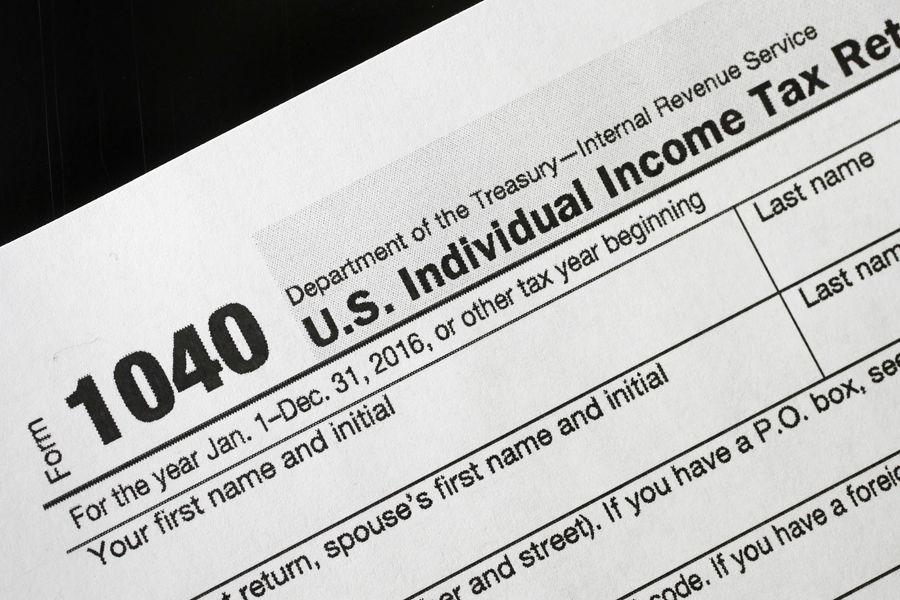
A 1040 tax form appears on display, Tuesday, Jan. 10, 2017, in New York. The IRS is delaying tax refunds for millions of low-income families as the agency steps up efforts to combat identity theft and fraud. Starting in 2017, a federal law requires the tax agency to delay refunds until Feb. 15 for people who claim the earned income tax credit and the additional child tax credit. The IRS says processing times will delay most of the refunds until the end of February. (AP Photo/Mark Lennihan)
Giving Tax Cuts a Fighting Chance
Published Aug. 29, 2017 • Read time: 4m
Will a returning Congress be able to deliver some much-needed tax relief to the American people? Seems simple enough, but so is Obamacare repeal, and lawmakers have (so far) managed to bungle that.
One way to avoid doing the same thing when it comes to taxes is to take a simple procedural step: choose the appropriate budget baseline. Sounds wonky, I know, but before your eyes glaze over, consider how this can make -- or break -- future tax cuts.
When conservatives push for tax cuts, we’re often told they will “cost too much.” Opponents predict humongous deficits if they reduce how much money they extract from us via taxes. Well, that gloom and doom can be made worse by the assumptions they made in the budget resolution.
Those assumptions are in how they construct a baseline -- some marker that says the government is expected to take in X amount of money next year, based on how much is currently being spent, taxed, etc. And that’s the sticking point.
Should lawmakers assume they’re going to extend all the expiring tax provisions they extend every year? Of course they should. That means going with the “current policy baseline,” to use the technical term.
And if they don’t? If they act, implausibly, like they won’t extend the tax provisions? That adds $460 billion in tax increases to the budget baseline.
Those increases won’t materialize. But if Congress assumes for budgetary purposes that they will, it makes tax relief that much harder to enact. Why? Because tax-cut opponents can point to a much larger deficit prediction and say, sorry, we can’t afford it. Using the higher baseline could mean almost half a trillion dollars less in tax cuts over 10 years.
The Brute Force of Government Spending on Autopilot
Please Lie to Us
Soaking the Rich: A Primer
Obama's 180 on 529 Plans Explained Here
This is, frankly speaking, completely dishonest. But that’s exactly what the House budget committee has done. For all intents and purposes, they’ve assumed that Congress will break with what it does every year and let all those “temporary” tax provisions expire.
The Senate budget committee, however, still has a chance to do the right thing. It can choose the current policy baseline -- and quite possibly save tax reform.
Mind you, the tax provisions set to expire are a mix of bad and good. Some, such as subsidies to “green energy” provisions, aren’t good and should be allowed to expire. Others, by contrast, help balance out some of the distortions in our tax code and encourage the kind of investment our economy needs.
But let’s face it -- many of these provisions will be renewed again, as they always are. And assuming, quite logically, that they will be? That gives tax relief a fighting chance. Otherwise, any proposed tax cuts will be slapped with an unrealistically high “price tag,” and they’ll never get off the ground.
This whole baseline question underscores just how fundamentally flawed the Congressional Budget Office’s approach is. As tax policy experts Romina Boccia and Adam Michel point out in a recent op-ed for The Hill, CBO treats spending cliffs and tax cliffs differently:
“When spending expires, as in when the Social Security trust fund runs dry, for example, the CBO assumes Congress really intends for this spending to continue. When tax provisions expire, the CBO assumes Congress really intends for them to expire. This practice biases the budget in favor of tax hikes and spending increases.”
No wonder something as simple and straightforward as tax relief never seems to reach the end zone. The field is tilted. Spending more is easy, cutting taxes is hard -- and largely because the process makes it that way.
Tax relief is too important for Congress to keep fumbling it. The right package of cuts will unleash economic growth -- creating jobs, opportunity and prosperity for all. Why jeopardize that by making the wrong decision on the budget baseline?

A RealClear Thanksgiving: Investing in a Better Future
David DesRosiers • RealClearPolitics
Trump’s Newsom Problem: Antagonist-in-Chief
Carolina Lumetta • RealClearPolitics
America’s Free Spirit
John Maxwell Hamilton • RealClearPolitics
The GOP Majority Should Go Out in Glory
Daniel McCarthy • RealClearPolitics
Republican Majorities Could Return Sooner Than Expected
J.T. Young • RealClearPolitics
The Danger Before the Attack
Leslie J. Sullivan • RealClearPolitics
RCP Today
Top stories on RealClearPolitics
The Takeaway
Polling intelligence and analysis delivered to your inbox
World News
Featuring the latest world news
Policy
Featuring the latest policy news
Support Our Mission
As part of RealClearPolitics, authors aim to provide balanced, non-partisan analysis by presenting top reporting and commentary from all sides of the political spectrum.
Trusted by policymakers and citizens alike since 2000