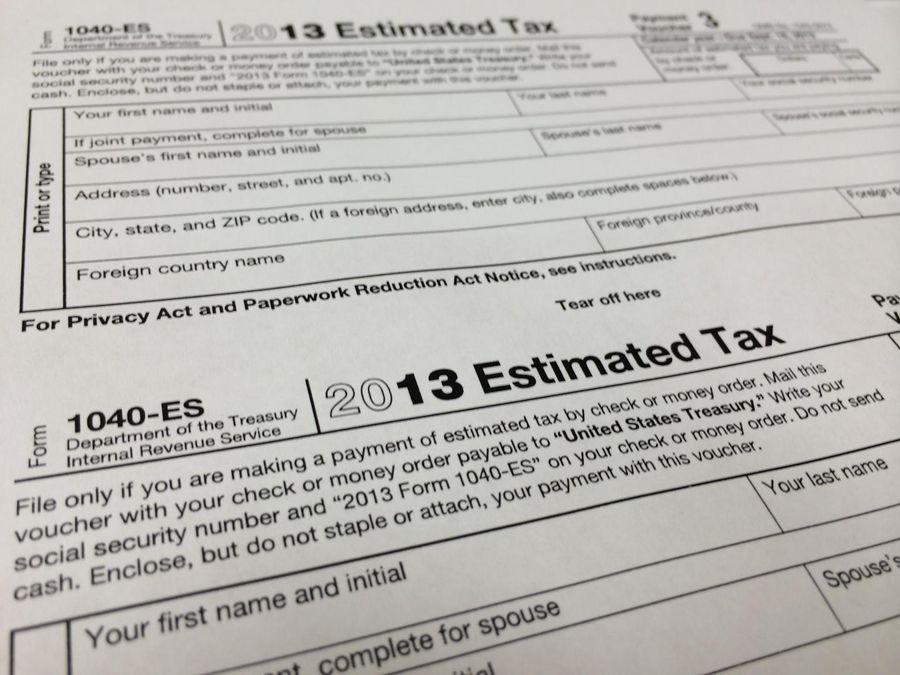
This Thursday, Jan. 9, 2013 photo, shows a 2013 1040-ES IRS Estimated Tax form at H & R Block tax preparation office in the Echo Park district of Los Angeles. âThe United States income tax is a pay-as-you-go tax, which means that tax must be paid as you earn or receive your income during the year,â the IRS says. âYou can either do this through withholding or by making estimated tax payments.â (AP Photo/Damian Dovarganes)
A Tax Cut That Works For All Americans
Published Sept. 27, 2017 • Read time: 3m
When you hear the phrase “corporate tax cut,” what do you picture? Middle-class workers, or Uncle Moneybags, the character from the Monopoly board game?
Probably the latter, unfortunately. Too many Americans buy into the popular misconception that such a cut would benefit only financial fat cats.
And who can blame them? Who’s telling them the truth: that a tax cut for corporations is a tax cut for the average American?
The United States has the highest corporate tax rate in the developed world -- a top marginal federal rate of 35 percent (38.9 percent when you include the state average). At first glance, sure, this levy seems to hit the rich and those who own corporations the hardest. A grumbling worker might think, “Good riddance!”
But that reaction makes a lot less sense when you consider what the corporate tax does. Business owners wind up with a lot less money to spend. That mean they’re investing less in the very businesses that employ the grumbling worker and his colleagues. That means fewer jobs. Lower wages. Less-competitive businesses.
Indeed, a corporate tax cut is actually a remarkably “progressive” tax change, as it benefits workers who earn their income in the form of wages. And those at the bottom of the income scale stand the most to gain from it.
They’re the ones who really suffer when businesses can’t expand -- and therefore can’t hire more workers, or pay their current workers a higher wage.
But the negative effects don’t stop there. It’s easy to speak of “corporations” as faceless entities, but think about it: they’re made up of people. I don’t just mean the workers, as important as they are. I mean the people who invest in them through the stock market.
The Brute Force of Government Spending on Autopilot
Please Lie to Us
Soaking the Rich: A Primer
Obama's 180 on 529 Plans Explained Here
Here again, misperceptions rule. It’s easy to think of Gordon Gekko when the stock market comes up, but what we should think about is … ourselves.
“Across the U.S., corporations employ 54.8 million hard-working individuals who create products for global and domestic markets,” writes tax expert Adam Michel. “Corporate profits also are ultimately claimed by people. More than half of Americans invest in the stock market, and almost 40 percent of corporate stock is owned through retirement plans.”
Unfortunately, that isn’t the message our representatives in Washington are hearing as they consider ways to cut taxes. Government scorekeepers such as the Joint Committee on Taxation, and the Congressional Budget Office, are telling them most of the benefits of cutting corporate taxes go to owners, not workers.
At least 10 separate economic studies show this isn’t true -- that at least 75 percent of corporate taxes is passed on to workers in the form of lower wages. But the CBO and the Joint Committee insist it’s the other way around.
Why? Because they’re not really accounting for how a corporate tax cut would help lower-wage workers. According to Michel, a 20-point cut in the corporate income tax rate, from 35 percent to 15 percent, could boost the relative market incomes of the poorest Americans by 2.4 percent. That would mean $365 for a household that earns $15,000 a year.
And let’s not forget what it would mean for the economy as a whole if we make it financially attractive for businesses who have gone abroad to return to the U.S. Think of the jobs they could contribute, and the economic boost that would result.
The fact is, we all pay the corporate tax. And we all have a stake in seeing it cut. Let’s ignore the naysayers -- and get it done.

A RealClear Thanksgiving: Investing in a Better Future
David DesRosiers • RealClearPolitics
Trump’s Newsom Problem: Antagonist-in-Chief
Carolina Lumetta • RealClearPolitics
America’s Free Spirit
John Maxwell Hamilton • RealClearPolitics
The GOP Majority Should Go Out in Glory
Daniel McCarthy • RealClearPolitics
Republican Majorities Could Return Sooner Than Expected
J.T. Young • RealClearPolitics
The Danger Before the Attack
Leslie J. Sullivan • RealClearPolitics
RCP Today
Top stories on RealClearPolitics
The Takeaway
Polling intelligence and analysis delivered to your inbox
World News
Featuring the latest world news
Policy
Featuring the latest policy news
Support Our Mission
As part of RealClearPolitics, authors aim to provide balanced, non-partisan analysis by presenting top reporting and commentary from all sides of the political spectrum.
Trusted by policymakers and citizens alike since 2000