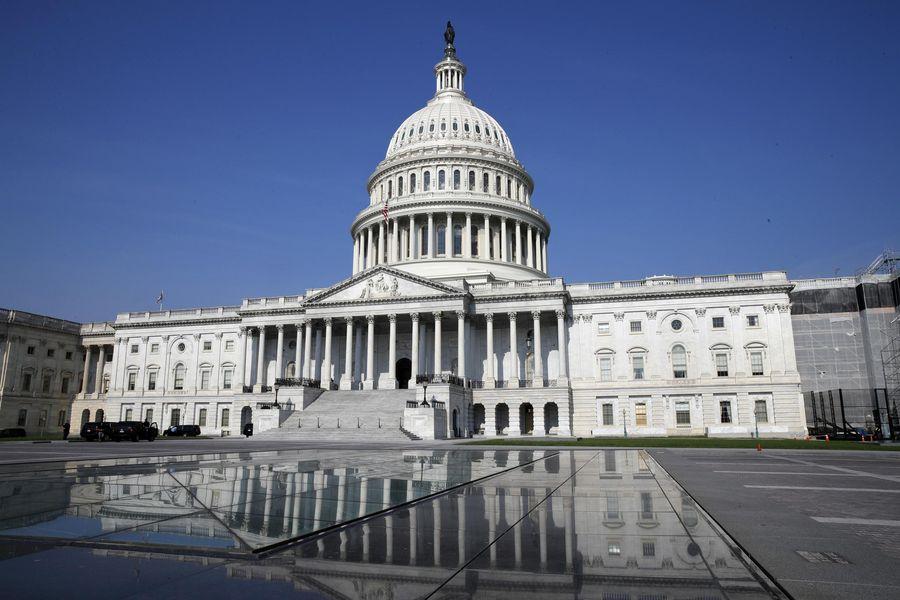
The U.S. Capitol is seen, Thursday, July 20, 2017, in Washington. Sen. John McCain, the 2008 Republican presidential nominee, Vietnam prisoner of war and political maverick in Congress for more than three decades, has been diagnosed with an aggressive type of brain tumor. (AP Photo/Jacquelyn Martin)
A Patriot's Pledge
Published Nov. 16, 2017 • Read time: 4m
This week, a group of wealthy individuals will send a letter to Congress opposing the Republican tax package. These men and women are patriots—they want to give back to the country that gave them so much opportunity.
They are right about the problem. Our economy is undergoing a major shift. Inequality is a growing problem, and middle class stagnation breeds hopelessness, economic isolationism, and social fragmentation.
We must do something.
The tax increases these individuals propose, however, aren’t the solution. They aren’t the best way to give back, and they won’t help the middle class.
Rate increases and provisions like the estate tax only hurt taxpayers who cannot afford expensive accountants and what’s wealthy in Omaha, Neb. isn’t what’s rich in Washington, D.C. If we raise rates on a couple earning $200,000 in my hometown, we hurt two veteran public school teachers.
Higher taxes also will reduce growth, which impacts those at the lower end of the income scale the most.
To get the wealthy to fund education, research, and roads, we need a visionary tax overhaul, not one that relies only on old ideas. My grandfather used to say, what got you to square one won't get you to square two. What helped expand the middle class before won’t necessarily work today.
Tax policy reform must include tax policy innovation.
Unfortunately, the GOP plan also falls short.
Republicans are right to reduce middle class taxes by doubling the standard deduction and cutting marginal rates. Capping the mortgage deduction at $500,000 makes sense since the median U.S. home price is $319,700. Reducing rates for Main Street businesses and incentivizing companies to bring profits back home will spur job growth, but a visionary plan also should help Americans relocate for a job or get training to find work in a different industry. Lawmakers should consider proposals like the Aspen Institute’s Worker Training Tax Credit, which businesses would use to invest in training for low- and middle-income workers.
The Brute Force of Government Spending on Autopilot
Please Lie to Us
Soaking the Rich: A Primer
Obama's 180 on 529 Plans Explained Here
The GOP’s corporate rate cut will help the middle class. According to Boston University’s Lawrence Kotlikoff, it will increase worker wages by $3,500. In my businesses, we’ll use our savings to hire more people and invest in new projects. Roughly 70 percent will go to my employees.
Progressives acknowledged business rate cuts would increase wages when President Barack Obama wanted them. President John F. Kennedy also knew that if entrepreneurs had the incentive to risk, create, and build, the tide would rise and lift us all. Growth hit 5.8 percent in 1964, the year JFK’s last tax cut was signed into law, and 6.5 percent the next.
When it comes to how the rich can fund our future, we need a patriot’s pledge.
Right now any taxpayer can check a box on their IRS form to donate to the Federal Election Commission (FEC) for public financing of presidential campaigns.
Why just the FEC? Why isn’t there a box for a Housing and Urban Development affordable housing fund, a Transportation Department infrastructure account, or Labor Department job-matching program? Why can’t I make a patriot’s pledge to fund to mental health care for veterans?
Americans should be allowed to supply additional capital to the federal government to help address specific problems. Today we can write bigger checks to the Treasury, but they’re not targeted. Congress could spend it all on fruitless endeavors that expand government, but don’t repair the fabric of our nation. That’s also true if we simply increase taxes.
A patriot’s pledge is new, but the seismic shift in our economy requires innovative thinking, just like it did when we created the GI Bill. It requires wealthy individuals to put patriotism over politics to elect to pay more. And it requires government to allow for and encourage that.
In July 1981, President Ronald Reagan said Congress needed to reduce taxes to “give this economy … back to the people.”
That’s what we need today. And, as Reagan and Kennedy showed, higher taxes won’t do it. Growth will. Our economy is more dynamic today than it was then. We’re poised to hit four or five percent growth—if Congress develops a truly innovative tax system that allows businesses to risk while encouraging wealthier individuals to take real ownership of solving America’s problems.
Todd Hitt is CEO of Kiddar Capital, a D.C.-area private equity firm.

A RealClear Thanksgiving: Investing in a Better Future
David DesRosiers • RealClearPolitics
Trump’s Newsom Problem: Antagonist-in-Chief
Carolina Lumetta • RealClearPolitics
America’s Free Spirit
John Maxwell Hamilton • RealClearPolitics
The GOP Majority Should Go Out in Glory
Daniel McCarthy • RealClearPolitics
Republican Majorities Could Return Sooner Than Expected
J.T. Young • RealClearPolitics
The Danger Before the Attack
Leslie J. Sullivan • RealClearPolitics
RCP Today
Top stories on RealClearPolitics
The Takeaway
Polling intelligence and analysis delivered to your inbox
World News
Featuring the latest world news
Policy
Featuring the latest policy news
Support Our Mission
As part of RealClearPolitics, authors aim to provide balanced, non-partisan analysis by presenting top reporting and commentary from all sides of the political spectrum.
Trusted by policymakers and citizens alike since 2000