
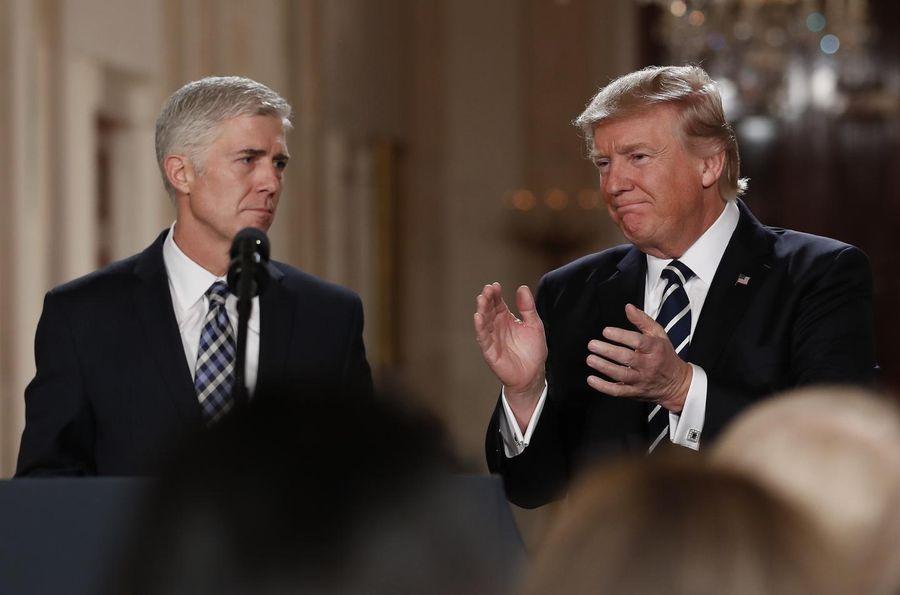
President Donald Trump applauds as he stands with Judge Neil Gorsuch in East Room of the White House in Washington, Tuesday, Jan. 31, 2017, after announcing Gorsuch as his nominee for the Supreme Court. (AP Photo/Carolyn Kaster)
Trump's Gorsuch Pick: Promises Made, Promises Kept
Published Feb. 2, 2017 • Read time: 5m
Well, that was quick. Once again proving himself to be no ordinary politician, President Trump took a New York minute to deliver on one of the most important promises of his presidential campaign. Make that promises, because Monday’s nomination of Neil M. Gorsuch to the U.S. Supreme Court fulfills a basket of Trump promises from the campaign trail.
It’s an excellent pick on its own terms. Judge Gorsuch has served on the Denver-based 10th Circuit since 2006. A graduate of Columbia University, Harvard Law, and Oxford University — where he earned a doctorate in legal philosophy —Gorsuch is a first-rate scholar and thinker. Just as important, and unlike many so-called intellectuals, his writing is as clear as a Rocky Mountain stream. Those opposing his nomination — and there will be many, given the Democrats’ bellicose approach to Supreme Court nominations — will pick fights with him over law and philosophy at their peril.
Gorsuch checks all the boxes candidate Trump laid out when he described the kind of nominee he would be seeking to fill Antonin Scalia’s seat on the high court. Gorsuch would also help Trump keep another important promise made to voters when he was running for the White House: a commitment to religious liberty in the United States.
It’s worth noting that Gorsuch was on the list of potential Supreme Court nominees Trump publicized last summer. Republican senators kept the Scalia seat open so American voters in the November election would have a say in the direction of their Supreme Court over the next generation. Trump stressed this issue on the campaign trail, which was savvy: in exit polls, one in five voters said the Supreme Court was the issue that mattered most to them.
Second, Trump consistently talked about replacing Justice Scalia with someone in the mold of, well, Justice Scalia. Judge Gorsuch may not possess the rollicking temperament and acerbic wit of “Nino” Scalia, but who does? This was not always a plus in terms of the internal “politics” of the Supreme Court, anyway, but in every way that matters, Neil Gorsuch more than fills the bill.
“The great project of Justice Scalia’s career was to remind us of the differences between judges and legislators… ” Judge Gorsuch said in a memorial tribute to Justice Scalia. “[J]udges should instead strive (if humanly and so imperfectly) to apply the law as it is, focusing backward, not forward, and looking to text, structure, and history to decide what a reasonable reader at the time of the events in question would have understood the law to be—not to decide cases based on their own moral convictions or the policy consequences they believe might serve society best."
In truth, Gorsuch himself doesn’t need many such reminders in his decisions on the appeals circuit bench. He has consistently based his decisions on the law and Constitution, and not on his own policy preferences or personal feelings. Consider his bracing words in one dissent. The U.S. Department of Labor was attempting to do something that was not in the plain text of the statute. Gorsuch would have none of it. “Maybe the Department would like such a law, maybe someday Congress will adorn our federal statute books with such a law. But it isn’t there yet. And it isn’t our job to write one—or to allow the Department to write one in Congress’s place.”
And here’s Gorsuch on the proper judicial approach to the Constitution: “Ours is the job of interpreting the Constitution. And that document isn’t some inkblot on which litigants may project their hopes and dreams for a new and perfected tort law, but a carefully drafted text judges are charged with applying according to its original public meaning.”
That’s pure “originalist” Scalia – minus the sharp tongue.
It’s an originalist jurisprudence that advances one of the key policy goals Donald Trump championed in his run against Hillary Clinton, but does so squarely within the confines of the Constitution: the protection of religious liberty. Consider Judge Gorsuch’s words in the Hobby Lobby case. This closely held for-profit company argued the Obamacare requirement that forced the chain to provide life-terminating contraceptives for its employees violated the owners’ religious freedom. The 10th Circuit (and later the Supreme Court) overturned the Obamacare administrative ruling.
“[Obamacare] mandate,” Gorsuch wrote in a separate Hobby Lobby concurrence, “infringes the [owners’] religious liberties by requiring them to lend what their religion teaches to be an impermissible degree of assistance to the commission of what their religion teaches to be a moral wrong.”
Gorsuch was in the minority when the full 10th Circuit refused to take up another religious liberty case (Little Sisters of the Poor v. Burwell). The Obamacare law required religious organizations to provide contraceptive coverage for their employees. A panel of judges for the 10th Circuit had no problem with this requirement, and the question was whether the full court should take up the issue. Gorsuch joined in a stinging dissent: “The opinion of the panel majority is clearly and gravely wrong—on an issue that has little to do with contraception and a great deal to do with religious liberty. When a law demands that a person do something the person considers sinful, and the penalty for refusal is a large financial penalty, then the law imposes a substantial burden on that person’s free exercise of religion.”
The Little Sisters case headed to the Supreme Court, which reversed the decision and sent the case back to the lower courts. Now Gorsuch is headed to the Supreme Court – another victory for religious freedom (and the social conservatives who backed Trump.)
Donald Trump has fulfilled his promises with this exceptional nominee. Now, it is time for the Senate to promptly do its part. It’s time for the Senate to give Judge Gorsuch a full and fair hearing and an up-or-down vote so the Supreme Court can get back to work at full capacity.




RCP Today
Top stories on RealClearPolitics
The Takeaway
Polling intelligence and analysis delivered to your inbox
World News
Featuring the latest world news
Policy
Featuring the latest policy news
Support Our Mission
As part of RealClearPolitics, authors aim to provide balanced, non-partisan analysis by presenting top reporting and commentary from all sides of the political spectrum.
Trusted by policymakers and citizens alike since 2000