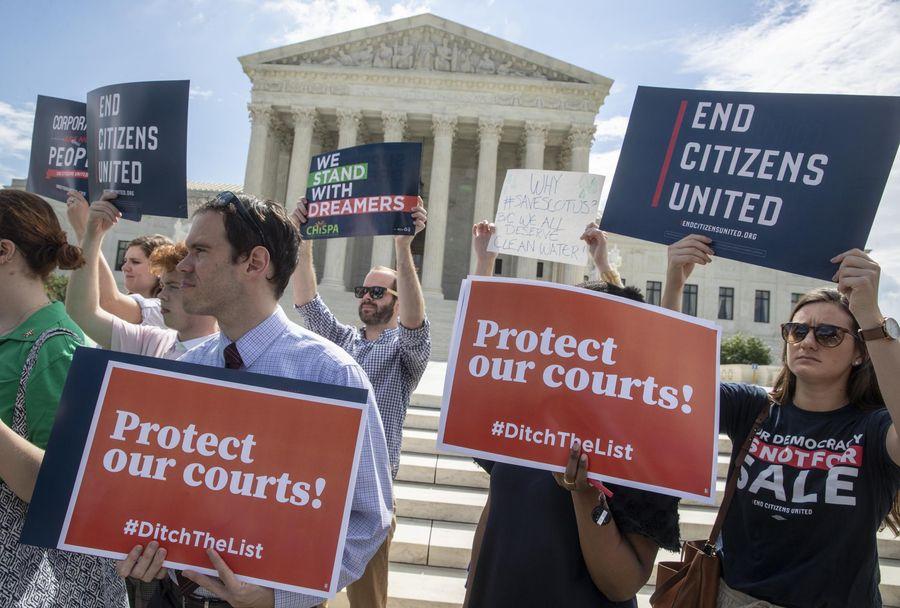
Activists rally at the Supreme Court as President Donald Trump prepares to choose a replacement for Justice Anthony Kennedy, on Capitol Hill in Washington, Thursday, June 28, 2018.(AP Photo/J. Scott Applewhite)
Nominate a Kennedy Replacement ASAP
Published June 28, 2018 • Read time: 4m
“When you’re the hammer, strike; when you’re the anvil, bear.”
That piece of homespun wisdom was a favorite of my father’s. Because he was an aggressive type, it was invariably offered when he perceived a hammer opportunity – which is why I brought him up short once by suggesting that he ask a blacksmith how many hammers he went through between anvil replacements.
Speaking of replacements, our Republic finds itself in need of one for Anthony Kennedy – the man who, owing to his mercurial swing-vote behavior, has arguably been the most powerful jurist on the Supreme Court since Ronald Reagan appointed him over 30 years ago.
This occasion promises to be a significant event in our politics.
Let’s recap. One major reason for the surprising victory of Donald Trump in November, 2016 was his consistent pledge to nominate strong conservatives to the federal bench. He reinforced that promise with the unprecedented publication of a list of jurists from which he would choose in the event of any Supreme Court vacancies. He has delivered on it with Neil Gorsuch, as well as with a record number of lower court appointments in a presidential first year, which conservative federal court observers have praised almost without exception.
In larger context, recent issues related to the high court have resonated far beyond Trump himself. When Antonin Scalia passed in February, 2016, Senate Majority Leader Mitch McConnell held fast to his proposition that Supreme Court appointments should not transpire in the supercharged atmosphere of presidential elections. This prevented the confirmation of Merrick Garland, which enraged Democrats, who were understandably enthused at the prospect of the Court’s staunchest originalist being replaced by the handpicked choice most liberal-leaning occupant of the Oval Office in U.S. history.
He's Mean, But Is He at Least Bright?
Supreme Hypocrisy
It's Time to End ALL Lame-Duck Sessions
The Court Fight Is About Democracy
Part of the Democrats’ anger was frustration in knowing much of their predicament stemmed from their own miscalculations. In 2013, then-Senate Majority Leader Harry Reid detonated the so-called “nuclear option,” eliminating the filibuster for executive branch nominations and federal judicial appointments other than to the Supreme Court. But a precedent had been set and in April 2017, McConnell extended that change to the Supreme Court, which is how Gorsuch got confirmed.
So here we are – less than 19 weeks out from the midterms, with President Trump in position to make an appointment that, because of Kennedy’s swing-vote position, is more consequential than tapping Gorsuch to replace Scalia – which was, for all the drama, just one originalist subbing for another. The Democrats have already invoked McConnell’s Garland-blocking rationale. Extending the majority’s logic to midterm elections as well, Senate Democrats are asserting that no appointment should be considered until after November. Republican acquiescence to that would be a mistake of both policy and politics. Here is why.
First, policy: judicial appointments are the primary responsibility of the executive, with the Senate acting in the inherently secondary role of “advice and consent.” Therefore, an election that does not include the executive is a far less compelling consideration. This is underlined by the fact that the coming election only involves a third of the Senate. One third of an advice-and-consent mandate falls far short of the impact of 100 percent of the appointment duty.
Second, politics: these days, we can all agree, even matters far less weighty than Supreme Court nominations are being played full-contact. And anyone who remembers the Democrats’ tactics at the Clarence Thomas and Robert Bork confirmation hearings know that they are certain to become ghastly. The hard-left wing of the Democratic party will expect senators to pay any price, bear any burden to prevent the confirmation of a real conservative to replace Kennedy. Although this is a specter that neither major political party wants right now, it’s quite likely it would hurt the Democrats a lot more.
Why? Because they face perhaps the most daunting Senate map in U.S. electoral history. While Republicans are defending just eight incumbents, Democrats (counting Independents who caucus with them) are defending 25 – 10 of whom must run in states that Donald Trump carried just 19 months ago. Our current political climate is chock full of people very tired of the self-licking ice cream cone of “Resistance” waged for its own sake. Those 10 Trump-state senators, and perhaps several others, will not have their re-election fortunes bolstered by a hyper-partisan debacle on C-SPAN – which our reality star president will turn into the Television Event of the Season.
Another favorite of many Dads, including mine: “Stop crying or I’ll give you something to cry about.” President Trump could say that to Chuck Schumer, except that fate beat him to it.

Newsom Defies Voters, Juries and Lawmakers To Spare Murderers While Defending Abortion
Curtis Hill • RealClearPolitics
The Algorithmic Tilt
Frank Filingeri • RealClearPolitics
A RealClear Thanksgiving: Investing in a Better Future
David DesRosiers • RealClearPolitics
Trump’s Newsom Problem: Antagonist-in-Chief
Carolina Lumetta • RealClearPolitics
America’s Free Spirit
John Maxwell Hamilton • RealClearPolitics
The GOP Majority Should Go Out in Glory
Daniel McCarthy • RealClearPolitics
RCP Today
Top stories on RealClearPolitics
The Takeaway
Polling intelligence and analysis delivered to your inbox
World News
Featuring the latest world news
Policy
Featuring the latest policy news
Support Our Mission
As part of RealClearPolitics, authors aim to provide balanced, non-partisan analysis by presenting top reporting and commentary from all sides of the political spectrum.
Trusted by policymakers and citizens alike since 2000