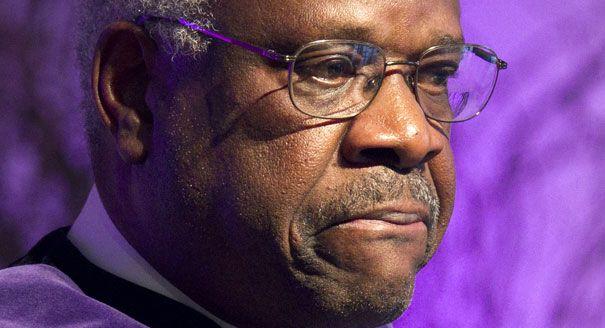
Justice Thomas Asks Question in Court, 1st Time in Ten Years
Published Feb. 29, 2016 • Read time: 3m
WASHINGTON (AP) -- Justice Clarence Thomas broke 10 years of courtroom silence Monday and posed questions during a Supreme Court oral argument, provoking gasps from the audience.
And it wasn't just one question; it was a string of them in an exchange that lasted several minutes.
It was only the second week the court has heard arguments since the death of Justice Antonin Scalia, Thomas' friend and fellow conservative, whom he'd sat next to for seven years. Scalia was famous for aggressive and sometimes combative questions from the bench. His chair is now draped in black in observance of his Feb. 13 death.
Thomas' gravelly voice unexpectedly filled the courtroom and enlivened an otherwise sleepy argument about gun rights. He peppered Justice Department lawyer Ilana Eisenstein, who was trying to wind up her argument, with 10 or so questions that seemed to be a vigorous defense of the constitutional right to own a gun.
"Ms. Eisenstein, one question," Thomas said. "This is a misdemeanor violation. It suspends a constitutional right. Can you give me another area where a misdemeanor violation suspends a constitutional right?"
Until then, it had been business as usual for the first 50 minutes of the hourlong session in Voisine v. United States. The court was considering the reach of a federal law that bans people convicted of domestic violence from owning guns.
None of the other justices visibly reacted to Thomas' remarks.
Eisenstein noted that violating other laws can, in some cases, limit a person's free-speech rights under the First Amendment.
He's Mean, But Is He at Least Bright?
Supreme Hypocrisy
It's Time to End ALL Lame-Duck Sessions
The Court Fight Is About Democracy
"OK," Thomas said. "So can you think of a First Amendment suspension or a suspension of a First Amendment right that is permanent?"
It was a topic no other justice had asked about. And his comments came after several of the other justices seemed to favor the government's position that the law applies whether the abuse is intentional or reckless.
Thomas last asked a question in court on Feb. 22, 2006, and his unusual silence over the years has become a curiosity. Every other justice regularly poses questions from the bench.
Thomas has come under criticism for his silence from some who say he is neglecting his duties as a justice. He has said he relies on the written briefs in a case and doesn't need to ask questions of the lawyers appearing in court.
Carrie Severino, a former clerk to Thomas who now heads a conservative advocacy group, said the justice had kept his silence "because he felt that oral arguments have become less civil and respectful of the attorneys and their arguments over the past two decades, often becoming little more than rhetorical jousting among the justices."
Like Scalia, Thomas has long championed Second Amendment gun rights. In December, he and Scalia objected when the high court refused to hear a challenge to a Chicago suburb's assault weapons ban that was upheld by lower courts. Thomas said the justices should not stand by while lower courts relegate "the Second Amendment to a second-class right."
Thomas did not speak during the court's second argument on Monday.
---
Associated Press writer Mark Sherman contributed to this report.

Newsom Defies Voters, Juries and Lawmakers To Spare Murderers While Defending Abortion
Curtis Hill • RealClearPolitics
The Algorithmic Tilt
Frank Filingeri • RealClearPolitics
A RealClear Thanksgiving: Investing in a Better Future
David DesRosiers • RealClearPolitics
Trump’s Newsom Problem: Antagonist-in-Chief
Carolina Lumetta • RealClearPolitics
America’s Free Spirit
John Maxwell Hamilton • RealClearPolitics
The GOP Majority Should Go Out in Glory
Daniel McCarthy • RealClearPolitics
RCP Today
Top stories on RealClearPolitics
The Takeaway
Polling intelligence and analysis delivered to your inbox
World News
Featuring the latest world news
Policy
Featuring the latest policy news
Support Our Mission
As part of RealClearPolitics, authors aim to provide balanced, non-partisan analysis by presenting top reporting and commentary from all sides of the political spectrum.
Trusted by policymakers and citizens alike since 2000