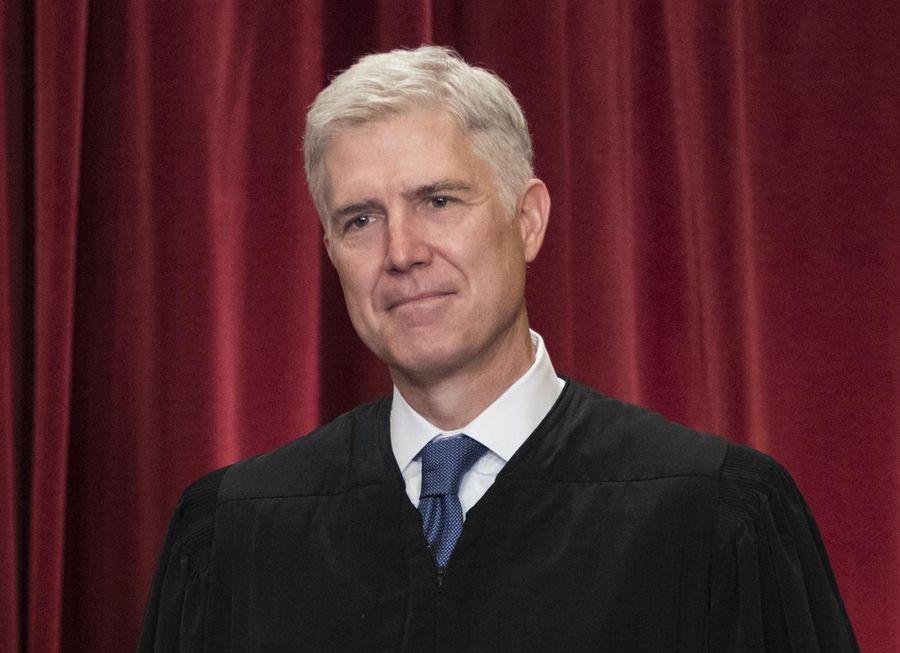
FILE - In this June 1, 2017, file photo Supreme Court Associate Justice Neil Gorsuch is seen during an official group portrait at the Supreme Court Building Washington. For those wondering where Gorsuch will fit on the Supreme Courtâs ideological spectrum, the best early clue might be to watch the company he keeps. Gorsuch has already paired up four times with Justice Clarence Thomas _ the courtâs most conservative member _ in separate opinions that dissent from or take issue with the courtâs majority rulings. (AP Photo/J. Scott Applewhite, File)
Clues to Gorsuch's Ideology Seen in Pairings With Thomas
Published June 26, 2017 • Read time: 4m
WASHINGTON (AP) -- To see where Justice Neil Gorsuch might fit on the Supreme Court, watch the company he keeps.
Gorsuch has already paired up four times with Justice Clarence Thomas - the court's most conservative member - in separate opinions that dissent from or take issue with the court's majority rulings.
While the sample size is small, the results show Gorsuch's commitment to follow the strict text of the law and a willingness to join Thomas in pushing the envelope further than the court's other conservatives.
Gorsuch was picked by President Donald Trump to be a reliable conservative in the mold of the late Antonin Scalia. But the question after his confirmation hearings was how far to the right he would be.
The early trend of Gorsuch and Thomas acting together has pleased those who hoped Gorsuch would continue Scalia's legacy and be another intellectual beacon for conservatives.
Ilya Shapiro, a senior fellow at the libertarian Cato Institute, tweeted Friday: "So far, his voting alignment closest to Thomas -excellent!"
The latest instance came Friday when Gorsuch issued his first written dissent in a minor case about a federal employee challenging his dismissal from the U.S. Census Bureau. The dispute was over where Anthony Perry could appeal a case that alleges violations of both federal civil service rules and laws prohibiting discrimination.
The court sided with Perry, ruling 7-2 that he could file his lawsuit in a federal district court instead of first waiting for a federal appeals court to consider part of his case. In dissent, Gorsuch faulted the majority for failing to apply the law as written.
He's Mean, But Is He at Least Bright?
Supreme Hypocrisy
It's Time to End ALL Lame-Duck Sessions
The Court Fight Is About Democracy
"Anthony Perry asks us to tweak a congressional statute - just a little - so that it might (he says) work a bit more efficiently," Gorsuch said, joined by Thomas. "No doubt his invitation is well meaning. But it's one we should decline all the same."
Later, he added: "If a statute needs repair, there's a constitutionally prescribed way to do it," Gorsuch said. "It's called legislation."
A day earlier, Gorsuch wrote a separate opinion when the Supreme Court unanimously limited the government's ability to strip U.S. citizenship from immigrants who lie during the naturalization process. Joined by Thomas, Gorsuch said the majority ruling was correct, but he argued that following "the plain text and structure of the statute" was enough. He said the court went too far in announcing two new tests that would apply to future cases.
In a separate case decided Thursday, the court by a 7-2 vote refused to overturn the murder conviction of a Boston man whose lawyer failed to object when the trial judge closed the courtroom during jury selection. The court said that the error did not appear to affect the outcome of the case, even though it violated the U.S. Constitution's Sixth Amendment right to a public trial.
Gorsuch agreed with the outcome of the case, but he signed on to a concurring opinion from Thomas that encouraged the court to reconsider whether the right to a public trial even extends to jury selection.
And last month, Gorsuch and Thomas disagreed when the court turned away an appeal from Louisiana Republicans seeking to ease limits on so-called soft money by political parties in federal elections.
A three-judge court in Washington, D.C., had earlier upheld the restrictions. Gorsuch and Thomas were the only justices who wanted the high court to set the case for argument and consider striking down the limits.
Thomas, appointed to the court in 1991, takes pride in his many dissents - often alone - insisting that the justices follow the original meaning of the Constitution even when that means overturning established case law. His absolutist stance has earned praise from conservative supporters. But critics point out that he rarely writes major opinions for the court because his views rarely align with the majority.
Like Gorsuch, Thomas did not wait long in writing his first dissent soon after joining the high court. It came in a 1992 case where a prisoner said his abusive treatment violated the Eighth Amendment's ban on cruel and unusual punishment.
The court ruled 7-2 that the prisoner could sue prison officials after he was punched and kicked by guards. But in dissent, Thomas said the Constitution's framers "simply did not conceive of the Eighth Amendment as protecting inmates from harsh treatment." He was joined by Scalia.
© 2017 The Associated Press. All rights reserved.

Newsom Defies Voters, Juries and Lawmakers To Spare Murderers While Defending Abortion
Curtis Hill • RealClearPolitics
The Algorithmic Tilt
Frank Filingeri • RealClearPolitics
A RealClear Thanksgiving: Investing in a Better Future
David DesRosiers • RealClearPolitics
Trump’s Newsom Problem: Antagonist-in-Chief
Carolina Lumetta • RealClearPolitics
America’s Free Spirit
John Maxwell Hamilton • RealClearPolitics
The GOP Majority Should Go Out in Glory
Daniel McCarthy • RealClearPolitics
RCP Today
Top stories on RealClearPolitics
The Takeaway
Polling intelligence and analysis delivered to your inbox
World News
Featuring the latest world news
Policy
Featuring the latest policy news
Support Our Mission
As part of RealClearPolitics, authors aim to provide balanced, non-partisan analysis by presenting top reporting and commentary from all sides of the political spectrum.
Trusted by policymakers and citizens alike since 2000