
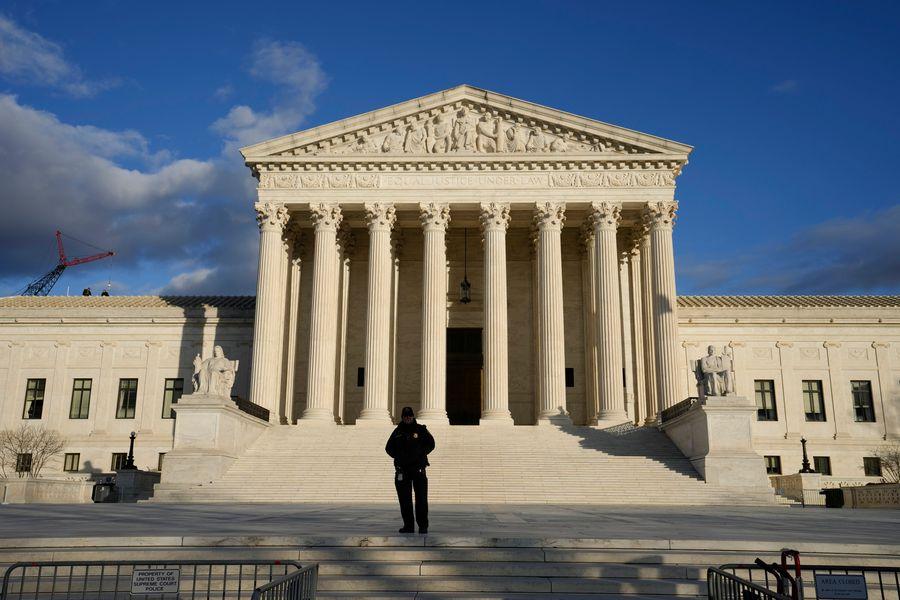
Supreme Court
By Focusing On Transparency, SCOTUS Could Leave Section 230 Intact
COMMENTARY
Published March 13, 2023 • Read time: 4m
For the first time since Section 230 was passed a quarter-century ago, the Supreme Court is hearing two cases that could decide the law’s future. Both cases revolve around social media platforms’ role in facilitating access to terrorism content. The first asks whether companies are responsible for the suggestions of their recommendation algorithms, while the second asks whether companies are liable when they fail to adequately remove terrorism content. Given the high court’s interest in lending further clarity to Section 230 and the justices’ remarks during oral arguments suggesting concern over the disruption that major changes could cause, perhaps a solution of enforced transparency could offer a legal middle ground.
The centrality of terrorism to the two cases reflects how much views about freedom of speech have changed over the past decade. A decade ago, Twitter touted itself as “the free speech wing of the free speech party,” where no voice would be censored. It was just eight years ago that Twitter refused Congress’ demands to remove Islamic State propaganda by pledging to uphold “the ability of users to share freely their views – including views that many people may disagree with or find abhorrent.” Even after quietly reversing its stance on terrorism content, the company still emphasized its role of “protecting and empowering all people to freely express themselves, even when that can lead to challenging conversations.”
This ethos of unfettered speech continues today. The ACLU recently argued that despite the grave national security concerns of a U.S. adversary potentially controlling a major social platform, “a ban on TikTok would violate the First Amendment rights of millions of Americans who use the app to express themselves daily.” In 2021, the ACLU similarly criticized Donald Trump’s social media suspensions, arguing that “it should concern everyone when companies like Facebook and Twitter wield the unchecked power to remove people from platforms that have become indispensable for the speech of billions.”
Yet against this backdrop of absolute freedom of expression lies growing concern over how the companies decide which policies to enforce, who gets quietly exempted from the rules, and what values are encoded in their rules. While the “Twitter Files” generated a relatively muted media response, the inside look they provided into Twitter’s engagement with outside interests and its often ad hoc approach to moderation decisions reinforces the opaqueness of how companies decide what we are allowed to see and say online. After years of dismissing concerns over moderation practices, Elon Musk’s purchase of Twitter seeded a sudden avalanche of concern among the media and commentators about the power of social censorship.
At their core, the two Supreme Court cases both revolve around the existential question of what the Internet is. As one of the drafters of Section 230 put it, when the bill was passed, “Congress had a really clear choice in its mind. Was the internet going to be like the broadcast media that were pretty highly regulated? [or] the town square or the printing press?” Congress’ choice to leave the web largely to police itself was a conscious decision, rather than an accidental oversight. At the same time, the Court’s willingness to accept two Section 230 cases for the first time in the quarter-century since it became law suggests a growing societal unease with the absolute protections that it affords.
Despite accepting the two cases, however, the court’s public remarks suggest that it is struggling to define a bright line where it could realistically narrow Section 230’s protections. Even Justice Clarence Thomas, who has in the past expressed support for narrowing platform immunity, seemed unsure of where such a line of liability could be drawn. As Justice Elena Kagan offered, “We’re a court. We really don’t know about these things. You know, these are not like the nine greatest experts on the internet.”
Perhaps the Supreme Court could find a middle ground by leaving Section 230’s protections in place, but adding a cost to the protections: transparency. Companies wishing to benefit from Section 230 would be required to publish their complete moderation rules as actually enforced, to provide a clear and detailed explanation of every enforcement action (along with the right of appeal), and to make a public dataset available to researchers and journalists that catalogs every content-moderation action taken, similar to the Lumen database of legal takedown requests.
In the end, the court’s struggles reflect our lack of insight into the real-world workings of content moderation on the modern web. Forcing companies to shine a bright light into the messy world of arbitrating what is seen and said in today’s digital public square would finally give Congress the data it needs to decide Section 230’s fate.



RCP Today
Top stories on RealClearPolitics
The Takeaway
Polling intelligence and analysis delivered to your inbox
World News
Featuring the latest world news
Policy
Featuring the latest policy news
Support Our Mission
As part of RealClearPolitics, authors aim to provide balanced, non-partisan analysis by presenting top reporting and commentary from all sides of the political spectrum.
Trusted by policymakers and citizens alike since 2000