
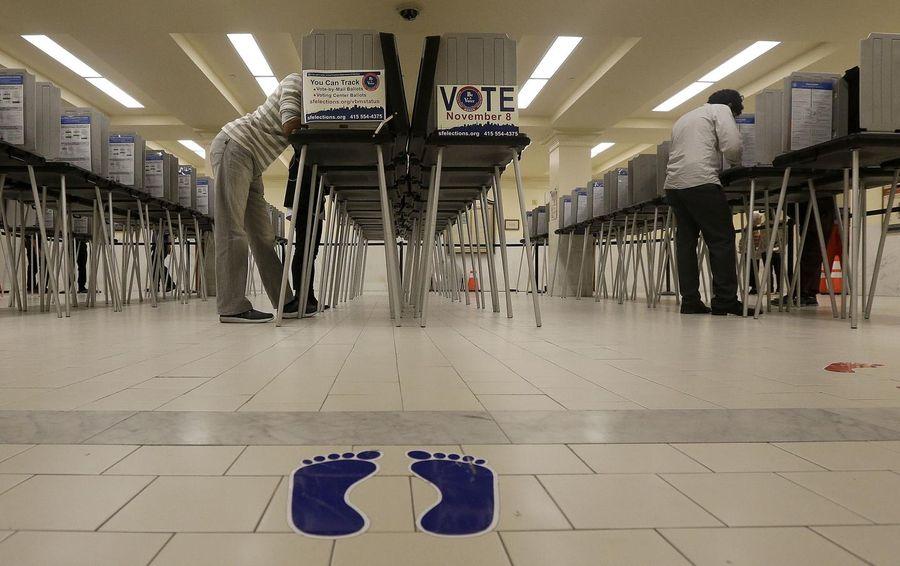
Voters cast ballots at City Hall in San Francisco, Tuesday, Nov. 8, 2016. (AP Photo/Jeff Chiu)
California's Surprisingly Centrist Core
Published Nov. 15, 2016 • Read time: 4m
With the votes tallied, the 2016 electoral map of the Golden State appears to be deeply divided. Narratives regularly speak of a liberal, prosperous coast and a conservative and impoverished inland -- two politically distinct “Californias.” The presidential results seemingly confirm this view, with the coast firmly voting Democratic blue and the inland region going Republican red once again.
In fact, 76 percent of California counties voted for one candidate over the other by 10 or more percentage points, and the average margin of victory across all 58 counties was 26 points. Clinton won 32 primarily coastal counties, carrying an average of 62 percent of the vote, while Trump won the remaining 26 inland counties, averaging 58 percent of vote in them. Certainly, these data make a strong case for the polarization narrative coupled with a deep geographic divide.
Despite these results, I have some good news: The cultural and political split is simply not as pronounced or widespread as many observers and pundits would like us to believe.
To begin with, public opinion data for decades regularly revealed that attitudes toward government, abortion, economic policies, immigration, environmental regulation, gay rights, satisfaction with the political system, and electoral behavior and political engagement are practically identical across regions of the state. And California voter registration statistics provide another powerful lens to make sense of the state’s political realities because citizens can opt out of narrow party choices.
Kids' Lives Matter Too
In a Corner of Ohio, Lessons of 2016
2016 Presidential Election Could Decide State Legislative Races
McCaskill Says No to Run for Missouri Governor
If we look at these statistics, what becomes immediately clear is that very few of the 58 counties are in fact polarized Democratic or Republican strongholds. The widely used metric for a polarized, “landslide” county is when 60 percent or more of the voters are registered for one party, but in 2016 not one county met this standard.
In contrast, close to 60 percent of the counties met this landslide standard in the 1960s. The number has plummeted since then and has hovered around the zero mark since 2002. If we relax the standard to 55 percent for one party, five counties are partisan-leaning and those happen to be the usual Bay Area suspects of Santa Cruz, San Mateo, San Francisco, Marin, and Alameda, with the Los Angeles region notably absent.
Expanding the definition to a simple majority, only 11 counties have one party with 50 percent or more of the total registration and – like the 60 percent landslide metric – the number of counties that meet the simple majority definition has deeply declined from almost 95 percent in the 1960s to a little under 25 percent today. These numbers and huge declines hardly suggest a state with counties that are deeply partisan and growing farther and farther apart. Indeed, they are moderating.
Of course, because of redistricting, one could argue that counties are not ideal units to look at questions of partisanship. Even with California's "independent" Citizens Redistricting Commission, boundaries can and do change with very real political consequences. Fortunately, the secretary of state provides registration data by congressional district as well. Despite concerns of manipulation to create safe districts for one party or another, only four of California’s 53 congressional districts are “landslide” districts at the 60 percent level (three in Los Angeles and one in the Bay Area). At the 55 percent level, seven districts are landslides and at the 50 percent level, only 13 are landslide counties by voter registration. Once again, it is hard to argue that California districts are heading in different directions politically when only 8 percent of them had 60 percent landslide partisan majorities before the 2016 elections.
The question for now is when will Californians demand more from their parties and when will the political elites actually listen to their very own constituents? 2016 publicized the fact that candidates on both the left and right were out of touch with the people and illustrated how cracked these partisan bases actually are. There is a huge opportunity here for parties and candidates that actually represent these moderate ideas and listen to the people. California has long been the harbinger of social change in the United States. “Disruption” is in the DNA of Californians and they should embrace their centrism and help usher in a new, moderate mode of pragmatic politics.
The GOP Majority Should Go Out in Glory
Daniel McCarthy • RealClearPolitics
Republican Majorities Could Return Sooner Than Expected
J.T. Young • RealClearPolitics
The Danger Before the Attack
Leslie J. Sullivan • RealClearPolitics
Jon Finer’s Old and Dangerous ‘New Approach’ to Israel
Peter Berkowitz • RealClearPolitics
The President Deserves Better
John Ullyot • RealClearPolitics
Congress Doesn’t Need Another Blame Game. It Needs To Find What’s Broken
Jarrod Bernstein • RealClearPolitics
RCP Today
Top stories on RealClearPolitics
The Takeaway
Polling intelligence and analysis delivered to your inbox
World News
Featuring the latest world news
Policy
Featuring the latest policy news
Support Our Mission
As part of RealClearPolitics, authors aim to provide balanced, non-partisan analysis by presenting top reporting and commentary from all sides of the political spectrum.
Trusted by policymakers and citizens alike since 2000