
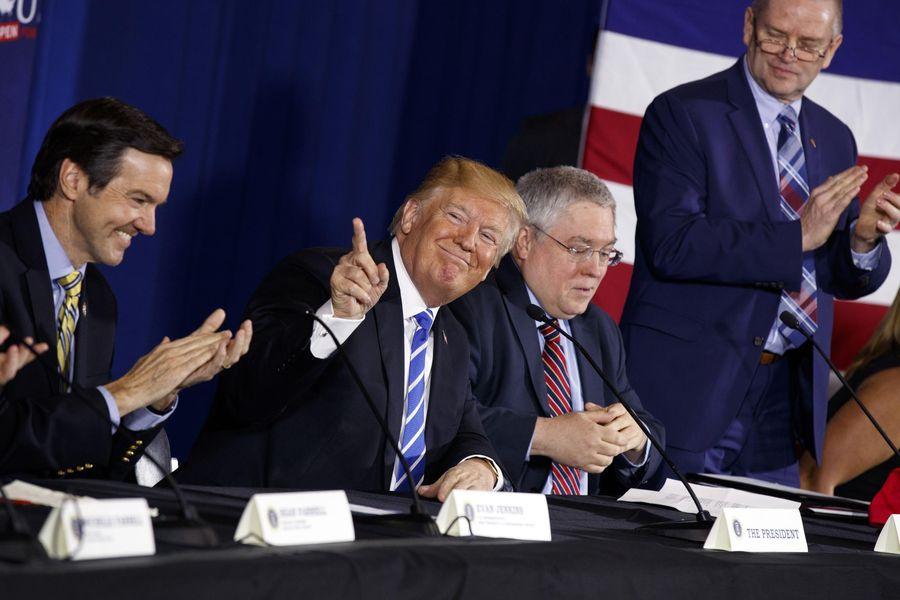
President Donald Trump smiles as people applaud him during a roundtable discussion on tax policy, Thursday, April 5, 2018, in White Sulphur Springs, W.Va., from left, Rep. Evan Jenkins, R-W.Va., West Virginia Attorney General Patrick Morrisey, and CEO of Davis Trust Company Hugh Hitchcock. (AP Photo/Evan Vucci)
West Virginia Senate Hopefuls Heap Praise on Trump
Published April 5, 2018 • Read time: 3m
Two of the Republican candidates running for Senate in West Virginia flanked President Trump during his visit there Thursday, heaping praise on him a month before a competitive primary to face Democrat Joe Manchin in the fall.
Trump, in a “tax roundtable” speech reminiscent of his remarks at campaign rallies, spoke at length on a range of topics, including immigration, his 2016 election victory and the coal industry. He also used the occasion to attack Manchin for voting against the Republican tax bill last year.
“He voted against [taxes]. No, it was bad,” Trump said of the two-term senator. “I thought it would be helpful because he talks. Grabs me, I grab him. He says hello, I say hello. But he votes against everything and he voted against our tax cuts, and that was bad.”
It was a familiar refrain from Trump, who has visited other red-leaning states with Democrats up for re-election this year to hammer the incumbents for voting against tax cuts, often delving into other topics du jour.
But the roundtable in West Virginia Thursday was also an opportunity for Rep. Evan Jenkins and Attorney General Patrick Morrisey to appear next to Trump and applaud his work for the state, earning themselves prime spots on television and feathers in their caps for future campaign events and ads. In many Republican primaries across the country, support for Trump has become a litmus test, with candidates battling on the airwaves and in statements over who is the best choice to back the president’s agenda.
Jenkins and Morrisey also face competition from Don Blankenship, a former mining executive who was released from federal prison last year after being convicted for violating safety standards in a mine explosion eight years ago Thursday. Blankenship has been airing millions of dollars worth of television ads boosting his bid. Republicans are nervous about his campaign, fearing he has become a formidable challenger who, if he emerges as the nominee, could endanger their chances of defeating Manchin in November.
Thursday’s event gave Jenkins and Morrisey a high-profile boost from Trump, though he did not endorse either candidate.
“Everybody in this room and everybody in West Virginia knows, and that is: You’re a man keeping your promises,” Jenkins said. “I was a proud early supporter of your candidacy.”
Morrisey also praised Trump, repeatedly framing his administration as an improvement over that of his predecessor.
“We had the bulls-eye on us until you got here, so thank you for that,” Morrisey said. Referring to the state’s opioid addiction crisis, he added: “Finally, after years of me being stonewalled by [President] Obama, the Trump administration is delivering. That is a great thing for the citizens of our state.”
Public polling in the primary has been limited, though Jenkins and Morrisey each released a private poll last month showing himself in first place -- trailed narrowly, in both cases, by Blankenship.
Trump declined to take sides in the race.
“Patrick and Evan, good luck,” he said. “I don’t know, you two. Good luck.”
Trump then took impromptu poll of the audience, asking the crowd to applaud if they were supporting Morrisey, then if they were backing Jenkins. Morrisey pointed out the event was being held in Jenkins’ congressional district.
“Well, it was fairly close,” Trump said.
RCP Today
Top stories on RealClearPolitics
The Takeaway
Polling intelligence and analysis delivered to your inbox
World News
Featuring the latest world news
Policy
Featuring the latest policy news
Support Our Mission
As part of RealClearPolitics, authors aim to provide balanced, non-partisan analysis by presenting top reporting and commentary from all sides of the political spectrum.
Trusted by policymakers and citizens alike since 2000