
Election 2026 Midterms Texas
The Midterms: A Blue Wave, a Senate Fight and a Campaign Without Rules
Published Nov. 3, 2026 • Read time: 26m
Join the Conversation
0National elections take place every two years in this country, and whether it’s a presidential cycle or a midterm election, overwrought commentators, partisan activists, and the candidates themselves repeat without self-awareness, let alone irony, a variant of the exhortation that “this election is the most important of our lifetimes.”
It’s an age-old talking point. The motivations of those peddling it range from trying to rally the faithful to justifying their own side’s mudslinging. Along the way candidates and their surrogates become Method actors: They truly believe that this election, any election, is the most consequential in history. Thus, nearly anything they say or do can be rationalized.
Welcome to the 2026 midterms, a cycle striking not only for its high stakes but also for the sheer venom of the campaigns. Few candidates or their surrogates this year come close to passing the Adlai Stevenson test. The famously cerebral Democrat, twice nominated for president (and twice a loser to Dwight Eisenhower) said in 1956 that the greatest hurdle in any campaign is “how to win without proving that you are unworthy of winning.”
In today’s Manichean environment, such philosophical reflections are for chumps. Democrats all over the country are running ads linking Republicans to deceased sexual predator Jeffrey Epstein – as Republicans did two years ago to Democrats. When Texas Republicans under President Trump’s direction brazenly tried to carve out five new GOP congressional districts with a mid-decade gerrymander, the Democrats didn’t merely denounce them. They copied the strategy, most notably in California, while convincing themselves they were the good guys. The California gambit only escalated the arms race, which spread to Florida and elsewhere.
Today, those three mega-states – California, Texas, and Florida – are ranked by the New York Times as the three most gerrymandered states in the country. Illinois, where Adlai Stevenson came from, registers in sixth place, but with the dubious distinction of boasting the single-most egregiously drawn district for partisan advantage.
Barack Obama also hails from Illinois, but from a different mold than Stevenson. Americans in a three-state area surrounding Washington, D.C., watching news or sports programming the weekend before Election Day were subjected to ads in which the former president exhorted Marylanders to support a referendum allowing Annapolis lawmakers to fashion a gerrymander that would vault Maryland into the top tier of undemocratic states.
The Maryland scheme would reduce Republican representation in the state’s eight-person congressional delegation from one to zero. This in a state of 6.3 million souls that elected a Republican governor while Obama served in the White House. Yet Obama claimed with a straight face that the measure would constitute “fair representation.”
House Democratic Leader Hakeem Jeffries. (AP Photo/J. Scott Applewhite)
House Democratic leader Hakeem Jeffries was more forthright when asked about the gerrymandering wars earlier in the year. “We’re going to win in November,” he said, “and then we’re going to crush their souls …”
That’s the spirit of a campaign season in which each side’s congressional candidates have routinely accused the other of protecting child molesters, harboring dual national loyalties, promoting transgenderism in children, war profiteering – or being alternatively racist, Islamophobic, or antisemitic. The last item on the list has an unfortunate ring of truth to it: The 2026 midterms feature several candidates and surrogates – most, but not all, on the left – who have used thinly disguised anti-Jewish tropes. Like a certain disease once thought to have been eradicated, these slurs have returned to public discourse in America.
If the 2026 campaign seems Orwellian, we can remind ourselves of the old adage that “politics ain’t beanbag” – taking comfort, if that is the right word, in the knowledge that campaign smears are hardly new. Yet we would also be wise to consult the man himself. “Political language,” George Orwell wrote after the end of World War II, “is designed to make lies sound truthful and murder respectable, and to give the appearance of solidity to pure wind.”
We the People – and ‘The People’s House’
Among those who have proclaimed this cycle “the most important” in U.S. history, or something close to it, are California Democrats Gavin Newsom and Adam Schiff, liberal commentators Bill Press and Ana Navarro, The Washington Monthly, and Texas congressional candidate Collin Allred, along with a host of political wannabes and liberal worthies including Obama himself.
“If we don’t put a stake in the ground this year we will lose this Republic,” Gov. Newsom said while stumping for fellow Democrats in New Hampshire two weeks ago. “That’s how important this election is.”
Democrats and “NeverTrump” Republicans aren’t the only ones issuing apocalyptic warnings. So are many prominent conservatives, starting with President Trump, Vice President JD Vance, and House Speaker Mike Johnson.
House Speaker Mike Johnson speaks as President Donald Trump listens during a campaign rally in Dubuque, Iowa. (AP Photo/Charlie Neibergall)
“We have to win,” Trump told an Alabama audience recently. “It’s the most important midterm election we’ve ever had because we have a lot of Communists running and they’re going to be controlling the Dumocrat Party.”
The president frequently acknowledges that midterm elections are usually a tough slog for the party in control of the White House. And though Mike Johnson keeps insisting “the polls are wrong,” most Republicans are conceding privately that the House is gone and that their only realistic chance of weathering the expected Tuesday night “blue wave” will be to hang on to their majority in the Senate. It won’t be easy, as late-breaking polls in states across the country are moving in the Democrats’ direction.
Let’s start with the House of Representatives.
All 435 members of Congress are up for reelection, as is the case every two years. Due to historic gerrymandering, existing demographics, geographic “self-sorting,” and the advantages of incumbency, however, few congressional districts are actually in play.
Currently, Speaker Johnson enjoys the thinnest of majorities: 219 Republicans to 214 Democrats, with two vacancies. The Democratic Party needs only four or five pickups to control the chamber. They are poised to do much better than that. The “generic congressional ballot,” which just asks voters which party they are supporting – without mentioning names – is moving precipitously in Democrats’ favor, and is now at +9 in the RCP Poll Average.
The RealClearPolitics map of the House lists 156 “solid” Republican congressional districts and 192 where the Democratic Party nominee is virtually assured of victory. That leaves 87 House seats, most which aren’t realistically up for grabs either.
Fifteen are rated “likely Democratic,” with 12 “likely Republican.” The next category on the blue-red scale is “lean Democratic” (20) and “lean Republican” (12). This leaves 28 congressional races rated “tossups.”
This math illustrates the depth of the problem facing Mike Johnson and GOP. If the RCP map is right – and sources ranging from the Cook Political Report to Larry Sabato’s “Crystal Ball” have similar configurations – sweeping every one of the tossup races, which is highly improbable, would still not give Republicans a majority in the House.
If Johnson is right about one thing, it’s this: For the GOP to hold serve would be a “historic” – his word – polling failure. It’s a sign of desperation when one party is putting all its hopes in the proposition that the polls are drastically off. But they’ve been wrong before, in precisely this context, as retired American University professor W. Joseph Campbell details. But this would be the worst flop since the Literary Digest poll had Republican nominee Alf Landon ousting incumbent president Franklin Delano Roosevelt. (After the votes were counted, FDR tallied 60% of the popular vote while carrying 46 of the 48 states, including Landon’s home state of Kansas.)
Alf Landon, Kansas governor and 1936 Republican presidential candidate. (AP Photo)
Unlike the House speaker, the titular head of the Republican Party has been tempering expectations. “When somebody gets elected president, that party always loses the midterms,” President Trump has been telling crowds. “I don’t know why. Nobody can explain it.”
Actually, there are various explanations for this phenomenon, but that’s not the point at this stage of the game. Nor is it theoretical for Trump: In the 2018 midterms during his first stint in the White House, Democrats needed a net gain of 25 seats to take control of the House. They got 40 – at a time when Trump’s job approval rating was higher that it is today.
“It was always a long shot for Republicans to hold the House in 2026,” says RCP senior elections analyst Sean Trende. “But that shot seems to have grown longer with each passing week.”
Yet the 2018 midterm results do offer some hope for Republicans on the Senate side of the U.S. Capitol. That year, Democrats needed to flip two Senate seats to gain control of the upper chamber. Instead, they lost two.
Gubernatorial races are also being held in 36 states Tuesday – including nine of the 10 most populous states in the country – with open governorships in California, Florida, Ohio, Georgia, North Carolina, and Michigan. Depending on Tuesday’s results, several potential 2028 presidential candidates may emerge from these races. For now, though, most of the focus is the U.S. Senate races.
Macro Senate map
Thirty-five of the 100 U.S. Senate seats are being contested this year. Of those 35, 23 are in states Donald Trump carried in 2024. And every GOP-held Senate seat is in a state Trump carried – except for Maine, which explains the outsized attention the Susan Collins race has attracted.
Maine was once a reliable bellwether, so much so that generations of American schoolchildren after the Civil War learned the ditty, “As Maine goes, so goes the nation.” That ended in the 1936 Roosevelt landslide, Maine and Vermont being the only states that went for Alf Landon, and prompting the puckish quip from FDR aide James Farley, “As Maine goes, so goes Vermont.”
For much of 2026, both political parties acted as though their new mantra was “As Maine goes, so goes the Senate.” But this may not be right either. Sen. Collins defied pre-election polls last time: She was underwater by 7 or 8 points on Election Day, but won by more than 8 points. Even more remarkable, Collins seemingly defied gravity itself, carrying Maine easily while Joe Biden was winning there by 9 points – a 17-point swing.
Sen. Susan Collins speaks to diners at a campaign stop. (AP Photo/Robert F. Bukaty)
So Collins’ fate may be not be indicative of anything. As the year wore on, and the president’s popularity began its steady decline, competitive races emerged in several of those GOP-held Senate seats carried by Trump – and once thought to be safe. The list includes Alaska, Iowa, Kansas, Nebraska, Ohio, South Carolina, and Texas.
Add the Senate races in Maine, Michigan, and Minnesota – three states that went for Kamala Harris in 2024 – and the battle lines are drawn. To be sure, there is action in other states. Trump has campaigned in North Carolina, Georgia, and Florida, but it seems that Senate control will be decided in the Midwest.
Each of these states has dynamics unique to the states and the candidates, but some strong national trends are wafting across the country like a powerful El Niño wind – impacting the elections in both houses of Congress.
Democratic candidates for the Senate, House, and governorships are pressing the case against Republicans on a host of issues, but two stand out the most: “For us, it’s ‘costs and corruption,’” a prominent Democratic Party official told RCP.
Their story line is that Donald Trump is not in this for the working-class voters that form the core of his 2024 coalition. Instead, Democrats say, he’s in for ego – he keeps trying to name buildings after himself and building monuments with his name on them – and for the money. Trump doesn’t really conceal it either. His erratic behavior toward the press often results in large lawsuits against media companies – sometimes to Trump’s financial benefit. He doesn’t even bother to deny that he and his family have made billions of dollars through the White House connection. And when asked who his proposed 250-foot arch overshadowing the Lincoln Memorial would honor, Trump blurted out, “Me.”
Polls have shown deep unease about the insider dealings of this administration and also disaffection with a host of other issues, starting with his handling of the economy, the Iran war, tariffs, and his incessant Canada-bashing. All of this rebounds onto Republican candidates. Trump and the Republicans have even found themselves on the short end of data centers, an issue that seemingly emerged out of nowhere.
As if all that weren’t enough, the primary season showed that there is a strong anti-incumbent mood. It’s true, as the president says, that Marxist candidates have infiltrated the Democratic Party and will soon be represented in Congress, but the more prevalent mood is a “throw the bums out” mentality that all incumbents must deal with. And Republicans are in control. For all those reasons, and the Democrats’ strong showing in pre-election polling, Polymarket currently gives Democrats a 71.5% chance of winning the Senate.
If the good news for Democrats is that they lead in almost all of the tossup Senate races, the good news for Republicans is that the margins are typically small, and if the GOP vote is underestimated by the pollsters, the way it has often (but not always) been in the Trump era, these races could be photo finishes.
The other potentially good news for Republicans is that they still have hopes of picking up one Senate seat currently held by Democrats. That’s Michigan. On paper, it seems safe for the “D” team. Abdul El-Sayed, a leftist who is openly antagonistic toward Israel specifically and U.S. foreign policy generally, leads Mike Rogers in all the polls. A New York Times/Siena poll released Monday morning delivered an eye-opening result: El-Sayed leads by 11 points, lifting his standing to +5.3% in the RCP Average. Betting markets put his odds of winning at 4-to-1.
Michigan Democratic Senate candidate Abdul El-Sayed. (AP Photo/Julia Demaree Nikhinson)
So why all the attention on Michigan? Two reasons. First, Rogers, a former congressman and FBI agent, came within about 19,000 votes of winning in 2024, losing to Elissa Slotkin by only 0.3 points. But Slotkin held a lead of 2.3 points in the final RCP Average. This pattern of polls overstating Democrats was present in the 2020 Michigan Senate race as well – and it may particularly impact El-Sayed: In the August primary El-Sayed led Rep. Haley Stevens by 10.2% in the final RCP Average – but won by only 1 point.
Stevens was back in the news again this weekend, and not in a helpful way for her party. She has jousted for weeks with El-Sayed over how his campaign and surrogates talk about Israel and Jews. In particular she took offense – as did many others – to an ugly antisemitic attack aired by an El-Sayed ally. El-Sayed’s reluctance to disavow the ad (he ultimately did so) prompted both sides to relitigate their primary fight. Then, over the weekend, Stevens stunned the Democratic Party establishment by endorsing Mike Rogers – a complication that was on no one’s bingo card.
Micro Senate map
A year ago, when the Ayatollah Khamenei was alive, gasoline was $3 a gallon, and Donald Trump’s job approval rating hovered around 45%, Republicans still harbored notions of increasing their Senate majority.
Susan Collins will survive in Maine, they told themselves – because she always does. Thom Tillis is retiring and, yes, Democrats will get Democratic Gov. Roy Cooper to run, but Trump carried North Carolina three times and he can find someone more loyal to the administration’s agenda than Tillis.
In Georgia, which Trump carried in 2016 and 2024, Trump will take aim at that pesky nobody Jon Ossoff, who we should never have let win in the first place. That was the view from Camp Trump, which also wasn’t worried about GOP strongholds like Ohio or Iowa, let alone South Carolina and Kansas. We’ll win those states, they assured themselves, because we always do. And if the Democrats want to waste time and treasure in Texas, they are more than welcome.
That was then, and this is now. Those states are all in play. Georgia and North Carolina, where Trump essentially hand-picked the Republican candidate, are not: They’re expected to easily go into the Democrats’ column Tuesday. Here’s a closer look at six key Senate races.
Alaska
RCP Average: Democrat Mary Peltola 49.2%, Republican Dan Sullivan 47.8%
Sen. Dan Sullivan is in the toughest race of his career against former Democratic Rep. Mary Peltola, who leads by 1.4 points in the RCP Average. Polymarket is far more bullish on Peltola than the polls, giving her a 72.5% chance of winning compared to 27.5% for Sullivan. Part of that confidence comes from the Aug. 18 top-four primary in which Peltola finished first with 49.5% of the vote to Sullivan’s 41.4%.
Peltola has won statewide previously. In a 2022 special election, she became the first Alaska native and the first woman elected to Congress from the state. She won a full term that November before losing the House seat to Republican Nick Begich in 2024.
Democratic Senate candidate Mary Peltola speaks to supporters during a campaign rally in Anchorage, Alaska. (AP Photo/Lindsey Wasson)
The campaign has been marred by what appears to be a Democratic Party dirty trick – the recruitment of a second Dan Sullivan to appear on the ballot. Daniel J. Sullivan, an unknown retired schoolteacher from a remote fishing village, was apparently recruited by Peltola supporters. The ersatz Dan Sullivan finished third in the primary with 2.5% of the vote and advanced to the general election. State officials tried to remove him in June, saying his candidacy was meant to confuse voters, but an Anchorage judge put his name back on the ballot. The New York Times reported last week that Peltola’s campaign was involved in recruiting him (which the Democrats deny, albeit unpersuasively).
Trump’s own heavy-handed involvement in the case may have blunted the effects of the Democrats’ shenanigans. Trump ordered the Justice Department to sue, asking the courts to block certification if Peltola’s margin is smaller than the vote for Daniel J. Sullivan.
On Saturday, Alaska’s Republican-run state government urged a federal court to dismiss the administration’s legal challenge, arguing in a written brief that there “is no reason for this Court to entertain this meritless lawsuit any longer.” On Sunday, U.S. District Court Judge Sharon Gleason did just that.
Two days earlier Trump railed against Alaska’s ranked choice method of elections, and in the process called into question the intelligence of Alaskans. Noting that the ballot lists the fake Dan Sullivan as “Sullivan, Daniel J. Jr.,” without a party affiliation, and the sitting senator as “Sullivan, Dan S. (Registered Republican) Incumbent,” Trump said it was all too confusing.
“You need about a 190 IQ to figure out the ballot,” Trump told a friendly talk radio host. “They put a ballot down where they’re talking about ‘incumbent’ Republican … most people don’t know in Alaska – and a lot of other states, too – what does ‘incumbent’ mean?” he said. “I don’t know what ‘incumbent’ means.”
Trump is apparently unaware that Alaska’s ranked-choice voting system actually makes the fake Dan Sullivan problem go away. It’s also safe bet that most Alaska voters do know the meaning of the word incumbent. The question to be answered is whether they want a new one.
Iowa
RCP Average: Republican Ashley Hinson 46.8%, Democrat Josh Turek 46.5%
Republican Rep. Ashley Hinson and Democratic state Rep. Josh Turek are running for the seat Sen. Joni Ernst is vacating, and neither the polls nor the betting markets can separate them.
Both candidates have well-rounded résumés. Hinson spent a decade as a reporter and anchorwoman at KCRG-TV in Cedar Rapids, then served two terms in the Iowa legislature before winning a U.S. House seat in 2020.
Republican U.S. Senate candidate Rep. Ashley Hinson speaks during a campaign stop in Ames, Iowa. (AP Photo/Ellen Schmidt)
Turek, who was born with spina bifida, won two paralympic gold medals in wheelchair basketball and represents Council Bluffs in the legislature. In 2022, he won his legislative district by six votes in a campaign in which he campaigned door-to-door, sometimes dragging himself up steps by his arms while pulling his wheelchair behind him.
What Hinson has going for her is tradition: Democrats have not won a Senate race in Iowa since Tom Harkin’s final reelection in 2008. Also, Iowa polls have a recent history of underestimating Republicans. In 2020, Ernst led by 1.4 points in the final RCP Average and won by 6.6%. Four years later, the final Des Moines Register poll had Kamala Harris up 3 points over Trump, who ended up winning the state by 13 points.
But Iowa is an example of how dynamics change in a place where a previously popular president’s policies generate unease among his supporters. This year’s race is being fought over the pressures on family farmers. Harvest time is the most fuel-intensive stretch of the year, and Iowa’s average retail diesel price was $6.14 a gallon as of Oct. 28 – up from $3.54 a year earlier, according to the Iowa Department of Agriculture and Land Stewardship. In addition, tariffs by Canada and China against the U.S., issued in retaliation for Trump’s tariffs, have hurt many farmers.
The president is aware. In the waning weeks of the campaign the administration has announced some $15 billion in initiatives to offset higher costs of diesel fuel and fertilizer – measures intended to quell voters’ fears across the Farm Belt, specifically in Kansas, Iowa, Nebraska, and parts of Texas. Gregg Ibendahl, a farm management specialist at Kansas State University, told the Associated Press that these payments should “more than cover the increase in fuel costs” – and could help with high fertilizer prices.
But if some of the administration’s policies have left Trump voters uneasy, Iowa is also a state he carried three times by an average of slightly more than 10 percentage points. Turek, who ran hard against the administration in the Democratic Party primary, has avoided directly criticizing the president during the general election campaign while stressing his previous bipartisanship in the state capitol.
For her part, Hinson has acknowledged some of the dissatisfaction with Trump’s policies and has vowed to be “a thorn in his side if he’s wrong for our state.”
Kansas
RCP Average: Democrat Adam Hamilton 49.8%, Republican Roger Marshall 46.2%
This started out as a campaign widely assumed outside Kansas to be a foregone conclusion. Kansas voters haven’t sent a Democrat to the Senate since 1932 – the year FDR blew away Herbert Hoover – and both of its Senate seats have been held exclusively by Republicans since 1939, the longest such active streak in the country.
Republican Sen. Roger Marshall, right, and Democratic nominee for U.S. Senate Adam Hamilton participate in a debate in Kansas City, Mo. (AP Photo/Charlie Riedel, Pool)
But Marshall, an obstetrician by profession, is uncharismatic; lives most of the year in Florida, not Kansas; and has been unwaveringly loyal to Trump in a state that – like Iowa – is cooling in its ardor for the president and his policies. Moreover, Marshall has been hurt by revelations that he turned overdue medical bills to a collection agency that aggressively pursued the unpaid debts.
Also, Hamilton is neither a typical Senate candidate, nor a typical Democrat. He is the founding pastor of the United Methodist Church of the Resurrection in Leawood, which started in a funeral home chapel in 1990 and is now the largest United Methodist congregation in the country. After toying with the idea of running as an independent, Hamilton ran as a Democrat, but he has said that if he wins he will not vote for Chuck Schumer as Senate Majority Leader.
This once-sleepy race has turned unexpectedly nasty. Despite vowing to run a positive campaign, Hamilton’s ads on the collection agency angle have been heavy-handed and, according to Marshall, unfair and inaccurate. Marshall issued a cease-and-desist letter, which was ignored. Meanwhile, he put out his own attack ads accusing Hamilton’s church of shielding a sexual predator. Hamilton’s campaign, in turn, aired one of the misleading cookie-cutter DNC ads accusing Marshall of preventing the release of the Justice Department’s investigative files on Jeffrey Epstein.
For his part, Marshall has called Hamilton “too woke” and a “snake oil salesman,” while JD Vance has gone to Kansas to criticize the pastor’s faith. All of this suggests a level of desperation, but in the past few days Marshall had predicted publicly that in the end Republican voters “will come home.”
Polls are not showing that – they are moving in the other direction – but polls have underestimated Republicans in Kansas before. In 2014, independent Greg Orman led Sen. Pat Roberts by 0.8 points in the final RCP Average, and Roberts won by nearly 11 percentage points. Marshall himself won his first Senate race in 2020 by a similar margin.
Again, though, Hamilton is a different kind of Democrat. At a recent campaign event held in a college chapel, he never mentioned Marshall by name, saying that in Kansas liberals and conservatives cannot “be enemies,” before leading the crowd in a Christian hymn.
University of Washburn political scientist Bob Beatty told ABC News that Hamilton “is like a gift from the political gods to the Democrats.” We shall see Tuesday night if it’s enough.
Ohio
RCP Average: Democrat Sherrod Brown 48.9%, Republican Jon Husted 46.1%
Democratic Ohio Senate candidate Sherrod Brown speaks during a campaign rally in Cleveland. (AP Photo/Sue Ogrocki)
Former Sen. Brown lost to Bernie Moreno two years ago and is trying to return to the Senate by taking JD Vance’s old seat. Husted, the former lieutenant governor, was appointed to the seat by Gov. Mike DeWine in January 2025 after Vance became vice president.
Brown’s lead is not much bigger than the 2024 polling miss. Moreno led Brown by 1.7 points in the final RCP Average that year and won by 3.6, meaning the polls underestimated the Republican by about 2 points.
But polls in Ohio don’t always underestimate Republicans. In 2022, Vance led Tim Ryan by 8 points in the final RCP Average and won by 6.5%, one of the few recent races where the polls overstated the Republican. Trump carried Ohio by about 11 points in 2024.
Brown, who has a history of supporting organized labor, has been campaigning on compelling companies to offer health insurance, requiring the owners of data centers to cover the full cost of utilities, and has vowed not to confirm any Trump judicial appointments if elected.
To show how potent the data center issue has become, Husted, who has supported them enthusiastically in the past, now also says that data centers should cover the infrastructure and electricity costs they create. This brings to mind a witty headline in Roll Call. It came after Trump campaigned with Husted, a physically fit former college football star, and the president complimented the senator’s derriere. The headline read, “At Trump rallies, data centers take back seats to butts.”
South Carolina
RCP Average: Republican Darline Graham Nordone 47.8%, Annie Andrews 45%
The seat opened after the sudden death of Sen. Lindsey Graham on July 11. Gov. Henry McMaster appointed Graham’s sister, a political novice, to fill the remainder of the term, making her the first woman to represent South Carolina in the Senate. She was assumed to be a placeholder, but Trump urged her to run in her own right and with the president’s backing, she won the primary and the runoff.
It didn’t go over well with some prominent Republicans, and a week ago, Andrews was endorsed by former Republican Gov. David Beasley in a joint video with Jim Hodges, the Democrat who beat Beasley in the 1998 governor’s race.
Sen. Darline Graham waves during a campaign rally in Rock Hill, S.C. (AP Photo/Scott Kinser)
More than any other senator, Graham Nordone is Trump’s lookout. She may not be as well-regarded as her brother, but this is difficult territory for Democrats. Six years ago, Democratic challenger Jaime Harrison raised $132.7 million in his race to unseat Lindsey Graham and polls showed a close race that autumn – some of them with Harrison in the lead. It was an illusion. When the votes were counted, Graham won by double digits. South Carolina has not elected a Democrat to the Senate since Ernest Hollings in 1998.
Texas
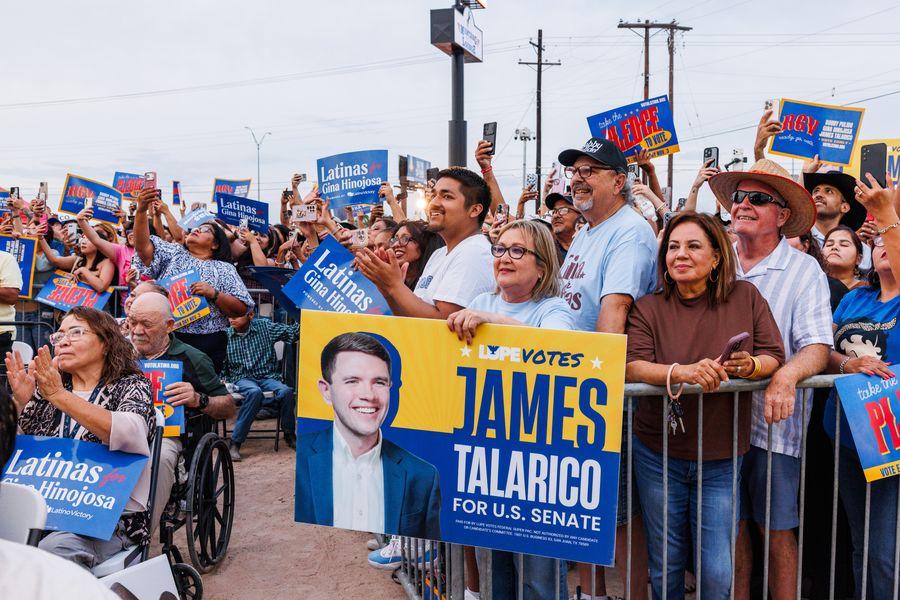
RCP Average: Democrat James Talarico 49%, Ken Paxton 46.5%
This is another race with the president’s fingerprints all over it. It would have been considered safe for the GOP – a Democrat has not won a statewide race in Texas since 1994 – but Trump compromised the chances of incumbent Sen. John Cornyn by refusing to endorse him in the primary, making Paxton’s challenge viable, and then endorsing Paxton late in the game. Paxton rode that endorsement to a 28-point win in the May 26 runoff, which suddenly gave Democrats hope.
Paxton has survived plenty of challenges during his political career. The Texas House impeached him over corruption allegations in 2023, and the state Senate acquitted him. In July 2025, his wife, state Sen. Angela Paxton, filed for divorce, citing “biblical grounds.” Paxton spent the 250th anniversary of the United States in London with his girlfriend. Can James Talarico, a longtime progressive trying to reposition himself as a moderate, take advantage?
The Texas Democratic Party once sent giants to Texas: men like Lyndon Johnson, Ralph Yarborough, and Lloyd Bentsen. Doing so again has become something of a Democrat quest akin to a search for the Holy Grail – but turns out in the end to be more like Charlie Brown trying to kick Lucy’s football.
The polls favor Talarico, but polls in Texas have underestimated the winner in the last two Senate races. Ted Cruz led by 4.4 points in the final 2024 RCP Average and won by 8.5. Cornyn led by 6.5 points in 2020 and won by 9.8. In 2018, however, the miss went the other way, as Cruz led Beto O’Rourke by 6.8 points in the final RCP Average but won by just 2.6.
“Pretend I’m on the ballot,” Trump keeps telling the MAGA faithful that attend his rallies or watch on television. Whether they turnout in Texas – which the Trump-Vance ticket carried by nearly 1.6 million votes two years ago – and these other states will determine Senate control. But one thing seems certain: This year, Democrats don’t have to pretend. They are motivated.
Jonathan Draeger contributed to this report.
Support Our Mission
The Internet provides an endless stream of content. Not all of it is worth your time. That's why, every day, RealClearPolitics curates the most essential news and information—from all sides and across mediums. The links, videos, and podcasts curated here are the product of human judgment, not algorithms or AI. Please help power our mission of presenting a thoughtful, balanced public discourse through a tax-deductible donation.
Would you consider supporting us today?
Contributing to RealClear Politics through the RealClear Media Foundation supports essential initiatives that drive meaningful change.




RCP Today
Top stories on RealClearPolitics
The Takeaway
Polling intelligence and analysis delivered to your inbox
World News
Featuring the latest world news
Policy
Featuring the latest policy news
Support Our Mission
As part of RealClearPolitics, authors aim to provide balanced, non-partisan analysis by presenting top reporting and commentary from all sides of the political spectrum.
Trusted by policymakers and citizens alike since 2000