
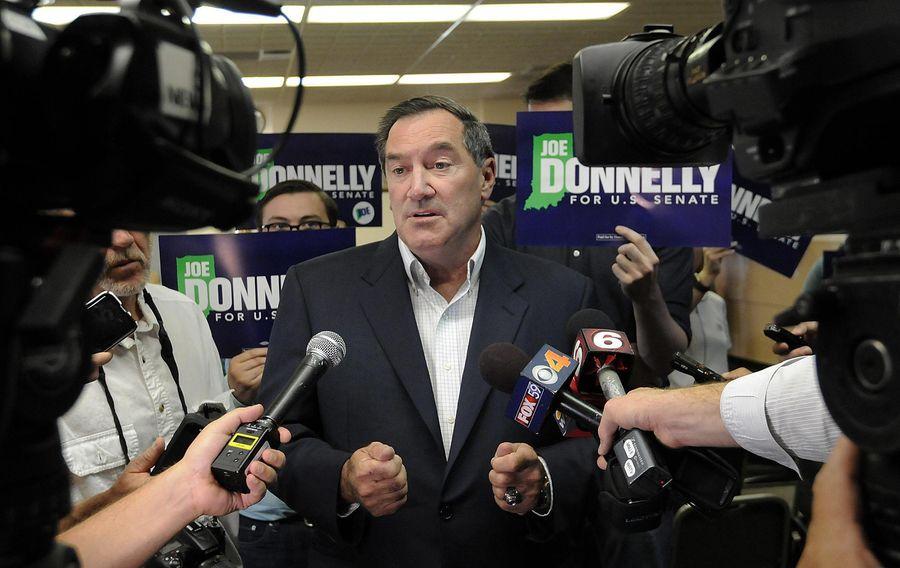
U.S. Sen. Joe Donnelly takes questions from the media after speaking Monday, Aug. 21, 2017, at the UAW in Anderson. Ind. as part of his
Senate Dems Continue to Lead Republicans in Fundraising
Published April 24, 2018 • Read time: 5m
Senate Democrats continued their strong fundraising in the first three months of 2018, maintaining a strong cash advantage in every state they’re defending this fall.
Democrats are defending 25 seats total – including 10 in states President Trump won in 2016 -- to just nine for Republicans. In all 10 of those Trump-state races, the incumbent outraised every Republican challenger. (Three Republicans surpassed Democrats after making sizable loans to their campaigns.) Still, every Democratic incumbent ended March with more cash on hand than their GOP challengers.
And even in the states where Republicans are defending seats, Democrats put up strong fundraising quarters that either matched or led their GOP counterparts. Nevada Rep. Jacky Rosen doubled Sen. Dean Heller’s first-quarter fundraising, taking in $2.6 million compared to just $1.1 million for the incumbent, though Heller still had more money in the bank.
“We can look across the map and see that Republican donors are not as engaged as Democratic donors are,” said Brad Todd, a GOP consultant advising several candidates. “It’s going to take more work to get the money we need to win the election because their donors are red hot and ours are waiting and seeing.”
In several cases, crowded and divisive GOP primaries are slowing down fundraising and causing headaches for Republicans focused on flipping red states.
In West Virginia, Sen. Joe Manchin failed to top $1 million fundraising for the quarter, a poor showing for an incumbent. But he still has more than $5 million in the bank and Republicans are concerned the seat could fall off the map if Don Blankenship, a former coal executive who recently finished a prison sentence for conspiring to violate mine safety standards, wins the GOP primary. Blankenship is entirely self-funding his race, and loaned himself $1.6 million so far this year. His opponents, Rep. Evan Jenkins and Attorney General Patrick Morrisey, each raised less than $400,000, and had just over $1.3 million in the bank heading into the May 8 primary.
In Indiana, Sen. Joe Donnelly raised three times more than Reps. Todd Rokita and Luke Messer, who are competing in the GOP primary with businessman Mike Braun, who loaned himself $2.2 million to fund most of his campaign.
In Arizona, Rep. Martha McSally raised $2.8 million, narrowly outpacing Democratic Rep. Kyrsten Sinema in the race to succeed retiring Sen. Jeff Flake. McSally far surpassed her two primary competitors, former state Rep. Kelli Ward and former Sheriff Joe Arpaio, two candidates who many Washington Republicans worry wouldn’t be able to win the general election. One poll last week showed McSally with a 10-point lead in the primary, while a second showed her trailing Ward by nine points. Meanwhile, Sinema has $6.7 million in the bank.
And in Wisconsin, which has seen the highest percentage of outside money so far this cycle, Sen. Tammy Baldwin hauled in $3.7 million and had nearly $8 million in the bank. Meanwhile, the two Republicans competing in the primary to run against her, Kevin Nicholson and state Sen. Leah Vukmir, both ended the quarter with less than $1 million in the bank, though the primary isn’t until August.
In Missouri, Sen. Claire McCaskill raised nearly $4 million, and had $11.5 million in the bank, second only to Ohio Sen. Sherrod Brown. Attorney General Josh Hawley pulled in $1.5 million, and has just $2.2 million on hand. Hawley’s allies argued that that amount is in line with their fundraising goals and with top recruits from previous cycles, but some Republicans privately expressed concern that his numbers lagged McCaskill so heavily.
One national GOP operative, who requested anonymity to speak candidly, said it could simply come down to “bad candidates” in races across the map.
“I don’t know what it is. We should be able to raise more,” the operative said.
Still, some party operatives said Republicans shouldn’t panic just yet. Rob Jesmer, a former executive director of the party’s campaign committee, said once primaries are in the rear-view mirror, he expects Republicans to have the necessary funds to compete across the map.
“These races get nationalized and by the time the shooting starts, there’s usually close to parity in money,” Jesmer said.
“I think we’re in for a very challenging cycle,” he added in reference to the political environment facing Republicans. “But no matter what happens, it won’t be because the GOP didn’t have enough money.”
Still, Democrats holding such a large cash advantage at this point in the cycle is significant. TV advertising is cheaper for candidates than outside groups, meaning it could be difficult for Republicans to make up the difference this fall if challengers continue to be outraised in the coming months.
There were, however, several bright spots for the party. In North Dakota, Rep. Kevin Cramer pulled in $1 million after reversing course and announcing his Senate bid only in mid-February -- though Sen. Heidi Heitkamp maintained a strong cash advantage.
Rep. Marsha Blackburn, who is running to replace retiring Sen. Bob Corker in Tennessee, raised $2 million and has $6 million in the bank. Her Democratic opponent, former Gov. Phil Bredesen, outraised Blackburn, but only after making a seven-figure loan to his campaign. Blackburn still has more than three times the cash on hand, and one GOP operative pointed out that her fundraising quarter came amid weeks of speculation that Corker might reverse his retirement decision and run again.
Perhaps the brightest spot for Republicans, however, came right after the fundraising quarter ended. Florida Gov. Rick Scott announced he will run against Sen. Bill Nelson earlier this month. Nelson ended the first quarter with $10.5 million, but Scott is independently wealthy and a strong fundraiser, and is expected to tally large sums in the coming months.






RCP Today
Top stories on RealClearPolitics
The Takeaway
Polling intelligence and analysis delivered to your inbox
World News
Featuring the latest world news
Policy
Featuring the latest policy news
Support Our Mission
As part of RealClearPolitics, authors aim to provide balanced, non-partisan analysis by presenting top reporting and commentary from all sides of the political spectrum.
Trusted by policymakers and citizens alike since 2000