
Senate Sinema
Kyrsten Sinema Has Made Her Job Harder
COMMENTARY
Published Dec. 23, 2022 • Read time: 7m
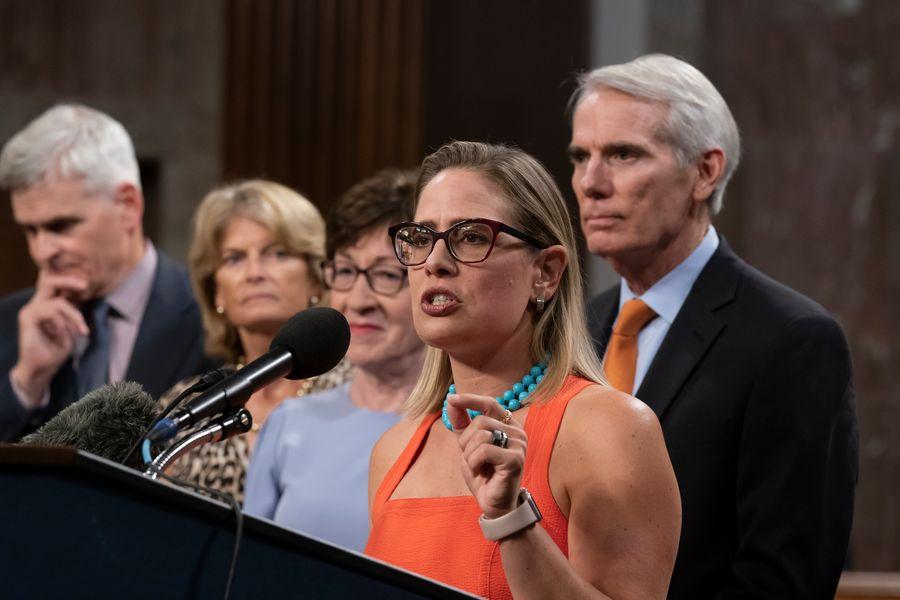
On December 5, news outlets reported that Democratic Sen. Kyrsten Sinema and Republican Sen. Thom Tillis had reached agreement on an immigration reform proposal, pairing a path to citizenship for the undocumented “Dreamers” who were brought to America as kids with robust investment in border security.
On December 9, Sinema declared she was no longer a Democrat, and re-registered as an independent.
On December 20, Sinema took to the Senate floor to express her disappointment that her proposal won’t get a vote before the end of the 117th Congress, accusing “Washington” of another “retreat to partisan corners instead of doing the hard and necessary work of finding lasting solutions when it comes to the crisis at our border.”
Sinema had been on quite a legislative winning streak over the past two years. She played a central role in the negotiations that produced three of biggest bipartisan success stories in the Biden era: infrastructure, gun safety and same-sex marriage rights. But her first attempt at a tri-partisan success was a bust.
Of course, it would not be fair or accurate to pin the blame for the failure of a last-ditch, lame-duck session legislative gambit on the letter after Sinema’s name. A fast-tracked compromise on such a highly charged, long intractable issue would be a stiff challenge for any legislator.
Still, Sinema should take note. Becoming an independent did not make the job of legislating any easier.
For the past 23 months, when Sinema struck an initial deal with a small group of Republicans to advance a Democratic priority – however incrementally, whatever the concessions – she could be confident that her fellow Democrats would be supportive, and the only unknown would be whether a sufficient number of Republicans could be convinced to cross the aisle.
Any compromise is going to have detractors on the left and the right. But upsets on the left for Sinema’s deals have been contained in part because Democrats are invested in the success of their incumbents, particularly those who represent swing areas. While it’s true that Sinema’s relationship with progressives had deteriorated to such a degree that organizations had already formed to support a primary challenge, the Senate Democratic campaign arm supports incumbents.
Moreover, most Democrats in swing areas want opportunities to burnish their bipartisan bona fides, and Democratic leaders want to oblige. As difficult as Sinema was about the Democrats’ progressive ambitions, she provided bipartisan deals that served the Democrats’ political interests.
Going forward, Sinema’s political interests do not necessarily dovetail with Democratic political interests. Assuming she runs for reelection (she has not made an announcement about her 2024 plans but she did file the paperwork for another Senate candidacy), she will create a three-way race. Democrats will have their own nominee, who will likely be a credible candidate; Reps. Ruben Gallego and Greg Stanton are expected to run. For Washington Democrats, further polishing Sinema’s resume by supporting her legislative handiwork would no longer be a no-brainer. While they would rather keep Sinema than have the seat fall into Republican hands, a strong Sinema candidacy risks splitting the Democratic vote and helping the Republicans win.
If Sinema wants a tri-partisan win on immigration reform or anything else, she has to convince a group of Republicans and a group of Democrats that supporting her compromises serves both their partisan interests.
We should never say never. Maybe Sinema can convince Democrats that snubbing a reasonable compromise of hers will bruise their reputations and jeopardize vulnerable incumbents. Maybe she will be able to point to poll numbers showing she can win a three-way race, so best to treat her like the other independents in the Senate Democratic caucus: Vermont’s Bernie Sanders and Maine’s Angus King. But she will have to do that while simultaneously making parallel arguments to Republicans. By leaving the Democratic Party, she’s added an additional obstacle to the already frustrating legislative obstacle course.
Keep in mind that the 118th Congress is likely to provide far less fertile ground for bipartisan breakthroughs than the 117th. When both chambers had Democratic majorities, any Senate-passed bipartisan compromise was a safe bet to pass the House. As we saw when Republicans took control of the House in 2010 during the Obama presidency, a Republican House speaker has little incentive to put Senate-passed bills on the floor for a vote. The best hope for a functional Congress, as I wrote in this space earlier this month, is if Kevin McCarthy can’t appease the right-wing splinter group denying him 218 House votes to become speaker, prompting center-right Republicans to partner with Democrats to elect a bipartisan speaker. But that’s still a longshot scenario.
Perhaps Sinema is playing 12-dimensional chess, recognizing that Congress is likely to become comically dysfunctional and symbolically separating herself from the cacophony in advance of her next election. But to my eye, Sinema’s greatest political asset is her record in “Getting Stuff Done” (also the name of her super PAC). And she got stuff done while being a Democrat. If she becomes an independent and ceases to get stuff done, she will be vulnerable to charges that she is not enough of a team player to get stuff done.
Because her relationship with Arizona Democrats has become so frayed, staying in the party, and facing a competitive primary, was a risk. But trying to win a race as an independent is possibly a bigger risk. Typically, when independents win, one of the major party candidates is weak or nonexistent, giving the independent the ability to scoop up voters who normally vote for a particular party. The Democratic Senate candidates who have run against Angus King have never won more than 13% of the vote. When Joe Lieberman prevailed as an independent in the 2006 Senate race, after being purged in the Democratic primary, he leaned on Republican voters; the GOP nominee failed to crack 10%. Bernie Sanders has had an easier time, never having faced a Democratic opponent in a Senate race.
Neutralizing one party is hard enough. To win as an independent against two credible party nominees – who clear at least 20% of the vote each – is even harder, as it involves poaching a considerable number of voters from both parties, or drawing out a legion of unlikely unaffiliated voters, to win with pluralities in the upper 30s or low 40s. We’ve seen this in a scant few gubernatorial races in the 1990s: Minnesota, 1998; Maine, 1994; Alaska and Connecticut, 1990. But it’s happened only once in a gubernatorial this century – Rhode Island, 2010. Not since 1970, when New York tapped the Conservative Party’s James Buckley, has a third-party Senate candidate defeated two major party candidates who each got at least 20% of the vote. (Also in 1970, incumbent Virginia Senator Harry Byrd Jr., a conservative, left the Democratic Party to become an independent and won reelection with an outright majority, holding the Republican candidate to just 15%.)
If Sinema runs for reelection as an independent, she will be trying to accomplish something with very little precedent, and with less capacity to live up to her Getting Stuff Done mantra. She has proven doubters wrong in the past, so she shouldn’t be counted out. But by abandoning the political infrastructure that has buoyed her legislative and political accomplishments, she has made her job harder.





RCP Today
Top stories on RealClearPolitics
The Takeaway
Polling intelligence and analysis delivered to your inbox
World News
Featuring the latest world news
Policy
Featuring the latest policy news
Support Our Mission
As part of RealClearPolitics, authors aim to provide balanced, non-partisan analysis by presenting top reporting and commentary from all sides of the political spectrum.
Trusted by policymakers and citizens alike since 2000