
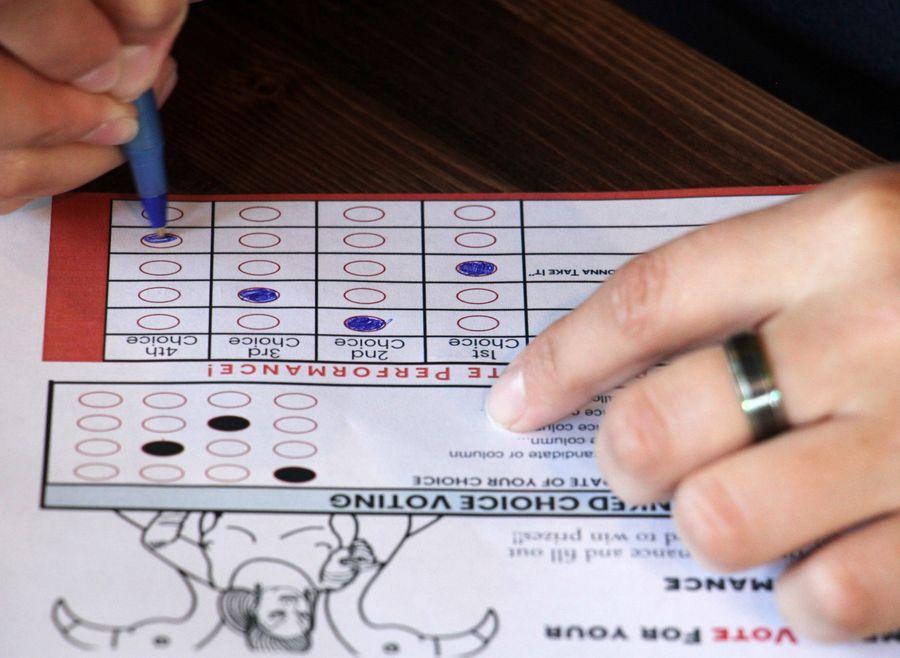
Election 2022 Alaska Ranked Choice Voting
DOJ Just Made the Case for Ranked-Choice Voting
COMMENTARY
Published Oct. 26, 2026 • Read time: 4m
Alaska’s U.S. Senate race was already one of the closest in the country. Republican Sen. Dan Sullivan is fighting for a third term against former Rep. Mary Peltola, and the RCP poll average shows Peltola narrowly ahead. Control of the Senate could depend on the result.
The race also has an unusual complication. A second candidate, a former teacher and Forest Service employee from the remote southern Alaska town of Petersburg, is also named Dan Sullivan. Republicans called him a sham candidate, and state election officials tried to remove him from the ballot. The Alaska Supreme Court put him back on. He will appear as “Daniel J. Sullivan Jr.” with no party label. The senator will appear as “Dan S. Sullivan,” marked as both Republican and incumbent.
Now the Trump administration has stepped in. On Thursday the Department of Justice filed a federal lawsuit asking a judge to block certification of the results in one specific case: if Sen. Sullivan loses but would have won had the other Sullivan’s votes gone to him. The Justice Department argues that voters will be confused under Alaska’s ranked-choice system. It says the senator’s supporters may not know how to rank the Republicans on the ballot, and some may leave the incumbent off entirely.
Election law scholars are skeptical of the suit’s legal footing. The deeper problem, though, is its logic. The confusion DOJ describes is far more damaging under the voting system the administration seems to prefer than under the one Alaska uses.
Here is how Alaska’s system works. Voters rank the candidates in order of preference. If no candidate wins a majority of first choices, the last-place candidate is eliminated. Each ballot ranking that candidate first then moves to that voter’s next choice. The process repeats until someone has a majority.
Now picture DOJ’s supposedly confused voter. He or she supports the Sen. Sullivan but marks Daniel J. Sullivan first by mistake, then ranks the incumbent second. Under ranked-choice voting, this mistake is largely harmless. The Petersburg Dan Sullivan won just 2.5 percent in the primary and will almost certainly be eliminated early. When that happens, the ballots that chose him first are moved to the voter’s second choice, the senator, and counts fully in the final round.
Under “first-past-the-post,” the system most states use and the one President Trump has defended against ranked-choice reforms, that same voter is simply out of luck. A plurality ballot has no second choice. If she marks the wrong Sullivan, her vote goes to a candidate with no chance of winning, and nothing can recover it.
The only ballots ranked-choice voting can’t save are those that rank Daniel J. Sullivan first and leave the incumbent off entirely. That is a much smaller group than first-past-the-post would lose. It is also hard to call those voters confused. Someone who ranks one Sullivan and deliberately leaves the other off may have meant exactly that.
In other words, the harm DOJ alleges is an argument for ranked-choice voting. Name confusion, spoiler candidates, and vote-splitting among similar candidates are the problems the system was designed to solve. A spoiler can tip a plurality election by drawing a few points from a front-runner. In a ranked-choice election, the spoiler’s voters still get a say between the real contenders. If the administration worries that a look-alike candidate could swing a federal election, the remedy is more ranked-choice voting, not less.
There is also the matter of whose system this is. Alaskans adopted open primaries and ranked-choice general elections by ballot initiative in 2020. In 2024, opponents put a repeal on the ballot, and voters narrowly kept the system. Alaskans have now chosen this method twice in four years. They have used it in statewide races, and they have shown they understand how to rank candidates.
DOJ’s suit asks a federal judge to second-guess that choice before a single vote is counted. It presumes, without evidence, that Alaskans cannot tell their sitting senator from a sketchy long-shot challenger, even on a ballot that labels one of them “incumbent.” That is condescending to Alaska’s voters and unfair to its election officials.
If any system can absorb a ballot with two Dan Sullivans, it is the one Alaskans chose. While the Justice Department has filed numerous dubious election-related lawsuits, I’m willing to concede that a few intelligent people must still work there. They have to know that their case is fatally flawed legally, logically, and politically. Their only real intent, therefore, must be to highlight the potential for voter confusion to Alaska voters in an attempt to prevent the unlikely “lost vote” scenario outlined above.
This is an entirely partisan goal and has nothing to do with sound, safe, and fair elections. It’s sad that this administration continues to debase our institutions in pursuit of political gain. Alaskans should vote accordingly.
Support Our Mission
The Internet provides an endless stream of content. Not all of it is worth your time. That's why, every day, RealClearPolitics curates the most essential news and information—from all sides and across mediums. The links, videos, and podcasts curated here are the product of human judgment, not algorithms or AI. Please help power our mission of presenting a thoughtful, balanced public discourse through a tax-deductible donation.
Would you consider supporting us today?
Contributing to RealClear Politics through the RealClear Media Foundation supports essential initiatives that drive meaningful change.


RCP Today
Top stories on RealClearPolitics
The Takeaway
Polling intelligence and analysis delivered to your inbox
World News
Featuring the latest world news
Policy
Featuring the latest policy news
Support Our Mission
As part of RealClearPolitics, authors aim to provide balanced, non-partisan analysis by presenting top reporting and commentary from all sides of the political spectrum.
Trusted by policymakers and citizens alike since 2000