
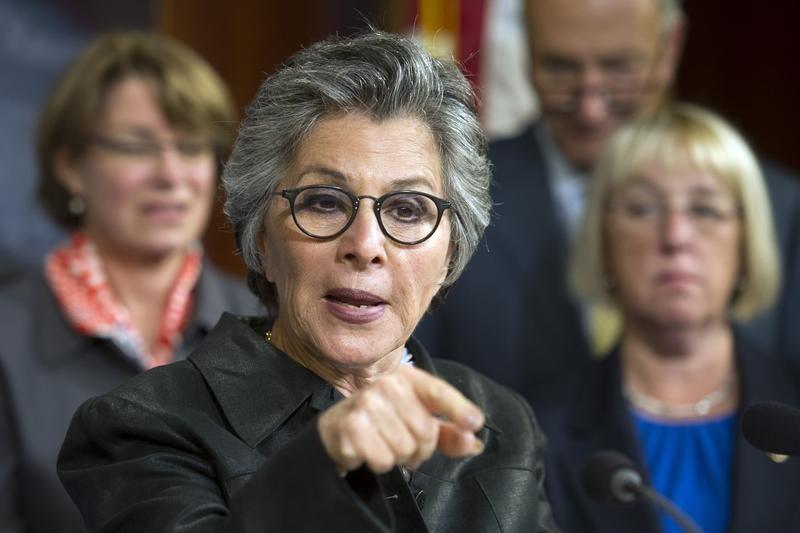
Boxer Exit Opens Door for Party's New Guard
Published Jan. 9, 2015 • Read time: 4m
Predictions that she would retire have followed California Sen. Barbara Boxer since she soundly beat Republican Carly Fiorina in 2010—speculation that wasn't surprising about a politician born exactly 22 years after World War I ended.
But the abrupt timing of Boxer’s Thursday announcement that she wouldn’t seek re-election in 2016 even caught some of her closest friends off guard. House Minority Leader Nancy Pelosi learned at a press conference Thursday that the California Senate seat would be open in 2016.
“Of course, I wish the best for her,” said Pelosi. “Officially, I think it’s a big loss for the country. But she knows her timetable.”
Pelosi told reporters she had just ignored a call from her fellow San Francisco Democrat, thinking she’d call her back later, and that Boxer “wanted to have dinner or something.” Not everyone would ignore a call from Boxer, especially someone in the large pack of politicians who could feasibly replace her.
Los Angeles Mayor Eric Garcetti, state Attorney General Kamala Harris, state Lt. Gov. Gavin Newsom and former Los Angeles Mayor Antonio Villaraigosa round out the top tier. Save for Villaraigosa, they’re all under 60, still in office, and on Californians’ minds. Golden State Democrats also hold every other statewide elected position, nearly 40 House seats and top mayoral offices.
On the Republican side, former GOP gubernatorial nominee Neel Kashkari and San Diego Mayor Kevin Faulconer would start as logical contenders. Former Assemblyman Tim Donnelly—who finished closely behind Kashkari in last June’s gubernatorial primary—could also make an impact in a crowded field.
California’s jungle primary system in which the top two vote-getters move to the general election, regardless of party, could make a mess of the tidy transition Democrats are hoping for. If enough candidates jump in, it’s possible that two Democrats will end up battling each other in November, perhaps generating bad blood within the party.
Presumably, two Republicans could make it to the general election, although that’s highly unlikely. The more chaos, the better for the moribund GOP. But Washington Democrats aren’t rooting for uncertainty.
“I appreciate that Senator Boxer has made an early decision, giving us more than enough time to get behind a strong Democratic candidate who will hold this seat,” said Democratic Senatorial Campaign Committee Chairman Jon Tester in a statement. Beyond serving as a hold in a year when Democrats could win the Senate back, the eventual nominee could become the standard bearer for a new generation of California Democrats.
Gov. Jerry Brown, who turned 76 earlier this year, was first elected governor in 1974. Sen. Dianne Feinstein, who has represented California in the Senate since 1992, is also the oldest senator in the country, at 81. Boxer joined the chamber in 1993, less than two months after Feinstein. Like Boxer, Nancy Pelosi is 74.
After decades of dominance by politicians who were born before the Pearl Harbor attack, a new generation of ambitious and restless public officials is poised to rise in California. Brown is term-limited; Boxer is retiring; and Pelosi seems sidelined as the leader of a historically miniscule House Democratic minority. Feinstein is still going strong—she recently bested the CIA in a power struggle over the issue of torture—but she’s an octogenarian.
Whether that opens up California politics for a Republican rebirth—or simply a new generation of Democrats—remains to be seen. The deck may be stacked against Republicans, who have proven recently and consistently that they can’t win statewide in California. Either way, however, the state remains important.
In the last 50 years, California has produced a pair of two-term presidents, several more presidential candidates, the first female House speaker, myriad cabinet secretaries, a Supreme Court justice and countless other politicians of note. And as Sen. Ted Cruz of Texas has proven, the outcome of primary elections in massive, one-party states can have a huge, tangible impact on national politics.
The next Senate race will certainly be fun to watch; the new senator might be too.


RCP Today
Top stories on RealClearPolitics
The Takeaway
Polling intelligence and analysis delivered to your inbox
World News
Featuring the latest world news
Policy
Featuring the latest policy news
Support Our Mission
As part of RealClearPolitics, authors aim to provide balanced, non-partisan analysis by presenting top reporting and commentary from all sides of the political spectrum.
Trusted by policymakers and citizens alike since 2000