
Rising Generation of Wis. Stars Grabs GOP Reins
Published Aug. 28, 2012 • Read time: 6m
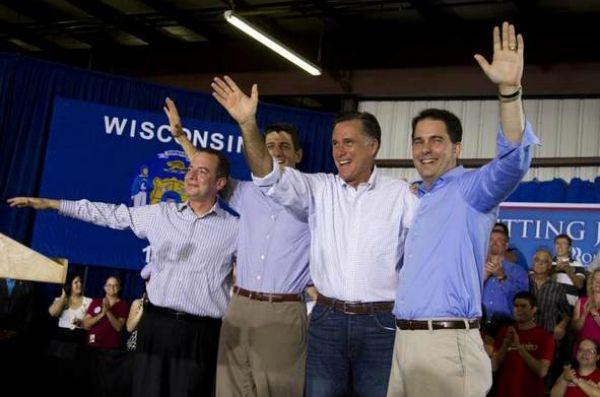
The day after Paul Ryan was picked as Mitt Romney's running mate, the 42-year-old Wisconsin congressman made a triumphant return to his home state, choking back tears as he addressed more than 10,000 supporters at a rally in Waukesha.
Standing behind Ryan on stage that afternoon, beaming with pride as he extolled the virtues of being a born and bred Wisconsinite, were Gov. Scott Walker and RNC Chairman Reince Priebus. It was a moment that illuminated just how much these three friends and political soul mates, born four years apart and raised in towns less than an hour’s drive from each other, have captured the attention and imagination of Republicans across the country.
“We’re just guys from ’Tosa [shorthand for Wauwatosa], Kenosha . . . and Janesville,” Ryan said, gesturing toward Walker, Priebus, and himself.
“What we learned in this state, just a little while ago,” he added referring to the triumph of Walker in the hotly contested June 5 recall election, “is that we want to elect men and women who run for office and tell us who they really are, what they really believe, what they’re really going to do, and then when they get elected, they do that. That’s what we do here in Wisconsin!”
In an interview on the eve of the Republican convention, Priebus was asked by RCP what’s in the water in his state these days. “It’s not the water, but it might be something in the beer,” he quipped. “Or maybe the bratwurst. Anyway, we’re calling it the ‘Cheesehead Revolution.’ ”
Counter-revolution might be more like it. The RNC chief’s banter aside, something is going on in the Midwestern state that produced Robert M. La Follette, and it’s not another Progressive Party movement.
In 1932, Wisconsin was one of the states that Justice Louis D. Brandeis had in mind when he wrote that one the “happy incidents” of federalism was “that a single courageous state may, if its citizens choose, serve as a laboratory; and try novel social and economic experiments without risk to the rest of the country.”
Make no mistake, in his oft-mentioned metaphor -- usually abbreviated as “laboratories in democracy” -- Brandeis was lauding laboratories of liberalism. But that’s the funny thing about a social science lab: You can grow anything you want in them; or, to be precise, anything the voters support.
The GOP’s new trio of big cheeses from Wisconsin, currently serving as the idea factory for the party, view themselves as the corrective to eight decades of excess liberalism -- that is to say, excess liberal spending. To them it’s not ironic that their vision would take root in the Land of La Follette -- it’s logical. It’s also appropriate that, for the most part, they are more interested in fiscal conservatism than the culture wars.
“Look at the age group of those guys,” says Ron Bonjean, a GOP political consultant. “They are all in their early forties, and the issues that galvanized them are property taxes, pension reform, and, of course, the budget.”
“While social issues are still important to the party, the sorry state of the country’s finances have led this generation of the party’s leadership to focus their talents on turning this disaster around,” added Bonjean, who is a member of the board of visitors for the University of Wisconsin’s political science department. “They are very reflective of where Wisconsin is, and they are leading the rest of the nation.”
Another Republican said the seeds of the Cheesehead Revolution were first planted with an older group of Republicans, Tommy Thompson and Bob Kasten, both 70, and former Gov. Lee Dreyfus, who died in 2008. These men embraced school choice, championed lower taxes, and courted the business community, while mentoring a coterie of young disciples.
Paul Ryan interned in Kasten’s Senate office, as did 46-year-old Paul Clement, the former solicitor general who would be on everybody’s short-list for a Supreme Court vacancy if Romney were to win in November.
Asked about the Cheesehead Revolution, Clement riffed off Priebus’s quip. “Cold beer and colder winters has got to be part of it,” he said, “but I also think some of the credit has to go to Tommy Thompson and even Lee Dreyfus for providing examples of how Republicans could govern in a state that gave birth to the Progressive movement and yet still remain popular.”
But remaining popular is not an easy trick in such a closely divided political environment. Scott Walker’s tenure has been a bruising experience in his state, and although the recall election there was decided in Walker’s favor, both the Romney and Obama camps are poised to go to the mat against each other from now until November. In the process, a new generation of Democrats is being galvanized, too.
Last year, 37-year-old Jessica King was brought into office (state Senate) in the wave of recall elections aimed at Walker and his party. “Before 2011, I believe everyone who had heard of Wisconsin or knew where it was thought, ‘Well, that’s just the nicest place on Earth,’ ” King told David Greene of NPR. “Can you imagine what it must take to make the nicest people on Earth have the kind of demonstrations we’ve had in the last year and a half, right? To really be divided?”
The GOP Cheesehead revolutionists knew the path they were taking wouldn’t be unanimous. They weren’t even sure it would be accepted. They told each other they might not win. But they believed the stakes were worth the risk.
“Back in 2007 when we were at rock bottom in Wisconsin, I told Paul and Scott that we were going to rebuild the [Wisconsin Republican] party around them,” Priebus said. “We were going to offer big and bold ideas -- and we may fail.”
But he thought they would succeed.
“In Wisconsin, people are willing to look a little deeper at issues,” he said. “They have the patience to listen to political positions that are explained in some detail -- and to entertain big solutions to big problems.”
The RNC chairman said he understands that the Progressive Party had deep roots in Wisconsin, but he noted that the Republican Party’s roots are even deeper.
“Our party was founded in 1854 in Ripon,” he said. “I believe we are witnessing the birth of a new Republican Party -- and it’s only fitting that the place where our party was born would furnish the new leadership.”

RCP Today
Top stories on RealClearPolitics
The Takeaway
Polling intelligence and analysis delivered to your inbox
World News
Featuring the latest world news
Policy
Featuring the latest policy news
Support Our Mission
As part of RealClearPolitics, authors aim to provide balanced, non-partisan analysis by presenting top reporting and commentary from all sides of the political spectrum.
Trusted by policymakers and citizens alike since 2000